
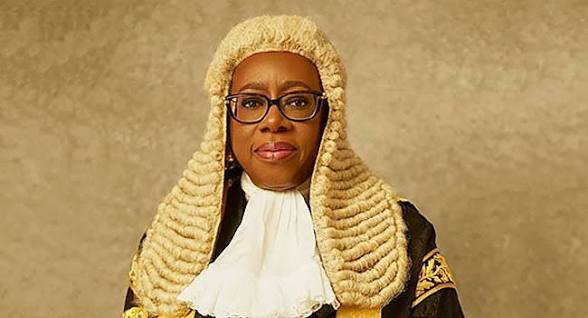
Nigeria’s 2027 election disputes will test more than the ability of courts to interpret electoral law. They will also test whether judges can maintain public confidence while making decisions that are inevitably exposed to political pressure and intense public scrutiny.
That is why Chief Justice of Nigeria Justice Kudirat Kekere-Ekun’s warning to judges who may serve on election tribunals deserves attention. Her message was not simply about courtroom conduct; it was about protecting the credibility of a judiciary that will be asked to settle some of the country’s most politically consequential disputes.
Speaking on Wednesday, October 7, 2026, at the opening of the 2026/2027 legal year of the National Industrial Court of Nigeria in Abuja, Kekere-Ekun warned judges who could be appointed to election petition tribunals ahead of the 2027 general elections that their conduct would be closely scrutinised.
She said judges serving on election tribunals would be dealing with politically sensitive disputes requiring “an even greater degree of impartiality, restraint and detachment.”
The CJN specifically warned judges against associations, public engagements or other conduct that could create a reasonable perception of political alignment.
She also criticised the duplication of court actions, warning that conflicting judgments could damage public confidence and bring the judiciary into disrepute.
Her warning extended to lawyers. She said the legal profession must not become a vehicle for manipulating judicial processes and argued that the proper court should be determined by law rather than by which judge or court a litigant believes is more likely to deliver a favourable outcome.
The CJN also addressed the growing use of artificial intelligence in legal practice, warning that lawyers must verify AI-generated authorities because apparently convincing citations, cases and quotations can be incorrect or entirely nonexistent.
At the same ceremony, NICN President Justice Benedict Kanyip said the court disposed of 2,236 cases during the previous 12 months. He also said only 31 cases were referred to the court's Alternative Dispute Resolution Centre during the period.
The CJN's warning is important because election tribunals occupy an unusually difficult position.
Judges are expected to apply constitutional provisions, electoral legislation and judicial precedent without regard to the political consequences of their decisions. Yet virtually every major election petition has political consequences for somebody.
That creates a difficult balancing act.
A tribunal may issue a decision based entirely on its interpretation of the evidence and law, but political actors can still portray that decision as favouring one party or candidate. The judiciary therefore has to protect not only the correctness of its decisions but also the appearance of institutional independence.
Advertisement
Kekere-Ekun's emphasis on judges' associations and public engagements addresses precisely that problem. A judge does not necessarily have to be politically aligned to be perceived as politically aligned. In an election dispute, perception itself can become a threat to confidence in the institution.
That does not mean judges should govern their lives according to every political accusation. It means the higher the political sensitivity of a case, the greater the need for judges to avoid conduct that reasonably raises questions about impartiality.
But scrutiny cannot become intimidation
There is another side to the CJN's warning that deserves equal consideration.
Judges should be protected from intimidation, personal attacks and deliberate misrepresentation. But judicial independence also requires room for legitimate criticism.
Kekere-Ekun acknowledged this distinction in her address, arguing that criticism of judgments and judicial processes is legitimate while personal attacks, deliberate misrepresentation and attempts to pressure courts through public opinion are not.
That distinction matters.
A judiciary that cannot be criticised risks becoming insulated from legitimate public accountability. But a judiciary subjected to political campaigns designed to intimidate judges faces a different danger.
The challenge for Nigeria is therefore not to eliminate criticism of courts. It is to preserve a culture in which legal criticism remains possible without becoming political intimidation.
Election litigation will put that distinction under pressure
Nigeria's 2027 election cycle is likely to generate substantial legal scrutiny because electoral disputes are decided through formal judicial processes rather than political arguments alone.
The quality of that process will depend partly on whether litigants respect the limits of judicial procedure.
The CJN's warning about duplicated proceedings is therefore significant. If similar disputes are taken before different courts in the hope of obtaining favourable outcomes, conflicting decisions can create confusion even before an appellate court resolves the matter.
For citizens, the problem is bigger than technical legal procedure.
When two courts appear to reach contradictory conclusions, many Nigerians may not see a complex jurisdictional dispute. They may simply see a judiciary that cannot agree with itself.
That perception can weaken confidence in the eventual judgment, even when the legal reasoning is sound.
Kekere-Ekun's comments about artificial intelligence may ultimately prove just as important as her election warning.
Legal professionals increasingly have access to systems capable of generating summaries, legal arguments and case citations. The danger is that an AI-generated answer can look authoritative while containing an invented case or an inaccurate quotation.
The CJN's point is straightforward: appearance is not verification.
A lawyer remains responsible for the authority submitted to a court, regardless of whether the information originated from an AI system, a search engine, a database or another lawyer.
This is particularly relevant as AI becomes more common in Nigeria's legal and professional environment. Technology can reduce research time, but it cannot transfer professional responsibility from the lawyer to the machine.
The NICN's own numbers add another dimension
Kanyip's report of 2,236 cases disposed of over the previous year illustrates the workload facing the National Industrial Court.
Yet his disclosure that only 31 cases were referred to the court's ADR Centre points to a different challenge: judicial efficiency is not simply about judges deciding cases faster.
Where appropriate, alternative dispute resolution can potentially resolve labour disputes without requiring every disagreement to proceed through a full litigation process.
Advertisement
The court's concern is therefore institutional as well as individual. A judiciary under heavy caseload pressure needs both effective judges and effective mechanisms for resolving disputes.
Two perspectives can be true at once
From the judiciary's perspective, protecting judges from political pressure and irresponsible attacks is essential to judicial independence.
From the public's perspective, demanding transparency and scrutinising judicial decisions is equally important in a democracy.
These positions are not necessarily contradictory.
The stronger position is one in which judges are insulated from improper pressure but their decisions remain open to reasoned public and legal scrutiny.
That distinction will become particularly important during the 2027 election disputes, when losing political actors may have strong incentives to question the credibility of adverse judgments.
The significance of the CJN's warning is ultimately institutional.
Nigeria does not need election tribunals merely to produce judgments. It needs tribunals whose decisions can command sufficient confidence that political disputes do not simply migrate from polling stations into a deeper crisis of faith in the courts.
That places responsibility on everyone involved: judges must maintain impartiality, lawyers must respect procedure, political actors must resist attempts to intimidate courts, and the public must distinguish legitimate criticism from attacks designed to undermine judicial authority.
The judiciary cannot control how politicians react to its decisions. It can, however, control the standards by which those decisions are reached and the conduct of those entrusted with delivering them.
Ultimately, the real test of the 2027 election tribunals will not be whether every politician accepts every judgment. That is unlikely. The more important test will be whether Nigerians can look at the process and reasonably conclude that the courts applied the law without political direction.
You must log in to comment or reply.
Comments