
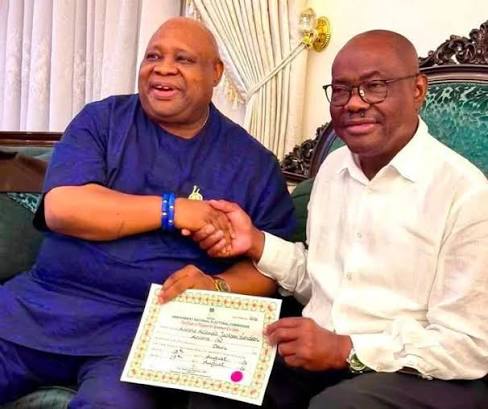
The political signals coming out of Abuja after Ademola Adeleke’s Osun victory are significant, but they should not be confused with a formal change of party. The governor’s meetings with President Bola Tinubu and Nyesom Wike have fuelled speculation about a new political alignment, yet Adeleke’s campaign council insists that cooperation with the Federal Government does not mean joining the APC.
Osun State Governor Ademola Adeleke visited President Bola Tinubu at the Presidential Villa in Abuja on Thursday, August 20, 2026, shortly after his victory in the Osun governorship election.
Adeleke later met with Minister of the Federal Capital Territory Nyesom Wike and presented his Certificate of Return.
The meetings generated speculation that Adeleke could be preparing to move towards the All Progressives Congress ahead of the 2027 general elections.
On Friday, however, Pelumi Olajengbesi, spokesperson for the Ademola Adeleke Campaign Council, rejected that interpretation. He described Adeleke’s meeting with Tinubu as a courtesy visit and said the governor would work with the Federal Government while remaining outside the APC.
“The essence of that visit has nothing to do with Governor Ademola Adeleke joining APC,” Olajengbesi said, adding that such a move was “an impossibility.”
Wike offered a markedly different political interpretation.
Speaking to journalists during an inspection exercise in Abuja, the FCT minister said Adeleke was “fully supporting Mr President” and declared: “Adeleke belongs to us, and we all belong to Mr President.”
Wike also predicted a larger political coalition around Tinubu ahead of the 2027 presidential election.
The political significance of the episode is heightened by Adeleke’s election victory. The Independent National Electoral Commission declared him the winner after he secured 511,067 votes, defeating APC candidate Bola Oyebamiji, who received 444,815 votes. ADC candidate Najeem Salaam finished third with 17,180 votes.
The most reasonable reading of the events is that Adeleke is trying to separate governance from partisan confrontation.
A state governor, regardless of party affiliation, has practical reasons to maintain a working relationship with the Federal Government. Osun depends on federal institutions, allocations, infrastructure cooperation and other areas of intergovernmental coordination. A courtesy meeting with the President therefore does not, by itself, establish a political defection.
Advertisement
But politics rarely operates only through formal declarations.
The timing of Adeleke’s meetings, coming immediately after his re-election, gives them a wider political meaning. Nigeria is already moving towards the 2027 election cycle, and politicians across party lines are assessing alliances, influence and possible coalitions.
That is where Wike’s interpretation becomes important.
The FCT minister is not simply describing a government-to-government relationship. By saying Adeleke “belongs to us” and that they all belong to Tinubu, Wike is placing the Osun governor within a broader political camp.
That is a political claim, rather than evidence of a formal party switch.
The first narrative comes from Adeleke’s camp: the governor can work with Tinubu without abandoning his party.
That position is consistent with Olajengbesi’s explanation that Adeleke’s visit was motivated by respect for the presidency and a desire to maintain cooperation between Osun State and the Federal Government.
The second narrative comes from Wike and elements of the Tinubu camp: Adeleke’s actions indicate a wider political realignment around the President.
Those positions can coexist, at least for now.
A politician does not have to join the APC to cooperate with Tinubu or support particular Federal Government initiatives. Likewise, political cooperation can develop into a broader electoral alliance without immediately producing a formal defection.
That distinction matters because turning every meeting between Nigerian politicians into evidence of a party switch risks confusing political engagement with political realignment.
Adeleke’s position is particularly interesting because Osun has historically been a competitive political battleground.
His victory over the APC candidate gives him considerable political capital within the state. At the same time, the closeness of the contest means the APC remains a significant force in Osun politics.
For Tinubu’s camp, attracting influential governors and political figures into a broader alliance could strengthen its position ahead of 2027.
For Adeleke, maintaining access to the Federal Government could also be strategically useful. His immediate political responsibility is not the 2027 presidential election alone; it is governing Osun after a hard-fought election.
The challenge is therefore to balance state interests, party loyalty and personal political calculations without allowing one to completely undermine the others.
The ADC question adds another layer
The role of the African Democratic Congress has also become part of the political argument.
ADC figures and other opposition politicians have sought to associate themselves with the wider opposition movement, while Wike has criticised claims that the party helped Adeleke win Osun.
Olajengbesi, however, said Adeleke’s campaign did not seek support from the ADC and that the governor's victory was primarily the result of Osun voters and his administration's record.
This disagreement illustrates how quickly electoral victories become political assets that rival parties attempt to claim.
The question is not simply who supported Adeleke during the election. It is who can build a durable political relationship with his administration before 2027.
Advertisement
The immediate consequence may be a more pragmatic relationship between Osun and the Federal Government.
If Adeleke maintains cooperation with Tinubu while remaining in his existing political camp, it could demonstrate that opposition-party governors can work with the Federal Government without formally crossing the political divide.
But there is also a political risk.
If the relationship becomes increasingly identified with Tinubu's 2027 project, Adeleke could face pressure from politicians and supporters who expect him to remain firmly within his party's political structure.
Conversely, refusing to cooperate with Abuja purely for partisan reasons could make governance more difficult.
That is why the distinction between cooperation and alignment will remain important in the months ahead.
For now, there is no verified evidence that Ademola Adeleke has joined the APC. His campaign council has explicitly rejected the possibility, while Wike has publicly portrayed him as part of a political camp supporting Tinubu.
Both developments are politically significant, but they are not the same thing.
Ultimately, the question is less about whether Adeleke can shake hands with Tinubu or Wike and more about what those relationships become when the 2027 electoral contest moves from speculation to organisation. If the cooperation remains governmental, Adeleke's position is relatively straightforward. If it develops into an electoral alliance, Nigeria's political map could look considerably different.
What happens next will determine whether the Abuja meetings were simply the normal business of government—or early signs of a much broader political realignment.
You must log in to comment or reply.
Comments