
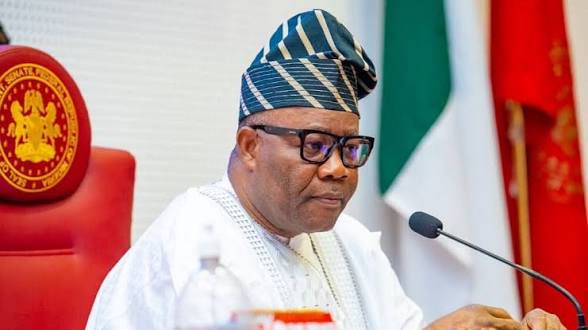
Politics is often judged by moments of confrontation, but it is equally defined by how leaders handle disagreements after the headlines fade. The light-hearted exchange between Senate President Godswill Akpabio and Senator Adams Oshiomhole demonstrates that humour can ease political tension, even as it raises questions about the seriousness of legislative debate.
During Senate plenary on Thursday, July 23, 2026, Senator Adams Oshiomhole jokingly accused Senate President Godswill Akpabio of violating a private "no more hostilities" agreement between them.
The exchange followed Akpabio's reference to an earlier controversy surrounding a viral video that allegedly showed Oshiomhole massaging a woman's legs aboard a private jet. Oshiomhole has consistently maintained that the video was generated using artificial intelligence.
Raising a point of order, Oshiomhole reminded the Senate that both men had agreed to stop teasing each other over previous controversies. Rather than escalating the issue, he withdrew his intended motion and reaffirmed his respect for Akpabio.
Akpabio responded with an apology, insisting he never intended to offend his colleague. He reaffirmed their truce, praised Oshiomhole as a friend and former governor, and concluded with another joke comparing broken agreements to international conflicts, drawing laughter across the chamber.
Advertisement
Interpretation: Beyond the Laughter
On the surface, the exchange appeared to be nothing more than friendly banter between two experienced politicians. Yet it also illustrates how modern politics increasingly blends governance with public performance.
Moments like these spread rapidly on social media because they humanise political figures and offer relief from Nigeria's often tense political atmosphere. At the same time, they reveal how viral online controversies can continue influencing parliamentary conversations long after the original incident.
The reference to an AI-generated video is particularly significant. As artificial intelligence becomes more sophisticated, politicians worldwide are confronting misinformation, manipulated media and questions about authenticity. Oshiomhole's repeated denial that the video was genuine reflects a broader challenge facing public officials in the digital age.
The exchange also highlights another feature of Nigerian politics: personal relationships often shape legislative interactions as much as formal parliamentary procedure. While disagreements are inevitable, maintaining cordial relationships can help reduce unnecessary conflict within legislative institutions.
Supporters of the Senate leadership may see the incident as evidence of maturity and political civility. Rather than allowing personal disagreements to dominate proceedings, both lawmakers quickly restored mutual respect through humour and public reconciliation. From this perspective, the exchange demonstrated that political rivals can disagree without creating institutional instability.
Others may argue that repeated jokes about personal controversies risk distracting from more pressing national issues. At a time when Nigerians remain concerned about inflation, insecurity, unemployment and economic reforms, critics could question whether parliamentary attention should remain firmly focused on legislation rather than viral social media moments.
There is also a wider debate over whether humour strengthens democratic engagement by making politics more relatable, or weakens public confidence by giving the impression that serious institutions are becoming entertainment platforms.
The immediate political consequences are likely to be minimal, but the exchange reinforces several broader trends.
Advertisement
First, it shows how digital controversies now have a lasting influence on traditional political institutions. Viral content can shape public perception long after its authenticity has been questioned.
Second, the incident demonstrates that political communication has evolved beyond formal speeches. Short, humorous exchanges often receive more public attention than lengthy policy debates, influencing how citizens evaluate political leaders.
Finally, the episode reminds lawmakers that maintaining respectful relationships remains essential in a legislature where cooperation is necessary to pass laws and oversee government activities. While humour may reduce tension, Nigerians will ultimately judge political leaders by their legislative performance rather than their wit.
Ultimately, the question is not whether politicians should joke with one another. Healthy personal relationships can improve parliamentary cooperation. The real issue is whether such moments remain brief interruptions rather than becoming defining features of legislative business. As Nigeria faces complex political and economic challenges, citizens are likely to expect that the humour seen inside the Senate chamber is matched by equally serious attention to governance outside it.
You must log in to comment or reply.
Comments