
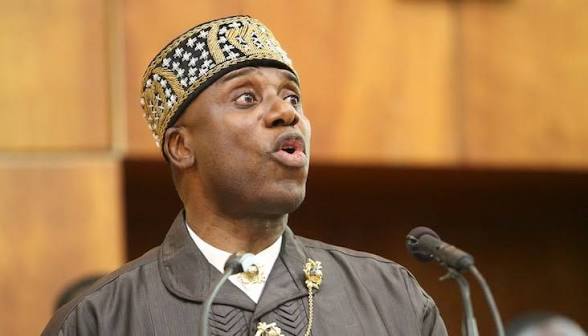
Former Rivers State governor and ex-Minister of Transportation, Rotimi Amaechi, has intensified the early battle for the 2027 presidential election, declaring himself the most experienced aspirant within the African Democratic Congress coalition while accusing President Bola Ahmed Tinubu of using economic hardship as a political strategy.
The remarks come at a time when opposition parties are struggling to build a united front ahead of the next general election. Beyond the political rhetoric, the comments reflect a deeper fight over leadership credibility, economic frustration, and the future direction of Nigeria’s opposition movement.
Speaking during an interview on ARISE News on Friday, Amaechi argued that his political experience places him ahead of other aspirants reportedly linked to the ADC presidential race, including former Vice President Atiku Abubakar and businessman Mohammed Hayatu-Deen.
Amaechi pointed to his years in public office, including his tenure as Speaker of the Rivers State House of Assembly, chairman of the Nigeria Governors’ Forum, governor of Rivers State, and Minister of Transportation.
“I’m the most experienced of them all. I’m the youngest but most experienced,” Amaechi said during the interview.
He also referenced his leadership role within the Nigeria Governors’ Forum, recalling tensions with the presidency during former President Goodluck Jonathan’s administration.
“The president then didn’t want me to come back,” Amaechi stated while discussing his second tenure as chairman of the Governors’ Forum.
However, a closer look at the interview shows that Amaechi’s comments were not only about his political résumé. Much of the conversation focused on the worsening economic hardship facing Nigerians and the growing political consequences ahead of 2027.
Advertisement
The former minister accused the ruling All Progressives Congress government of exploiting poverty and hunger during elections.
“The president is creating hunger as a way of manipulating voters,” Amaechi alleged.
That framing significantly raises the political temperature because economic hardship has become one of the biggest issues shaping public opinion across Nigeria.
Yet the deeper issue is not simply whether Amaechi is more experienced than Atiku or other contenders.
The bigger question is whether opposition figures can successfully convert widespread economic frustration into a credible political movement capable of challenging the APC in 2027.
Nigeria’s inflation crisis continues to pressure households and small businesses. Food inflation remains one of the strongest drivers of public anger, particularly in urban centres such as Lagos, Port Harcourt, and Abuja.
For many Nigerians, political experience alone may not be enough. Voters increasingly want clear economic solutions, security improvements, and stronger institutional trust.
Amaechi attempted to address that concern by saying his first priority as president would be restoring the rule of law.
“The first thing I would do as president of Nigeria is the rule of law. It has to be law and order,” he said.
However, what makes this more complex is Amaechi’s own long political history within the APC establishment he is now criticising. Opposition critics may question whether voters will view him as a genuine alternative or as another member of Nigeria’s traditional political elite repositioning ahead of the next election cycle.
The ADC coalition is gradually emerging as one of the major opposition platforms positioning itself against the APC ahead of 2027. But internal competition could become a major challenge.
Atiku remains one of Nigeria’s most recognised opposition figures, while newer political actors continue to attract younger voters seeking alternatives outside the traditional power structure.
Political analysts say the ADC’s biggest challenge may not be defeating the APC directly but managing competing ambitions within its own coalition.
Nigeria has seen similar opposition struggles before. Ahead of the 2015 elections, opposition parties succeeded largely because they united behind a single presidential candidate. Fragmentation later weakened several alliances after victory.
Advertisement
Current political trends suggest that any divided opposition movement in 2027 could benefit the ruling party, especially if economic reforms begin showing measurable improvements before the election season intensifies.
Beyond campaign speeches, the economy may become the defining factor of the next presidential race.
The removal of fuel subsidies, naira instability, rising electricity costs, and food inflation have significantly changed voter expectations since the 2023 elections.
Small business owners, transport workers, and low-income households remain among the hardest hit groups. Political messaging built around economic pain is therefore likely to dominate opposition strategy over the next year.
Amaechi’s remarks appear designed to tap directly into that national frustration.
The real challenge now is whether opposition parties can move beyond criticism and present a unified, credible economic roadmap that convinces Nigerians they can govern differently.
Without that, early political momentum may struggle to translate into electoral success.
You must log in to comment or reply.
Comments