
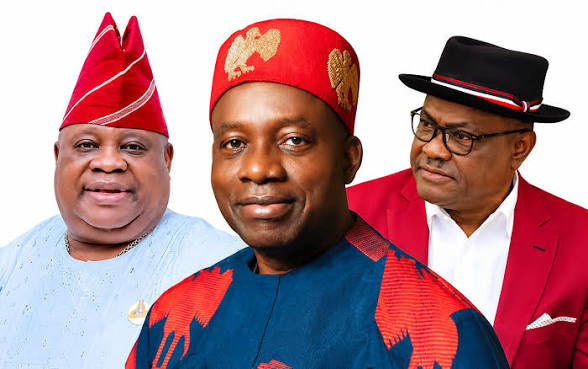
The All Progressives Congress (APC) has included Nyesom Wike, Chukwuma Soludo and Ademola Adeleke in its expanded presidential campaign council for President Bola Tinubu's re-election bid in 2027.
The appointments bring politicians affiliated with the Peoples Democratic Party (PDP), All Progressives Grand Alliance (APGA) and Accord into the ruling party's campaign structure.
The development highlights the cross-party alliances emerging ahead of the 2027 presidential election, while raising questions about how support for Tinubu will affect other political contests.
The APC named the three politicians in its revised presidential campaign council announced on Tuesday, October 13, 2026, according to reports.
The appointments assign campaign responsibilities to politicians who are not members of the ruling party.
Wike, the Minister of the Federal Capital Territory, is a prominent PDP figure. Soludo is the governor of Anambra State and a member of APGA, while Adeleke, the governor of Osun State, belongs to the Accord Party.
The APC's national chairman, Nentawe Yilwatda, said the party had approached the three politicians to seek their support for Tinubu's re-election.
Speaking on the outreach, Yilwatda explained that the APC had engaged political stakeholders beyond its membership, including politicians who had previously contested elections against its candidates.
He said Adeleke and Soludo agreed to support Tinubu after the APC approached them following electoral contests in Osun and Anambra states. He also said Wike had agreed to work for the President's re-election in Rivers State and the Federal Capital Territory.
The reactions from the politicians' parties reflect different aspects of the political arrangement.
The PDP National Caretaker Committee's National Publicity Secretary, Jungudo Mohammed, said Wike's willingness to work with Tinubu was expected.
According to PUNCH, Mohammed explained that Wike had received approval under the party's former national chairman, Umar Damagum, to cooperate with the President's administration.
He maintained that Wike's participation in Tinubu's campaign did not make the FCT minister an APC member.
His comments concern Wike's political activities and should not be interpreted as proof that the PDP has formally endorsed Tinubu for the 2027 presidential election.
APGA welcomed Soludo's appointment as Anambra State coordinator of Tinubu's presidential campaign.
In a statement signed by its National Publicity Secretary, Ejimofor Opara, the party described the appointment as consistent with its support for cooperation between Anambra State and the Federal Government.
APGA also reiterated its stated decision to support Tinubu's re-election bid. The party said it would continue to pursue electoral victories for its candidates in legislative elections while backing the President.
This position illustrates how a political party can support a presidential candidate from another party while maintaining its own candidates for other offices.
Advertisement
Bamidele Salam, an Accord chieftain and member of the House of Representatives representing Ede South, Ede North, Ejigbo and Egbedore Federal Constituency in Osun State, welcomed Adeleke's appointment, according to PUNCH.
His reaction indicates support for the governor's campaign role. However, that statement alone does not establish a separate, formal presidential endorsement by the entire Accord Party.
Why Does It Matter?
1. The APC Is Seeking Support Beyond Its Membership
The appointments indicate that the ruling party is seeking to build a broader coalition around Tinubu ahead of the 2027 election.
Support from politicians with established positions in their states could help the APC reach voters beyond its traditional party structure. However, the appointments do not establish how many additional votes the coalition will secure.
2. State-Level Alliances Could Shape the Election
Osun, Anambra and Rivers are politically significant states where party affiliations and relationships among influential politicians can affect campaign organisation.
By involving Adeleke, Soludo and Wike, the APC is seeking support from political figures with influence in these areas.
The practical effect will depend on how the campaign is organised and whether the politicians can translate their stated support into voter mobilisation.
3. Supporting Tinubu Does Not Automatically Mean Supporting Every APC Candidate
Wike has maintained that backing Tinubu does not require him to support APC candidates in every other election.
This distinction is important because presidential and legislative contests can involve different political alliances.
A politician may support a presidential candidate while backing candidates from another party for the Senate, House of Representatives or state legislature.
Consequently, the coalition's presidential objective does not necessarily eliminate competition between its participants in other elections.
4. The Arrangement Could Test Relations Within the APC
Wike's Rainbow Coalition has generated disagreements with some APC governors, according to reports.
Imo State Governor Hope Uzodimma, who chairs the APC Progressive Governors' Forum, has argued that alliances should not undermine Tinubu's re-election or weaken the party's candidates.
The disagreement reflects a political question facing the ruling party: how can it accommodate supporters from outside its membership while maintaining the loyalty and electoral interests of its own candidates?
The appointments do not resolve that question.
Key Questions
Have Wike, Soludo and Adeleke Defected to the APC?
Their inclusion in the campaign council does not establish that they have defected.
Wike is associated with the PDP, Soludo belongs to APGA, and Adeleke is a member of Accord. Their campaign appointments concern support for Tinubu's re-election.
Why Is the APC Working With Opposition Politicians?
APC national chairman Nentawe Yilwatda said the party had approached political stakeholders outside its membership to secure support for Tinubu.
The strategy allows the party to pursue cooperation with influential politicians without requiring all of them to become APC members.
Has the PDP Endorsed Tinubu for 2027?
The statements attributed to the PDP caretaker committee's spokesperson concern Wike's cooperation with the President.
They should not be treated as evidence of a formal endorsement of Tinubu by the entire PDP.
The distinction between an individual politician's support, a spokesperson's explanation and a party's official presidential endorsement remains important.
Does APGA Support Tinubu's Re-election?
Yes. According to the statement reported by PUNCH, APGA reaffirmed its support for Tinubu's 2027 presidential bid and said it had adopted him as its consensus candidate.
The party also said it intended to contest legislative elections independently.
Advertisement
What Is the Rainbow Coalition?
The Rainbow Coalition is a political arrangement promoted by Wike to bring together APC members and supporters of Tinubu from other political parties.
Wike has said its objective is to support the President's re-election. He has also maintained that coalition members can retain their preferences for candidates in other elections.
The next significant developments will be how the expanded campaign council organises its activities and whether the coalition's participating politicians sustain their declared support as the 2027 election approaches.
The APC's campaign activities and any further formal statements from the participating parties will help clarify the arrangement's scope.
The appointments alone do not establish how the election will turn out.
Nigeria's political parties compete for elected offices, but political cooperation can extend beyond formal party membership.
Such arrangements may involve individual politicians, state-level alliances or broader coalitions built around a presidential candidate.
The APC's decision to include Wike, Soludo and Adeleke illustrates this distinction between party affiliation and electoral cooperation.
The arrangement also leaves room for competing interests. Politicians who cooperate in a presidential election may still disagree over governorship, legislative and other contests.
For voters, the key issue is whether these alliances produce clear political commitments and translate into accountable governance rather than serving only as campaign arrangements.
The expanded campaign council is expected to play a role in organising support for Tinubu ahead of the 2027 presidential election.
Further developments will show how the coalition operates in each state and how its members balance presidential campaigning with their parties' interests in other elections.
The unresolved question is whether cooperation across party lines will develop into a coordinated electoral force or remain focused mainly on supporting Tinubu's presidential bid.
The APC's inclusion of Wike, Soludo and Adeleke signals an effort to broaden support for Tinubu ahead of 2027 without requiring the three politicians to belong to the ruling party.
Their appointments also highlight the distinction between presidential alliances and competition for other elected offices. How effectively the coalition mobilises support, and whether it maintains cooperation amid competing party interests, will become clearer as the election approaches.
You must log in to comment or reply.
Comments