
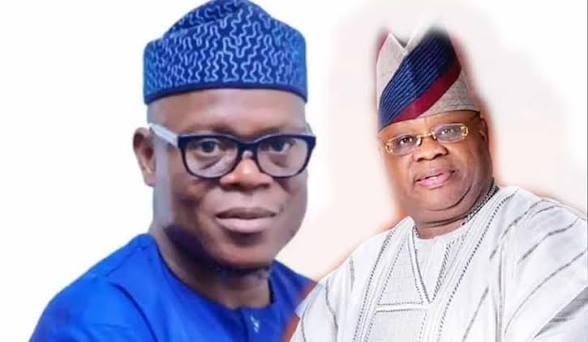
 The political lines drawn during the 2026 Osun governorship election have shifted quickly after the poll, with APC National Secretary Surajudeen Ajibola Basiru visiting Governor Ademola Adeleke and discussing support for President Bola Tinubu’s 2027 re-election bid.
The meeting is notable because Basiru campaigned for the APC candidate, Bola Oyebamiji, against Adeleke in the August 15 election. Adeleke, contesting under the Accord Party, defeated Oyebamiji by 511,067 votes to 444,815, according to the declared election results.
Basiru's visit therefore goes beyond a routine congratulatory meeting. It brings together two politicians who were on opposing sides of a closely watched state election but now have a shared political interest around Tinubu's 2027 campaign.
Basiru said the visit had three purposes: to congratulate Adeleke on his re-election, thank him for attending the burial of Basiru's mother, and discuss how Osun could be delivered for Tinubu in the 2027 presidential election.
TVC reported that Basiru specifically described the meeting as involving discussions on securing Osun for Tinubu. The Guardian also reported that Basiru said Adeleke had promised to work towards delivering the state for the President.
The personal element of the meeting is also significant. Basiru acknowledged that Adeleke had visited him during his period of bereavement and attended his mother's burial despite their political differences.
Basiru said he had delayed returning the gesture because he was campaigning against Adeleke during the governorship election. He also openly acknowledged that he had wanted Oyebamiji, the APC candidate, to win.
That admission provides an unusually direct account of the political divide that existed only weeks before the meeting.
The election that changed the political setting
Adeleke's victory was not an APC victory.
INEC declared the incumbent governor, running on the Accord platform, winner with 511,067 votes, giving him a 66,252-vote margin over APC candidate Bola Oyebamiji, who received 444,815 votes.
The Guardian reported that Adeleke won 19 of Osun's 30 local government areas, while Oyebamiji won 11. The result represented a setback for the APC, which had mounted a substantial campaign to remove Adeleke from office.
That makes Basiru's subsequent visit politically significant. The APC national secretary was not meeting the candidate his party had just supported; he was meeting the governor who had defeated that candidate.
Advertisement
Yet the relationship between Adeleke and Tinubu had already developed in a different direction from the rivalry between Adeleke and the APC at state level.
Adeleke's support for Tinubu did not begin with Basiru's visit.
The Osun State Government said in March that Adeleke had reaffirmed his endorsement of Tinubu for a second presidential term. In June, the governor again publicly endorsed Tinubu while campaigning for his own re-election under Accord.
After winning the August 15 election, Adeleke again reaffirmed that position. He described Tinubu as a “son of Osun State” and said he continued to support the President's 2027 bid.
That distinction matters.
Adeleke's state-level political competition with the APC did not prevent him from supporting Tinubu at the presidential level.
The August 30 meeting appears to have taken advantage of that existing political position.
This is where the available evidence requires caution.
Basiru spoke about Adeleke's promise to help deliver Osun for Tinubu. But there is no evidence in the reports reviewed that establishes a formal political agreement between Adeleke and Tinubu.
In fact, Adeleke has previously rejected that interpretation.
After his re-election, the governor said he had never reached an agreement with Tinubu over his support for the President's 2027 campaign. He said his support was based on Tinubu's regional identity and his assessment of the President's development efforts in the South-West.
His campaign council also rejected suggestions that his endorsement was the product of a pre-arranged political deal. It said the decision was based on Tinubu's performance and reforms.
That creates an important distinction between political support and a formal political bargain.
The evidence establishes that Adeleke supports Tinubu's re-election and that APC officials now want to translate that support into electoral backing in Osun. It does not establish the existence of a secret or formal agreement.
For the APC, Osun presents an obvious political challenge.
The party failed to defeat Adeleke in the governorship election despite making a major effort to regain control of the state. The Guardian reported that the APC had established a 276-member national campaign council and multiple subcommittees for the contest.
The party therefore faces a different task in the 2027 presidential election.
It does not necessarily need Adeleke to become an APC politician. What matters electorally is whether the governor's support for Tinubu can translate into votes for the President without changing the governor's separate political identity.
That distinction could become important as the 2027 campaign develops.
The relationship between Tinubu and Adeleke has also been more cordial than their party affiliations might suggest.
Following Adeleke's re-election, Tinubu congratulated him. Adeleke subsequently visited the President at the Presidential Villa and presented his certificate of return.
This provides additional context for Basiru's visit.
Advertisement
The meeting was not the first sign of cooperation between the two political camps. Rather, it came after several public interactions between Tinubu and Adeleke and after the governor had repeatedly declared his support for the President's second-term bid.
Several questions cannot yet be answered from the available evidence.
First, how much electoral support can Adeleke actually deliver for Tinubu? A governor's endorsement does not automatically translate into every supporter voting for the same presidential candidate.
Second, what form will Adeleke's promised support take? Basiru spoke about delivering Osun for Tinubu, but the public reports do not provide a detailed campaign structure, target, or mobilisation plan.
Third, will the relationship affect APC's future strategy in Osun? Adeleke remains outside the APC and defeated its candidate in the governorship election. Whether the cooperation around the presidential election will remain separate from the state's party politics is still unclear.
Fourth, will the arrangement face resistance within either political camp? Adeleke's supporters include people who backed him as an Accord candidate, while APC members campaigned against him only weeks ago. The available evidence does not yet show how those different constituencies will respond.
The immediate political development is the beginning of deeper mobilisation for the 2027 presidential election.
Basiru has publicly linked his meeting with Adeleke to the objective of securing Osun for Tinubu, while Adeleke has already reaffirmed his support for the President.
The next significant test will therefore not be whether the two politicians can meet. They have already done so.
The more consequential question is whether the political understanding expressed publicly after the Osun governorship election can produce measurable support for Tinubu across the state while Adeleke remains outside the APC.
For now, the evidence shows cooperation on the presidential question — but not a change in party affiliation or proof of a formal political deal.
You must log in to comment or reply.
Comments