
A rapid military response averted what could have become another highway abduction crisis in Nigeria’s South-East.
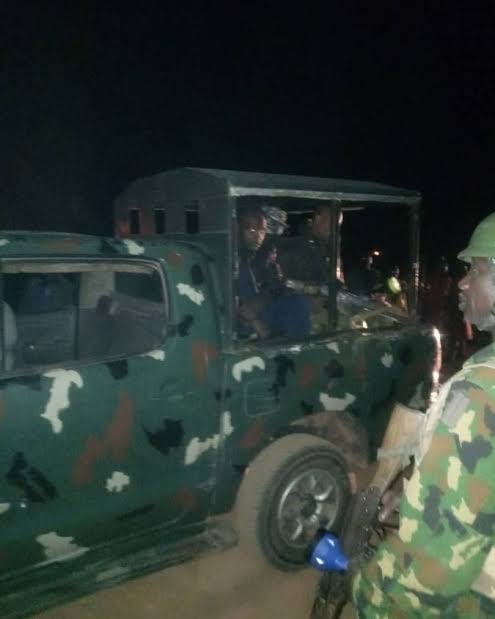
Troops under Operation Whirl Stroke intercepted suspected kidnappers along the Enugu–Otukpo Road this week, rescuing three passengers after an 18-seater commercial bus was reportedly seized during a night operation. The intervention, according to the military, forced the assailants to abandon their captives and retreat before direct engagement.
The incident adds to a growing pattern of attempted highway kidnappings across Nigeria’s inter-state corridors — routes that remain economically vital yet increasingly vulnerable.
In a statement issued by Lieutenant Ahmad Zubairu, Acting Media Information Officer of Operation Whirl Stroke, troops stationed at a Forward Operating Base in Otukpo received intelligence on February 25 that a Benue Links bus (registration TYK 221 YK) had been hijacked.
The bus was said to be conveying four adult passengers and a minor at the time of the attack.
Advertisement
Troops reportedly mobilised immediately, tracking the suspected kidnappers along their withdrawal route. Their pursuit compelled the attackers to abandon three of the victims. No exchange of gunfire was reported, though a mobile phone believed to belong to the suspects was recovered.
The Force Commander commended the unit’s “resilience, vigilance and operational efficiency,” while urging motorists to remain alert, particularly when encountering suspiciously empty stretches of road.
The rescue follows a similar intervention days earlier within the 82 Division Area of Responsibility, where five travellers were freed near the 9th Mile axis after troops engaged armed attackers.
Nigeria’s highway kidnapping crisis has evolved from opportunistic crime into a structured criminal enterprise in several regions. While operations like Whirl Stroke have recorded tactical successes, the pattern remains cyclical: attack, response, rescue, reassurance.
The absence of direct contact during the pursuit may signal that the kidnappers were operating on speed and surprise rather than territorial control. But it also underscores the mobility of armed groups who can strike and withdraw quickly.
Beyond the immediate rescue, the broader issue is deterrence. Successful rescues reduce casualties — but do they reduce attempts?
For commuters and transport operators, the economic implications are significant. Night travel premiums, route diversions, and private security arrangements increase transport costs. In agricultural belts connecting Benue and Enugu, insecurity along highways affects food supply chains and market pricing.
Security forces across the South-East and North-Central regions have intensified joint task force operations over the past year. Operation Whirl Stroke, originally focused on countering armed banditry and communal violence in Benue and adjoining states, has expanded its highway security posture.
Advertisement
Yet criminal actors appear adaptive. Intelligence-led responses are improving, but sustained route dominance remains the long-term benchmark.
Advisories urging motorists to monitor unusual gaps in traffic flow reflect a reality: travellers themselves are becoming part of early warning systems. While practical, this also signals that absolute security coverage is still evolving.
The concern now is whether security forces can shift from disruption to sustained deterrence along high-risk corridors like Enugu–Otukpo Road. Preventing kidnappers from mounting operations in the first place — rather than intercepting them mid-crime — will define long-term success.
What authorities do next — enhanced surveillance, aerial reconnaissance, deeper intelligence penetration, or transport-sector coordination — will determine whether this rescue marks a turning point or another chapter in a continuing cycle.
You must log in to comment or reply.
Comments