
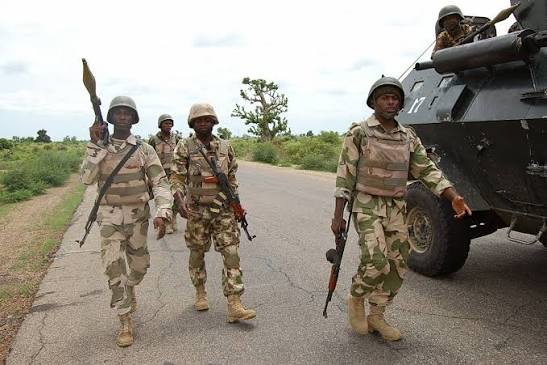
Before sunrise on Saturday, gunfire echoed across parts of Borno State as troops of Operation Hadin Kai clashed with suspected ISWAP fighters. By the end of the confrontation, five insurgents were dead—and three children abducted months ago were finally free.
The operation signals renewed pressure on extremist groups operating in Nigeria’s North-East.
Troops of Operation Hadin Kai, the military’s counter-insurgency task force in the North-East, rescued three children and neutralised five suspected terrorists during separate operations between February 20 and 21, 2026.
According to military authorities:
• Troops encountered suspected Islamic State West Africa Province (ISWAP) and Jama'atu Ahlis Sunna Lidda'awati wal-Jihad fighters near Sabsawa village in Borno.
• A firefight broke out during a fighting patrol.
• Five insurgents were killed during follow-up exploitation.
• In a separate perimeter patrol in Bama LGA, three children abducted about two months ago were rescued.
• An 18-year-old suspect also surrendered in Geidam, Yobe State.
The rescued children were handed over to the police for further procedures.
This story is not just about five insurgents killed.
It highlights three deeper issues:
Advertisement
1. Abduction Networks Are Still Active
The children were reportedly kidnapped along the Gubio axis two months ago. That suggests:
• Insurgent cells are still capable of abducting civilians.
• Movement between villages remains vulnerable.
Some rural corridors may still lack consistent security coverage.
2. Youth Radicalisation Remains a Concern
The surrender of an 18-year-old suspect raises a troubling reality: insurgent recruitment continues among teenagers.
In simple terms: If young people are still joining these groups, the conflict is not just military—it’s social and economic.
3. ISWAP vs JAS Dynamics
Security analysts have long observed that ISWAP operates with more structured command systems than traditional Boko Haram factions. The presence of both factions in the same operational zone indicates:
• Fragmented but persistent insurgent activity.
• Ongoing territorial contest in rural Borno.
Analysis
Nigeria’s insurgency began in 2009.
Tens of thousands have been killed.
Over 2 million people have been displaced at the peak of the conflict.
Since 2021, authorities have recorded increased surrender rates among insurgents.
However, ISWAP has adapted by restructuring cells and using mobility tactics.
Bama, Ngurosoye, and surrounding LGAs remain sensitive zones due to proximity to forested and border areas.
While military pressure has increased, insurgents often resort to:
• Hit-and-run attacks
• Kidnappings
Advertisement
• Rural infiltration
This latest operation fits into that pattern: aggressive patrols followed by rapid engagement.
The operation reflects tactical success. But the bigger picture is more complex.
3 Key Takeaways
1. The military maintains offensive momentum in Borno.
2. Insurgent recruitment and abduction networks are not fully dismantled.
3. Civilian protection in remote corridors remains a major security test.
The real situation now is sustainability.
Will these operations translate into permanent territorial stability?
What authorities do next will determine whether these victories reduce long-term insecurity—or simply disrupt it temporarily.
You must log in to comment or reply.
Comments