
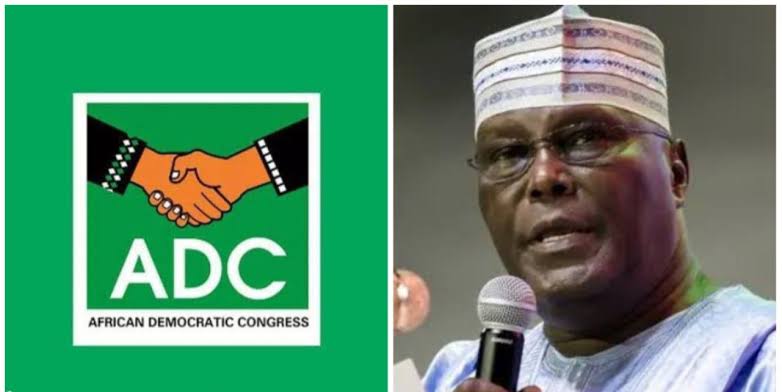
Nigeria’s opposition politics entered a new phase on Wednesday night after former Vice President Atiku Abubakar emerged as the presidential candidate of the African Democratic Congress for the 2027 general election, defeating former Transportation Minister Rotimi Amaechi and banker Mohammed Hayatu-Deen in a fiercely contested primary.
The outcome, announced at the Congress Hall of Transcorp Hilton in Abuja, immediately exposed growing cracks within the opposition coalition, with both Amaechi and Hayatu-Deen rejecting the process and alleging manipulation of the voting exercise.
While the ADC leadership projected the primary as evidence of internal democracy, the disagreement that followed highlights the difficult challenge opposition parties face in building a united front strong enough to confront the ruling APC in 2027.
According to figures announced by party officials, Atiku secured 1,846,370 votes, while Amaechi polled 504,117 and Hayatu-Deen received 177,120 votes.
The contest had already drawn national attention after the ADC abandoned an earlier plan for consensus talks and adopted a direct primary system across Nigeria’s 36 states and the Federal Capital Territory. That decision followed resistance from all three aspirants, who reportedly declined pressure to step down for a single candidate.
Speaking after his victory, Atiku attempted to calm tensions within the party and appealed directly to aggrieved members to remain in the coalition.
“I therefore appeal to all those who feel aggrieved to come back to our party and close ranks with the rest of us,” he said.
Advertisement
He also reached out personally to his rivals.
“In particular, I invite Chief Rotimi Amaechi and Alhaji Muhammad Hayatu-Deen to join me in this fight to save our democracy and our country,” Atiku added.
However, a closer look at reactions from rival camps suggests the unity Atiku seeks may prove difficult to achieve.
Several platforms focused primarily on the vote totals and victory declaration. Yet beyond the headline figures lies a more consequential issue: whether Nigeria’s fragmented opposition can truly consolidate ahead of the next presidential race.
Amaechi and Hayatu-Deen reportedly rejected the result before the final announcement was completed, citing concerns over the integrity of the process. Hayatu-Deen reportedly boycotted the official declaration entirely.
That development could weaken efforts to build a broad anti-APC coalition at a time when opposition parties are already struggling with internal distrust, defections, and leadership rivalries.
The situation also revives long-standing questions surrounding Atiku’s political positioning. Despite remaining one of Nigeria’s most influential opposition figures for over two decades, critics argue that repeated presidential bids have not translated into a durable national coalition capable of sustaining electoral victory.
Yet Atiku’s camp appears determined to frame the ADC primary as proof that democratic competition still exists within opposition politics.
“We constructed that while democracy is being strangled and squashed by the ruling party… democracy is alive and well in the African Democratic Congress,” Atiku declared during his speech.
That framing reflects a broader opposition strategy likely to dominate political messaging ahead of 2027 — portraying the election not simply as a contest between parties, but as a referendum on democratic space, governance, and economic hardship under the current administration.
The economic angle may become especially significant.
Nigeria continues to face high inflation, rising food prices, currency instability, and worsening unemployment pressures affecting millions of households and small businesses. Opposition parties are expected to increasingly connect those economic frustrations to their campaign narratives over the next year.
Atiku directly referenced these concerns in his address, criticising current borrowing trends and subsidy policies while promising reforms in education, healthcare, and national security.
He pledged free and compulsory basic education and promised stronger investment in healthcare infrastructure to reduce medical tourism abroad.
Advertisement
Yet the deeper political challenge may not be policy promises, but coalition management.
Nigeria’s recent political history shows that opposition alliances often collapse under the weight of competing ambitions long before general elections arrive. Similar coalition tensions weakened opposition negotiations in previous election cycles, particularly after disputed primaries and disagreements over zoning arrangements.
What makes the ADC situation more delicate is that the party is attempting to position itself as a credible alternative at a time when voter frustration with mainstream politics appears to be rising across urban centres such as Lagos, Abuja, Kano, and Port Harcourt.
For many younger voters facing economic uncertainty, the real concern is no longer campaign rhetoric but whether any opposition movement can remain united long enough to present a serious governing alternative.
The coming weeks may therefore determine whether Atiku’s victory strengthens the ADC or deepens internal fractures within the opposition bloc.
The real challenge now is not the primary result itself, but whether the party can prevent post-primary disputes from turning into defections, legal battles, or a fractured campaign structure before 2027.
You must log in to comment or reply.
Comments