
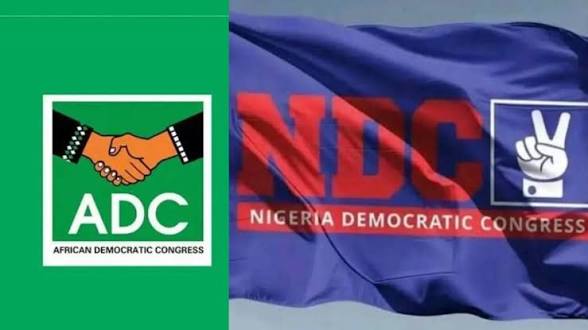
A new political home, but an old question about opposition cohesion
Nigeria’s opposition politics has become increasingly fluid ahead of the 2027 general elections, with politicians moving between platforms as alliances, candidacies and party structures evolve. The reported decision by former Secretary to the Government of the Federation, Babachir Lawal, to join the Nigeria Democratic Congress (NDC) adds another significant movement to that shifting landscape.
Lawal’s latest move is particularly notable because it follows a bitter departure from the African Democratic Congress (ADC) and months of changing public positions about where he stood in the emerging opposition alignment.
Former SGF Babachir Lawal has joined the Nigeria Democratic Congress, according to a report by The PUNCH on Tuesday, September 22, 2026.
Lawal was reportedly unveiled at an event in Abuja attended by NDC National Secretary Ikenna Enekweizu and National Leader Senator Seriake Dickson.
The former SGF said he was supporting the NDC's presidential ticket of Peter Obi and Rabiu Kwankwaso ahead of the 2027 general election. He argued that Nigerians concerned about insecurity, hunger and other national challenges should support the party.
The development comes about three months after Lawal resigned from the ADC.
In June, Lawal announced his departure from the ADC and alleged that its presidential primary had been manipulated in favour of former Vice-President Atiku Abubakar. Channels Television reported his allegation at the time, while Premium Times also reported his explanation for leaving the party.
Those allegations were disputed by political figures associated with the ADC and Atiku's camp, meaning they remain claims made by Lawal rather than established findings.
Lawal's journey from ADC critic to NDC supporter illustrates one of the defining features of Nigeria's opposition politics ahead of 2027: political alliances are still being negotiated and reorganised.
Advertisement
His movement is not simply a story about one politician changing parties. It also reflects the wider fragmentation of opposition politics following the breakdown of the earlier ADC-based alignment.
Peter Obi and Rabiu Kwankwaso had already moved from the ADC to the NDC in May, citing internal disputes and uncertainty surrounding the ADC. Lawal subsequently criticised the ADC process and eventually became publicly supportive of the Obi-Kwankwaso ticket.
There is also an important element of political evolution in Lawal's own position.
In early June, shortly after leaving the ADC, Lawal said he had ruled out APC, ADC and NDC and suggested that he might consider voting for another candidate.
By late July, however, he was publicly describing the Obi-Kwankwaso ticket as having a strong chance in the 2027 contest.
That change does not by itself establish the reasons for his decision. But it demonstrates how quickly political calculations and alliances can change in the period before an election.
From the NDC's perspective, Lawal's arrival can be presented as an expansion of its political structure and organisational capacity.
At Tuesday's unveiling, NDC National Leader Seriake Dickson described Lawal as an experienced political mobiliser and said he would have a leadership role in the party's campaign activities in the North-East.
That emphasis is significant because Lawal's political background extends beyond his former federal government position. His experience in northern Nigerian politics gives the NDC another prominent figure associated with the region.
The alternative interpretation comes from Lawal's history with the ADC.
His departure from that party followed serious allegations concerning its presidential primary. The ADC has rejected his criticisms, while party figures have subsequently argued that the organisation was functioning better after his departure. The Guardian, for example, reported in July that an ADC official described the party as experiencing greater cohesion after Lawal left.
The contrasting narratives demonstrate that Lawal's political movements are being interpreted differently depending on the political camp involved. To the NDC, his arrival represents additional political experience and mobilisation capacity. To some former allies in the ADC, his departure has been framed as beneficial to their own internal cohesion.
Neither interpretation should be confused with an independently established measure of Lawal's political influence.
The NDC's decision to give Lawal a campaign role covering the North-East is politically significant because the region will be an important arena for competing opposition and governing-party organisations during the 2027 election cycle.
Lawal is from Adamawa State and previously served as SGF under President Muhammadu Buhari. His political experience therefore gives him familiarity with a region where questions of party organisation, local networks and voter mobilisation will matter.
However, having a prominent political figure within a campaign structure does not automatically translate into electoral support. The eventual impact will depend on the NDC's organisation at state and ward levels, its ability to maintain internal cohesion, the strength of its candidates and how voters respond to its platform.
Lawal's entry gives the NDC another experienced political figure at a time when opposition parties are attempting to build structures ahead of the 2027 election.
It also places him inside the same political project as Obi and Kwankwaso after a period in which he had been publicly critical of the ADC's handling of its internal processes.
For the NDC, the immediate challenge will be translating political personalities into a coherent organisation. Opposition movements can attract influential figures while still facing difficulties over structures, candidate selection, regional interests and campaign coordination.
The party's ability to manage those pressures may ultimately be more consequential than the number of prominent politicians it attracts.
Advertisement
Lawal's defection should therefore be viewed within the larger process of opposition realignment rather than as an isolated political event.
The movement of politicians between ADC and NDC shows that the configuration of Nigeria's opposition remains unsettled more than a year before the 2027 general elections. At the same time, competing parties are attempting to consolidate their own structures and present themselves as credible alternatives.
For voters, these movements create an important distinction between political alignment and policy substance.
A politician changing parties tells the public something about the direction of that politician's political activity, but it does not by itself establish whether a party's policies will be effective or whether its candidates will deliver on their promises.
Those questions require closer examination of manifestos, records, proposed policies, candidate selection and the ability of political organisations to implement their programmes.
Ultimately, Babachir Lawal's move to the NDC is another indication that Nigeria's 2027 political map is still being drawn.
His transition from ADC member to critic, his initial rejection of the NDC and his subsequent public support for the Obi-Kwankwaso ticket illustrate how quickly political positions can evolve before an election.
The more important question now is not simply how many politicians join the NDC, ADC or other opposition platforms. It is whether these shifting alliances can produce durable political organisations with clear programmes and convincing answers to the problems voters say matter most.
What happens between now and 2027 will determine whether today's political realignments become lasting structures or remain another chapter in Nigeria's long history of pre-election coalition building.
You must log in to comment or reply.
Comments