
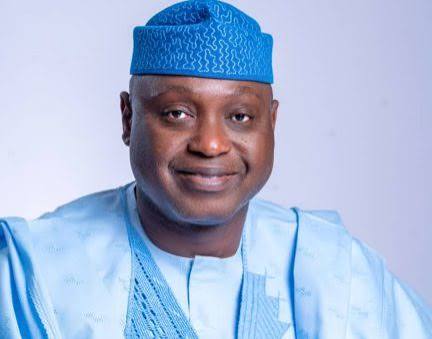
Political victories are often measured by vote margins, but some elections carry significance beyond the numbers announced at the end of polling. In Ekiti State, Governor Biodun Oyebanji's re-election appears to represent something deeper: a rare moment of political continuity in a state long known for frequent leadership changes and intense political rivalries.
Whether this victory becomes a turning point for governance in Ekiti or simply another chapter in the state's political history will depend on what follows in the next four years.
Governor Biodun Oyebanji of the All Progressives Congress secured another term in office after emerging victorious in Saturday's governorship election in Ekiti State.
The Independent National Electoral Commission declared Oyebanji the winner after he polled 319,224 votes, defeating the Peoples Democratic Party candidate, Wole Oluyede, who secured 40,543 votes, and the African Democratic Congress candidate, Dare Bejide, who polled 12,872 votes.
Reacting to the outcome, Senate Leader Senator Opeyemi Bamidele described the governor's victory as a strong endorsement of his leadership and governance record. Bamidele, who chaired the APC Governorship Election Campaign Council in the state, said the renewed mandate would guarantee continuity and accelerate development initiatives across Ekiti.
He further stated that Oyebanji had become the first governor in Ekiti to secure back-to-back re-election since Nigeria returned to democratic rule in 1999.
Ekiti politics has traditionally been characterised by sharp divisions and changing political alliances. Governors often struggled to retain widespread political support, and transitions in power were frequently accompanied by intense disputes.
Advertisement
Against that background, Oyebanji's re-election is noteworthy.
Supporters argue that his administration succeeded in building bridges among political stakeholders, including former governors and leaders from different political tendencies. The perception of stability and inclusiveness may have played a significant role in strengthening his electoral appeal.
In a country where political infighting often disrupts governance and slows development projects, the promise of continuity can become a powerful electoral message.
However, history also shows that electoral victories, regardless of their scale, do not automatically translate into lasting development. The real test of any administration begins after the celebrations end.
For the APC and its supporters, the election result is a clear affirmation that voters are satisfied with the governor's performance. The overwhelming margin of victory suggests a broad level of acceptance of his leadership style and policy direction.
To many within the ruling party, the result validates the argument that political stability and consensus-building have benefited the state.
A different interpretation, however, may come from opposition parties and independent observers.
Critics could argue that the huge margin of victory also reflects the current weakness and fragmentation of opposition politics in the state rather than an entirely unanimous endorsement of government performance. Some may question whether the opposition was sufficiently organised to present a competitive challenge.
In democratic systems, strong opposition parties are essential because they create accountability and force governments to continually improve their performance.
Therefore, while the election may be viewed as a triumph for the APC, it also raises questions about the future strength and competitiveness of opposition politics in Ekiti.
The implications of Oyebanji's re-election extend beyond Ekiti State.
At a time when many Nigerian states are grappling with political instability, governance disputes and leadership transitions, Ekiti's experience offers an alternative narrative centred on continuity and relative political harmony.
If the governor uses his second term to deepen reforms, improve infrastructure, create jobs and strengthen public services, his administration could become a model for how political stability can translate into tangible development outcomes.
Advertisement
But continuity also comes with heightened expectations.
Voters who delivered such a decisive mandate will likely expect faster progress, stronger economic opportunities and more visible improvements in living standards.
The second term may therefore prove more difficult than the first because expectations are now considerably higher.
Ultimately, the question is no longer whether Biodun Oyebanji deserved another term in office. The electorate has already answered that.
The real issue may be whether this historic re-election becomes the foundation for a lasting governance legacy or merely an impressive political milestone.
What happens next will define not only Oyebanji's place in Ekiti's history but also whether continuity in Nigerian politics can genuinely produce better outcomes for citizens.
You must log in to comment or reply.
Comments