
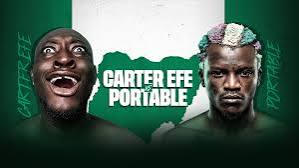
What began as a spectacle of street credibility and online bravado ended in a decisive upset in Lagos. The outcome not only unsettles Portable’s dominance in celebrity boxing but also signals how influencer-driven combat sports are evolving into a serious entertainment business in Nigeria.
On May 1, 2026, at Balmoral Hall, Federal Palace Hotel in Lagos, social media personality Carter Efe defeated street-pop artiste Portable in a three-round celebrity boxing bout at Chaos in the Ring 4.
All three judges scored the fight 27–30 in favour of Efe, handing Portable his first loss in the format and ending his run as the self-styled “celebrity boxing king.”
Portable had entered the bout with confidence, declaring:
“I will use you to collect my third belt… I will beat you now.”
Advertisement
Efe’s response was brief but pointed:
“One punch and you fall.”
Inside the ring, the contrast was clear. Portable’s aggressive, unstructured attacks were met with Efe’s more controlled counters—sharp uppercuts and body shots that gradually dictated the pace across all three rounds.
Beyond the spectacle, this fight reflects a broader shift in Nigeria’s entertainment economy. Celebrity boxing—once dismissed as comic relief—is increasingly mirroring global influencer fight culture seen on platforms like YouTube and TikTok.
However, a closer look shows deeper implications:
• Brand Power vs Skill Reality: Portable’s previous victories over entertainers like Charles Okocha and Speed Darlington were built on hype and physicality. Efe’s win introduces a different narrative—preparation and technique can outperform raw aggression, even in entertainment fights.
• Commercial Expansion: Events like Chaos in the Ring are quietly building a new revenue stream—ticket sales, sponsorships, streaming rights, and social media engagement.
• Audience Shift: Nigerian youth audiences are increasingly drawn to hybrid content—where music, comedy, and sport intersect.
Yet the deeper issue is sustainability. Without proper regulation, training standards, and promotion structures, the line between entertainment and athlete safety remains blurred.
Nigeria’s entertainment industry has historically expanded through hybrid formats—from reality TV to influencer marketing. Celebrity boxing now appears to be the next frontier.
Advertisement
Globally, influencer boxing has generated millions of dollars per event, and Nigeria’s version is beginning to follow a similar trajectory, albeit on a smaller scale. Lagos, as the country’s entertainment hub, is naturally becoming the center of this evolution.
Portable’s earlier victories had positioned him as the face of this movement. His defeat, however, introduces unpredictability—something that could either strengthen the sport’s credibility or fragment its narrative.
The immediate result crowns a new champion, but the bigger question lies beyond the ring. As celebrity boxing gains traction, the real test now is whether promoters can transform viral moments into a sustainable sports-entertainment industry.
What happens next—more structured fights, bigger sponsorships, or fading novelty—will determine whether this remains a passing trend or becomes a defining part of Nigeria’s evolving entertainment landscape.
You must log in to comment or reply.
Comments