
As Nigeria marks the 2026 Children’s Day, the Federal Government has renewed its commitment to expanding inclusive and quality education across the country.
The pledge, delivered in Abuja by the Minister of Education, Maruf Tunji Alausa, highlights growing pressure on authorities to close long-standing gaps in access, disability inclusion, and learning quality.
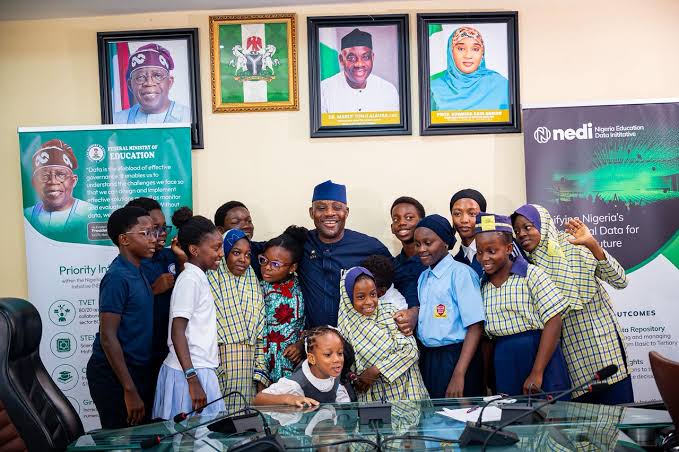
On Wednesday in Abuja, the Minister of Education, Maruf Tunji Alausa, hosted children from different schools and backgrounds at the Federal Ministry of Education headquarters as part of activities marking Children’s Day 2026.
The event, which also featured disability advocate and actress Dera Osadebe, was designed to spotlight children’s voices and reinforce national education priorities.
According to a statement by the minister’s media aide, Ikharo Attah, the engagement formed part of broader efforts to promote inclusive education, child development, and equal opportunity under the Federal Government’s education agenda.
During the session, Alausa emphasized that Children’s Day serves as a reminder of the country’s responsibility toward its youngest citizens.
Advertisement
“Today is about celebrating the strength, creativity, and limitless potential of our children. Every Nigerian child deserves to feel seen, heard, encouraged, and supported to achieve their dreams regardless of background or circumstance,” the minister said.
He also commended Dera Osadebe for her advocacy work around autism and disability inclusion, describing her efforts as a catalyst for broader national conversations on empathy and equal access.
Beyond ceremonial speeches and symbolic engagements, the announcement reflects a deeper policy direction: Nigeria is attempting to reposition education as a central pillar of its economic and social stability strategy.
The Minister’s reference to inclusive education is particularly significant in a country where millions of children remain outside the formal school system, while others face barriers linked to disability, poverty, and geography.
What makes this more complex is that inclusive education in Nigeria is still unevenly implemented at state and local government levels. While federal messaging is strong, execution often depends on funding capacity, teacher availability, and infrastructure readiness.
A historical comparison underscores this gap. Over the past decade, successive governments have launched similar initiatives aimed at reducing the number of out-of-school children, yet progress has remained slow due to insecurity in parts of the North, funding limitations, and population pressures.
Economically, education investment remains tightly linked to Nigeria’s long-term productivity outlook. Analysts consistently argue that without significant improvement in foundational learning outcomes, youth unemployment and economic inequality are likely to persist.
Nigeria is estimated to have one of the highest populations of out-of-school children globally, a challenge that has persisted across multiple administrations. UNICEF and education-focused studies have repeatedly highlighted access, affordability, and regional insecurity as key drivers.
The current policy direction under the Renewed Hope Agenda places emphasis on:
• Inclusive education expansion
• Safe learning environments
Advertisement
• Digital and skills-based learning development
• Increased access for vulnerable and disabled children
However, implementation remains uneven across states, raising questions about how quickly federal commitments can translate into measurable classroom outcomes.
The real test of the Federal Government’s pledge will not be in ceremonial speeches but in sustained investment, monitoring, and state-level execution.
As Nigeria continues to confront deep structural education challenges, the success of inclusive education policies will depend on whether commitments made in Abuja can translate into classrooms in rural and underserved communities across the country.
You must log in to comment or reply.
Comments