
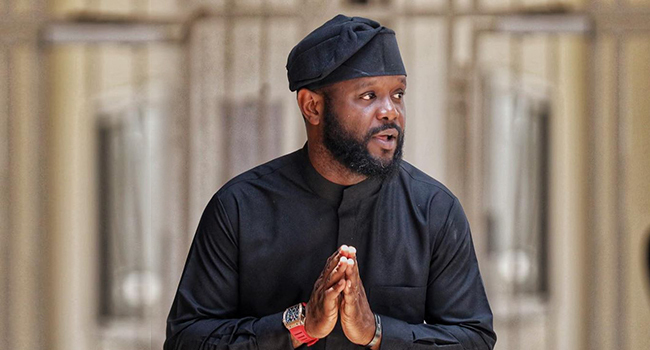
Political tensions surrounding Nigeria’s 2027 election cycle intensified on Monday after the CityBoy Movement publicly denied a viral social media claim alleging that its patron, Barrister Seyi Tinubu, made blasphemous comments about God while discussing future political ambitions.
The controversy highlights the growing role of misinformation, religious sensitivity, and digital propaganda in Nigeria’s political environment, where unverified statements can quickly escalate into nationwide debates before their authenticity is established.
The CityBoy Movement, a pro-Tinubu political support group, dismissed as “false and malicious” a widely circulated online publication that allegedly quoted Seyi Tinubu making controversial remarks concerning Almighty God and the 2027 presidential election.
In a statement issued on Monday and signed by the group’s Deputy Director-General for Communication and Public Affairs, O’tega Ogra, the organisation described the publication as deliberately provocative and capable of inflaming religious tensions.
According to the statement, the viral write-up — allegedly authored by an individual identified as “Albaabu Abudulahi” — falsely attributed comments to Seyi Tinubu that he never made.
“For the avoidance of doubt, Barr. Seyi Tinubu did not make the statement credited to him. The attribution is entirely false, malicious in intent, reckless in circulation and dangerous in consequence,” the statement said.
The group further stated that Seyi Tinubu remains deeply religious and believes that political authority ultimately comes from God.
Advertisement
“Barr. Seyi Tinubu is a man of faith who holds deep reverence for Almighty God. He believes firmly that all power belongs to God alone and that no man can attain, retain or exercise authority except by the grace, mercy and permission of the Almighty,” the statement added.
The movement acknowledged that Seyi Tinubu continues to support President Bola Ahmed Tinubu’s potential re-election campaign in 2027 but insisted that political ambition has never superseded his religious convictions.
The deeper issue is not merely whether the statement was fake, but how quickly emotionally charged political content spreads across Nigeria’s digital ecosystem.
Over the past few election cycles, misinformation campaigns involving religion, ethnicity, and political succession have become more sophisticated. Viral screenshots, edited graphics, fabricated quotes, and manipulated audio clips increasingly shape public perception before fact-checking efforts can catch up.
What makes this case more sensitive is Seyi Tinubu’s growing political visibility.
Although he currently holds no elected office, his influence within youth mobilisation circles and pro-Tinubu political structures has attracted increasing public scrutiny ahead of 2027 conversations. That rising profile makes him both politically valuable and politically vulnerable.
Yet the framing of the controversy also reveals a broader challenge facing Nigerian political communication: official denials alone often struggle to contain narratives once they gain traction online.
Nigeria’s political history shows that religious controversies can escalate rapidly when linked to national leadership debates.
From campaign-season accusations to sectarian misinformation during elections, religion has repeatedly shaped political alliances, voter emotions, and public trust. Analysts warn that even unverified claims can deepen existing social divisions if amplified recklessly.
A similar pattern emerged during previous election cycles when fake endorsements, fabricated speeches, and manipulated campaign materials circulated widely across Facebook, WhatsApp, TikTok, and X.
The current controversy reflects that same vulnerability.
For many Nigerians already frustrated by economic hardship, inflation, and political uncertainty, emotionally charged content often spreads faster than official clarification.
Advertisement
Beyond the immediate denial, the incident signals what could become a defining feature of Nigeria’s next political season: information warfare driven by social media virality.
Political observers say future campaigns may be shaped less by traditional rallies and more by digital narratives designed to provoke outrage, religious reaction, or tribal loyalty.
That creates risks not only for politicians but also for national stability.
The CityBoy Movement urged Nigerians to verify information before sharing politically sensitive claims online.
“The CityBoy Movement therefore urges Nigerians, across all faiths and political persuasions, to disregard this malicious fabrication and treat it for what it is: a calculated attempt by mischief makers to inflame passions and mislead the public,” the statement said.
What authorities, political actors, and media organisations do next may determine whether future election conversations remain issue-based or descend further into coordinated misinformation battles.
You must log in to comment or reply.
Comments