
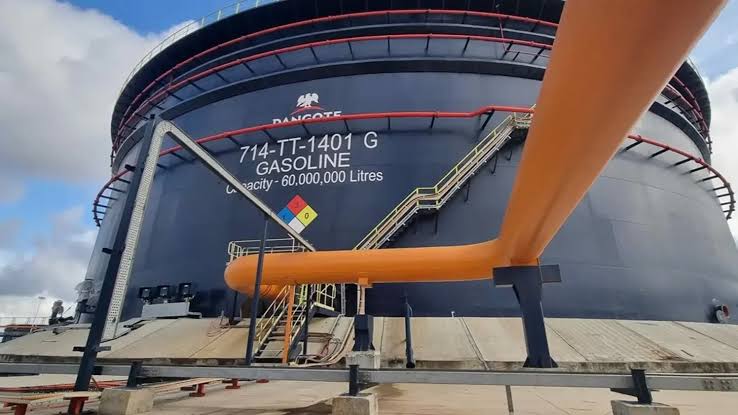
Dangote Refinery’s decision to absorb petrol delivery costs is potentially more important than the word “free” suggests. In Nigeria’s deregulated fuel market, where transportation costs can significantly influence what motorists pay, removing part of the logistics burden could improve efficiency—but only if the savings travel beyond marketers and reach consumers.
That is why the expansion of the initiative deserves attention not simply as a gesture by a major refinery, but as a test of whether competition and lower distribution costs can produce a measurable benefit at the pump.
The Independent Petroleum Marketers Association of Nigeria has welcomed the reported expansion of Dangote Petroleum Refinery’s free petrol-delivery programme to Imo, Anambra and other states.
IPMAN National Publicity Secretary and Public Relations Officer Chinedu Ukadike said the initiative could ease the financial pressure on independent marketers, particularly the cost of paying for petrol in advance and waiting for products to be loaded.
He also argued that receiving products closer to their areas of operation could reduce transportation risks and logistics costs.
Dangote's 2026 free-delivery programme was initially reported to cover Lagos, Ogun, Rivers, Kaduna, Delta and the Federal Capital Territory, with qualifying bulk buyers required to meet a minimum purchase threshold. Later reports said the programme had expanded to additional locations, including Imo and Anambra.
The key clarification is that “free petrol delivery” does not mean free petrol. The arrangement concerns transportation costs for qualifying bulk purchases.
Nigeria's fuel debate often focuses on the price coming out of a refinery or the price displayed at a filling station. But between those two points lies an expensive distribution chain.
Petrol has to be transported, stored and moved through different parts of the country. The farther a product travels, the more opportunities there are for transportation expenses and operational risks to affect its final price.
Dangote's approach addresses one part of that equation.
If marketers no longer have to shoulder certain delivery costs on eligible purchases, their working capital can potentially be released more quickly. That is particularly relevant to independent marketers, who may have less financial flexibility than larger downstream operators.
Ukadike's argument that marketers' money will not remain tied up for days or weeks therefore speaks to more than convenience. It touches on cash flow, inventory movement and the cost structure of a highly competitive downstream market.
But there is an important limitation.
Advertisement
A saving for a marketer is not automatically a saving for a motorist.
For consumers to benefit fully, some portion of the lower logistics cost would need to be reflected in retail pricing. Competition between filling stations could encourage that, but the outcome cannot simply be assumed.
IPMAN's argument: lower logistics costs can benefit everyone
IPMAN sees the initiative as evidence of what competition and deregulation can achieve.
Ukadike has argued that lower distribution costs should make it easier for independent marketers to obtain products and could eventually moderate pump prices.
From that perspective, expanding the programme beyond the initial locations is logical. If delivery costs contribute to regional price differences, bringing more states into the scheme could reduce some of those disparities.
IPMAN has therefore called for further expansion, particularly into northern Nigeria, where longer transportation distances can make distribution more challenging.
The consumer perspective: the pump price is what ultimately matters
For motorists, however, the mechanics of the distribution system are secondary.
What matters is the price they pay for a litre of petrol.
A refinery can reduce delivery costs, but consumers will only feel the effect if the resulting savings are transmitted through the downstream chain.
This is where expectations should remain measured. The initiative may create conditions for lower prices, but it does not guarantee that every filling station will immediately reduce its pump price.
The difference between potential savings and realised savings is therefore central to judging the programme.
The geographic expansion could become significant if it is sustained.
Nigeria's fuel market is national in scale but not uniform in distribution. A product that leaves a refinery in one part of the country can face very different logistics requirements depending on its destination.
That makes transportation an important part of the price equation.
Extending free delivery to states such as Imo and Anambra could help reduce some of those costs for eligible marketers operating there. Extending it further north could have an even more noticeable logistical significance because of the distances involved.
There is also a broader competitive implication.
Dangote Refinery's increasing role in supplying Nigeria's domestic petroleum market means its pricing and distribution decisions can influence how other downstream operators behave. If competitors respond by improving their own distribution arrangements or adjusting prices, consumers could benefit from stronger competition.
But concentration in supply also means that market outcomes should continue to be watched carefully. Competition works best when buyers have meaningful alternatives and pricing remains transparent.
IPMAN has described the initiative as an example of the benefits of deregulation and competition.
That argument deserves consideration, but it should not be treated as proof that deregulation automatically produces cheaper fuel.
A deregulated market can create incentives for efficiency, investment and competition. It can also expose consumers more directly to changes in supply costs, exchange rates, logistics and market conditions.
The Dangote initiative is therefore best understood as a market experiment with practical consequences.
Advertisement
It removes one cost from part of the supply chain and gives marketers an opportunity to operate with less logistical pressure. The next question is whether that efficiency becomes visible in the wider market.
For independent marketers, the immediate benefit could be improved cash flow and lower distribution expenses.
For consumers, the potential benefit is lower or more stable petrol prices.
For Dangote Refinery, wider distribution could strengthen its position in Nigeria's downstream market by making its products more accessible to marketers outside its immediate geographical base.
For government, the development could also offer an indication of whether market-based competition can ease some of the pressure created by Nigeria's costly fuel distribution system.
But the ultimate measure will not be the number of states covered by the programme.
It will be what happens to the price Nigerians actually pay.
Dangote's free petrol-delivery programme is worth watching because it addresses a less visible part of Nigeria's fuel problem: the cost of getting petrol from supplier to consumer.
The expansion to Imo, Anambra and other locations could make the initiative more meaningful, while IPMAN's call for wider northern coverage shows that marketers see room for further gains.
Ultimately, though, the market will judge the programme by its results. If lower delivery costs produce stronger competition and eventually lower prices at filling stations, the initiative will have demonstrated the practical value of efficiency in a deregulated market. If the savings largely remain within the supply chain, motorists may reasonably ask what “free delivery” has changed for them.
The real test, as always, is at the pump.
You must log in to comment or reply.
Comments