
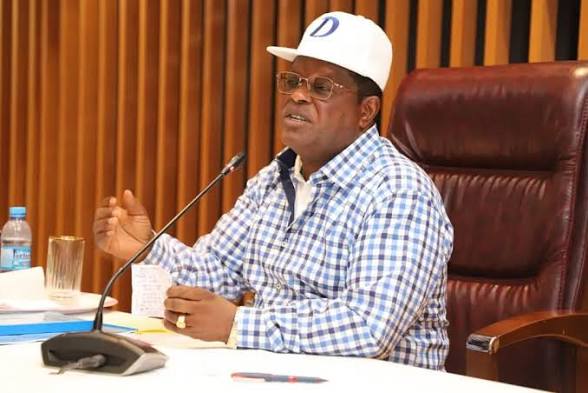
Political disagreements are an expected feature of democracy, but the language leaders choose often shapes public perception as much as the policies they defend. The latest exchange between Works Minister David Umahi and Labour Party figure Peter Obi is less about a single statement than it is about the increasingly combative tone that is beginning to define Nigeria's road to the 2027 general election.
Minister of Works David Umahi has dismissed suggestions that anyone wants former Anambra State governor Peter Obi dead, describing such claims as unreasonable and attributing them to what he called Obi's political frustration.
Speaking on Friday during an inspection of President Bola Tinubu's infrastructure projects in Ebonyi State, Umahi argued that the administration's visible development projects in the South-East have weakened Obi's political appeal in the region.
He also warned that if Obi continued criticising President Tinubu, he would publicly respond.
"Nobody wants Obi dead. We all want him alive to contest this election and watch himself lose again," Umahi said.
The minister further maintained that President Tinubu's infrastructure investments have brought unprecedented federal attention to the South-East and urged the region to support the President through the end of his expected tenure.
Advertisement
Umahi's remarks illustrate how infrastructure has become one of the ruling administration's strongest political arguments ahead of future elections.
Rather than limiting his comments to road construction or federal projects, the minister linked development directly to political loyalty, suggesting that visible infrastructure should influence electoral choices in the South-East.
That argument reflects a broader strategy by the All Progressives Congress (APC), which increasingly presents completed projects as evidence of national inclusion and effective governance.
At the same time, Peter Obi has continued to frame national debates around accountability, economic management and governance standards. The clash therefore represents two competing political narratives: one centred on physical infrastructure and federal investment, the other on broader institutional and economic reforms.
As Nigeria gradually moves toward another election cycle, these contrasting messages are likely to become even more pronounced.
From the government's perspective, Umahi argues that President Tinubu has addressed long-standing complaints about federal infrastructure in the South-East. Roads, bridges and other capital projects are presented as tangible evidence that the region is receiving greater attention than under previous administrations.
Supporters of this view contend that development should outweigh partisan politics and that federal investment deserves public recognition regardless of political affiliation.
However, supporters of Peter Obi and many opposition voices see the debate differently. They argue that infrastructure, while important, represents only one measure of governance. Issues such as inflation, unemployment, insecurity, cost of living and institutional accountability remain central concerns for many Nigerians.
The disagreement therefore extends beyond personalities. It reflects different definitions of what voters should prioritise when evaluating political leadership.
The exchange also highlights the increasingly personalised nature of Nigerian political discourse.
Advertisement
As prominent political figures respond directly to one another, policy discussions can risk being overshadowed by rhetoric. While vigorous debate is healthy in a democracy, sustained personal exchanges may deepen political polarisation rather than encourage constructive engagement.
For the South-East, the discussion carries additional significance. The region has long demanded greater federal investment, and ongoing infrastructure projects are likely to remain central to political campaigns over the coming years.
Nationally, the conversation underscores how governance achievements and public expectations will continue to compete for attention. Voters may ultimately judge leaders not only by projects delivered but also by broader economic conditions, security and institutional performance.
Ultimately, the latest remarks from David Umahi and Peter Obi reveal that Nigeria's political contest is already shifting from campaign preparation to narrative building. Infrastructure, economic management and political credibility are becoming intertwined in the battle for public opinion. What happens next will depend less on who delivers the sharpest political response and more on whether competing visions can persuade Nigerians facing everyday economic and security challenges.
You must log in to comment or reply.
Comments