
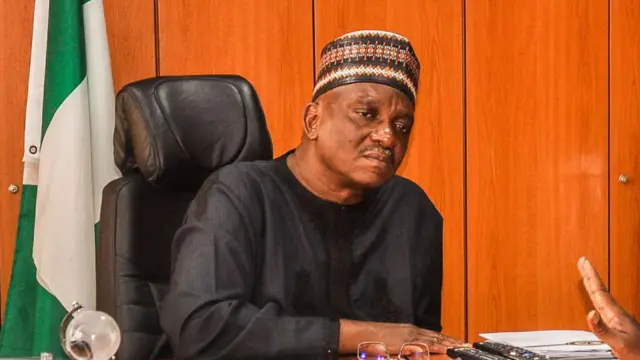
The arrest of former Minister of Power, Saleh Mamman, marks a critical enforcement phase in one of Nigeria’s most high-profile corruption cases in the energy sector. Coming shortly after his conviction for alleged misappropriation of ₦33.8 billion, the development raises renewed questions about accountability in public infrastructure spending.
Beyond the courtroom verdict, the latest EFCC operation signals a wider crackdown on high-level financial crimes linked to past government projects.
The Economic and Financial Crimes Commission (EFCC) has arrested former Minister of Power, Saleh Mamman, in Kaduna State.
According to EFCC Chairman Ola Olukoyede, the arrest took place around 3:30 am on Tuesday, during an early-morning operation. Mamman was reportedly taken into custody alongside two individuals said to have been providing him protection at the time.
Advertisement
Olukoyede further disclosed that the location where Mamman was arrested is now under investigation as authorities attempt to establish possible links or concealment activities surrounding the convicted former minister.
This arrest comes shortly after Mamman was convicted by the Federal High Court in Abuja for financial misappropriation tied to power sector projects valued at approximately ₦33.8 billion, one of the most significant corruption cases involving a former cabinet official in recent years.
Beyond the arrest itself, the case reflects a deeper structural challenge in Nigeria’s governance and justice enforcement system—how long it takes for conviction to translate into physical custody and sentence execution.
What makes this development significant is not just the arrest of a former minister, but the timing: it comes after a high-value corruption conviction involving critical national infrastructure spending in the power sector, an area that has historically absorbed trillions of naira with limited measurable output.
Nigeria’s power sector reforms have repeatedly faced setbacks due to financial leakages, policy inconsistency, and project mismanagement. Cases like this reinforce public concerns about whether recovered accountability is becoming systematic or remains episodic.
Historically, similar high-profile corruption convictions in Nigeria have often faced delays in enforcement. In several cases over the past decade, convicted officials either remained at large for extended periods or engaged in prolonged legal appeals before serving sentences.
What stands out here is the EFCC’s rapid follow-through after conviction—suggesting a possible shift toward stricter enforcement under current anti-graft leadership.
Yet the broader question remains: will high-profile arrests translate into sustained institutional deterrence, or remain isolated enforcement victories?
Advertisement
Nigeria’s anti-corruption drive has produced several landmark convictions in recent years, particularly in infrastructure-linked ministries. However, enforcement delays remain a recurring concern in governance assessments.
The power sector alone has historically absorbed trillions of naira over the past two decades, yet still struggles with unstable electricity supply, highlighting a persistent gap between investment and output efficiency.
This case adds to a growing dataset of corruption-related prosecutions in Nigeria’s public sector, where conviction rates are increasing but post-judgment enforcement remains uneven.
You must log in to comment or reply.
Comments