
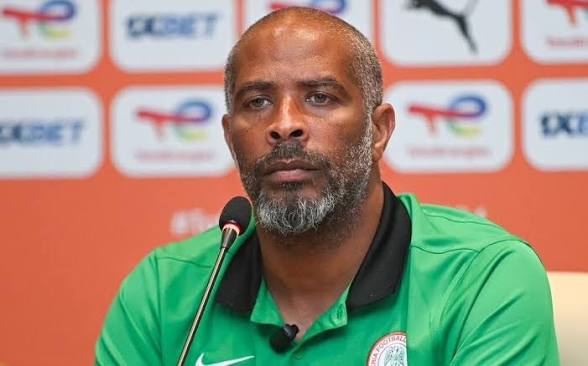
Success in international football depends not only on the senior national team but also on how effectively a country develops its next generation of players. Nigeria's decision to entrust Eric Chelle with both the Super Eagles and the Olympic Eagles suggests a commitment to continuity and long-term planning, while also increasing expectations for the coach.
The Chairman of the National Sports Commission, Shehu Dikko, confirmed on Tuesday that Eric Chelle will remain in charge of the Super Eagles under a new contract agreement.
Speaking after a meeting between the National Sports Commission and the Nigeria Football Federation in Abuja, Dikko said both parties had agreed on improved terms covering remuneration, support for his assistants, and new performance targets.
In addition to leading the Super Eagles, Chelle has also been handed responsibility for Nigeria's Under-23 side, the Olympic Eagles, as preparations begin for the men's football tournament at the Los Angeles 2028 Olympic Games.
The Franco-Malian coach's previous contract was due to expire at the end of 2026, and reports in recent months indicated he had requested a package worth around $130,000 per month, including payments for his technical crew.
Assigning both the senior and Under-23 teams to one coach reflects a growing belief that Nigeria's football challenges require long-term planning rather than frequent coaching changes.
Advertisement
For years, Nigerian football has struggled with the transition from youth teams to the senior national side. Talented players often emerge through age-grade competitions but fail to integrate smoothly into the Super Eagles setup. By giving Chelle oversight of both squads, football authorities appear to be pursuing a more unified development system.
Several successful football nations maintain consistent philosophies across different age groups, allowing players to progress through familiar tactical structures. If properly implemented, Nigeria could benefit from a stronger and more stable talent pipeline.
However, the strategy carries risks. Managing both teams means Chelle's performance will be assessed on multiple fronts. Success with the Super Eagles alone may not be enough if the Olympic Eagles continue to struggle.
Officials argue that many young players entering the senior team still fall within the Under-23 age bracket, making a unified technical structure a logical approach.
Supporters believe the move could finally address the lack of continuity that has affected Nigeria's national teams for years.
Critics, however, question whether expanding Chelle's responsibilities is wise at a time when expectations surrounding the Super Eagles remain high. Maintaining momentum will require significant focus and resources.
Questions also remain over whether Nigeria's football structure can provide the support needed for one coaching team to manage both responsibilities effectively.
The debate centres on two competing ideas: whether continuity creates stability or whether additional responsibilities could stretch the coaching staff too thin.
The appointment comes at an important moment for Nigerian football.
The Olympic Eagles have failed to qualify for the last two men's football tournaments at the Olympics, missing both Tokyo 2020 and Paris 2024. Returning to the Olympics would help restore Nigeria's reputation as one of Africa's leading producers of football talent.
Advertisement
For the Super Eagles, the stakes are equally significant. Football authorities appear determined to build a sustainable system rather than rely on short-term solutions.
The improved contract also signals a greater willingness to invest in technical leadership. However, increased investment inevitably brings greater scrutiny and higher expectations.
For supporters across Nigeria and the diaspora, the true measure of success will not be the contract announcement itself but whether it leads to consistent performances on the pitch.
Ultimately, the key question is whether Nigeria has embraced a long-term football vision or simply placed greater responsibility on one coach in the hope that continuity alone can solve deeper structural problems.
What happens next could shape both Eric Chelle's legacy and the future direction of Nigerian football.
You must log in to comment or reply.
Comments