
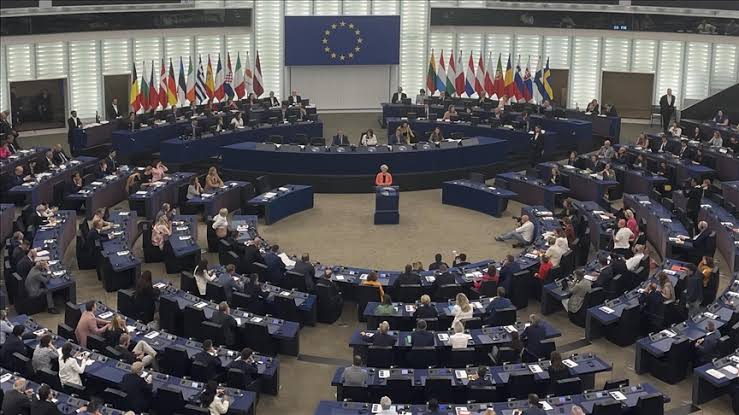
Growing international concern over insecurity in Nigeria has reached a new level after the European Parliament adopted a resolution urging the Federal Government to strengthen civilian protection and hold perpetrators of violent attacks accountable. The move follows renewed attention on deadly attacks in Plateau State and places Nigeria's security response under increased global scrutiny.
The European Parliament has called on the Nigerian government to take stronger action against worsening insecurity, particularly in the country's Middle Belt, following renewed violence that has claimed dozens of lives.
Lawmakers overwhelmingly backed a resolution condemning attacks on vulnerable communities and urging Nigerian authorities to improve security operations, strengthen civilian protection, and ensure those responsible for the violence face justice. The resolution also called for independent investigations into attacks and greater efforts to dismantle terrorist groups operating across the country, including Boko Haram and the Islamic State West Africa Province (ISWAP).
Particular attention was given to the June attack on Kawel village in Bokkos Local Government Area of Plateau State, where more than 20 Christians, including a pastor, were reportedly killed during an overnight assault by armed attackers.
During parliamentary discussions, Slovak Member of the European Parliament Miriam Lexmann described the killings as another tragic reminder of escalating violence affecting Christian communities in parts of Nigeria. She argued that repeated attacks demonstrate the urgent need for stronger protection of civilians and more effective accountability mechanisms.
The resolution also encouraged Nigeria to improve early-warning systems, expand conflict-prevention initiatives, and strengthen security coordination in vulnerable regions.
Advertisement
Coverage of the parliamentary resolution varied across news organisations.
Daily Post focused primarily on the European Parliament's condemnation of attacks on Christian communities and highlighted the overwhelming legislative support behind the resolution.
Official European Parliament documents, however, present the issue within a broader security and human rights framework. While acknowledging attacks on Christians in Plateau State, the parliamentary motion also addresses terrorism, communal violence, civilian protection, accountability, and the need for institutional reforms rather than portraying the crisis solely through a religious lens.
Other international reporting has generally emphasised Nigeria's complex security environment, noting that violence in the Middle Belt often involves overlapping factors including farmer-herder conflicts, criminal banditry, insurgency, ethnic tensions, and competition over land and resources. Analysts caution that reducing every incident to a single cause risks overlooking the broader drivers of insecurity that continue to challenge security agencies.
The European Parliament's intervention comes as Nigeria continues to battle multiple security crises simultaneously.
Beyond the Boko Haram insurgency in the North-East, authorities face persistent bandit attacks in the North-West, recurring communal violence across the Middle Belt, kidnapping-for-ransom operations, and separatist-related insecurity in parts of the South-East. These overlapping threats continue to stretch military and law enforcement resources.
Plateau State has remained one of Nigeria's most volatile flashpoints for years. Repeated cycles of violence have displaced thousands of residents, disrupted farming activities, weakened local economies, and deepened mistrust between communities.
International attention such as the European Parliament's resolution may increase diplomatic pressure on Nigeria to demonstrate measurable improvements in civilian protection and accountability. While such resolutions are generally non-binding, they often influence international discussions on human rights, foreign partnerships, development assistance, and security cooperation.
For Nigeria, the challenge extends beyond responding to individual attacks. Security experts have consistently argued that lasting stability will depend on combining military operations with intelligence gathering, justice reforms, community dialogue, economic development, and effective early-warning systems capable of preventing violence before it escalates.
Nigeria has faced persistent security challenges for more than a decade.
Advertisement
Boko Haram's insurgency has resulted in tens of thousands of deaths and displaced millions across the Lake Chad region. Meanwhile, attacks linked to armed groups, communal conflicts, and criminal networks have increasingly spread into other parts of the country, including Plateau, Benue, Kaduna, Niger, and Zamfara states.
The Middle Belt has experienced repeated episodes of violence involving farming communities, herders, criminal gangs, and armed militias. Human rights organisations have repeatedly called for impartial investigations into attacks regardless of the victims' ethnic or religious identities, arguing that ending impunity remains essential to reducing future violence.
The European Parliament's latest resolution reflects growing international concern over both the humanitarian consequences of the attacks and Nigeria's broader security challenges.
The resolution itself does not impose legal obligations on Nigeria, but it adds international weight to calls for stronger security reforms and greater accountability. Whether the Federal Government translates these recommendations into more effective protection for vulnerable communities could shape both domestic confidence and Nigeria's standing among its international partners as insecurity continues to test the country's institutions.
You must log in to comment or reply.
Comments