
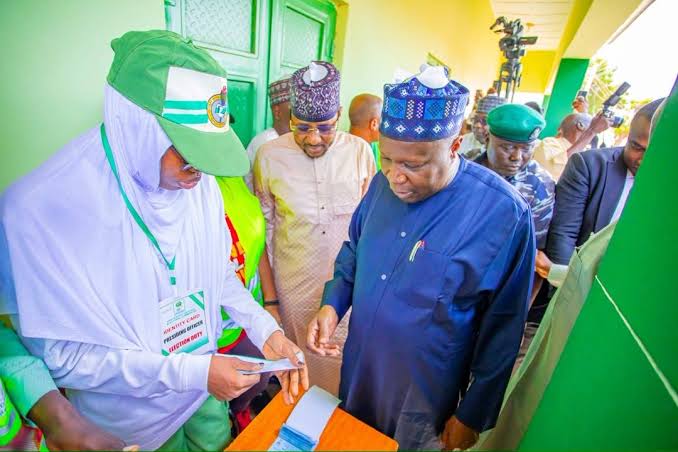
The Gombe/Kwami/Funakaye Federal Constituency bye-election is underway across three local government areas in Gombe State, with voters choosing a new representative for the House of Representatives seat left vacant after the death of former lawmaker Yaya Bauchi Tongo in June 2026.
The Independent National Electoral Commission (INEC) scheduled the election for September 19, 2026, covering 903 polling units, 31 Registration Areas and 495,851 registered voters across Gombe, Kwami and Funakaye.
Early reports from the polling units describe the process as largely peaceful, but they also point to an important contradiction in the day's assessments: while Governor Inuwa Yahaya and some officials and voters described the process positively, reports from some parts of Gombe metropolis recorded relatively low voter turnout.
That makes the central issue bigger than whether voting began without major disruption. The eventual question is whether the election will produce broad participation and a result that accurately reflects the votes cast across the entire constituency.
What the evidence shows
INEC announced the September 19 date in August following the vacancy created by Tongo's death. The commission said the election would be conducted under the constitutional and Electoral Act provisions governing bye-elections.
The scale of the constituency is significant. The election covers three LGAs, 31 Registration Areas and 903 polling units, with nearly half a million registered voters.
Ahead of election day, INEC also distributed sensitive electoral materials to the three LGAs. The exercise was conducted at the Central Bank of Nigeria premises in Gombe in the presence of political party agents, security personnel, election-security committee members, CBN officials and journalists. The Resident Electoral Commissioner, Umar Muktar Gajiram, said the materials were then sent to the relevant LGAs for deployment to polling units.
This provides evidence that one of the key logistical stages had been completed before voting began.
Reports from polling units on Saturday also indicated that INEC personnel and election materials arrived at a number of locations without the type of widespread delay that can disrupt the opening of polls. One contemporaneous report said voting began in some locations shortly after officials arrived around 8 a.m.
However, this should not be confused with evidence that every polling unit across the constituency experienced identical conditions.
The clearest unresolved issue from the early voting reports is participation.
A report monitoring polling units in Gombe metropolis observed relatively few voters at some locations during the morning. Low turnout was particularly noted around parts of Gombe Local Government Area.
Another report found that voters began appearing in larger numbers at some polling centres later in the morning. This indicates that observations from individual polling units at a particular time cannot necessarily be used to establish the final turnout for the entire constituency.
Advertisement
Governor Inuwa offered a different assessment after casting his ballot, describing the turnout as good and saying he was satisfied with the organisation of the exercise. His comments are important as the assessment of a participant in the election, but they are not a final turnout figure.
The distinction matters because actual turnout can only be established from official election data after voting and collation are completed.
At the time of these reports, therefore, there was evidence of voting and generally peaceful conditions at locations observed, but no final constituency-wide turnout figure.
The bye-election was triggered by the death of Yaya Bauchi Tongo, who represented the constituency in the House of Representatives.
INEC subsequently scheduled the poll to fill the vacant seat. The commission's timetable placed the election on September 19 after political parties conducted their nomination processes and campaigning ended before election day.
The vacancy means that voters in Gombe, Kwami and Funakaye are not simply participating in another election cycle; they are selecting a replacement for a currently vacant federal legislative seat.
That representative will have a role in the House of Representatives on matters affecting federal legislation, constituency representation and oversight.
Security has been another significant part of the election preparations.
Before voting, INEC's Gombe Resident Electoral Commissioner warned that the size of the constituency required careful coordination among security agencies. He specifically said electoral officials, materials, polling units and collation locations required protection.
The REC also stressed that security personnel should remain professional and impartial and should protect the electoral process rather than any political party or candidate.
The warning is relevant because an election is not considered secure merely because voting begins peacefully. Materials must also move safely, voters must be able to reach polling units, officials must perform their duties without intimidation and results must pass through the collation process without disruption.
So far, reports from monitored polling units have described the voting process as largely peaceful. An INEC National Commissioner overseeing the North-East also described the exercise as peaceful while monitoring voting in Gombe metropolis.
That is evidence about the process observed during the voting period, not a final assessment of the entire election.
Governor Inuwa Yahaya said after voting that he was satisfied with the process and expressed confidence in his party's prospects.
APC candidate Kallamu Usman Maijama'a also praised INEC's conduct and said the process gave him confidence about preparations for the 2027 general elections.
His assessment, like the governor's, is a political participant's view rather than an independent measure of the quality or outcome of the election. Punch reported that Kallamu also expressed confidence that he would win. That statement should be understood as a candidate's expectation, not evidence of the eventual result.
Other reporting has also documented the participation of candidates from several parties, including APP, APC, APM and NNPP. Earlier reports identified five parties in the contest, while reports following the release of the final candidate list identified four candidates. Because of these differing published accounts, Superior News should avoid stating a definitive candidate count without relying on the final INEC document itself.
The immediate consequence of the election is straightforward: the constituency will gain a new representative in the House of Representatives.
But the poll is also taking place months before Nigeria's 2027 general elections, making the conduct of the bye-election relevant to broader discussions about election administration, voter participation and security.
That does not mean the result can automatically be used to predict the 2027 elections. A bye-election involves a different electorate, candidates, political environment and turnout level.
What can be examined, however, is the practical performance of the electoral system: whether materials reach polling units, whether officials arrive on time, whether voters can cast ballots without intimidation, whether security agencies remain neutral and whether the results are properly collated.
These are measurable aspects of an election and provide more useful evidence than political predictions about what one bye-election might mean for 2027.
Several important questions cannot yet be answered from the information available during the voting period.
First, what was the final voter turnout?
Reports observed low participation at some polling units, while other locations recorded stronger turnout later in the day. Only official figures can establish the constituency-wide participation rate.
Second, were there problems outside the monitored polling units?
Advertisement
Reports from selected locations cannot establish that every one of the 903 polling units experienced identical conditions.
Third, what will the final results show?
Candidates' statements of confidence do not establish the winner. The result must come from the official collation and declaration process.
Fourth, were there any significant incidents during the later stages of voting and collation?
The available reports primarily describe the situation while voting was underway. A complete assessment requires information from the close of polls through counting, collation and declaration.
The immediate next stage is the counting and collation of votes after polling closes.
The decisive information will therefore come from the official results rather than statements made by candidates or political supporters during voting.
INEC's election information platform provides official election updates and results as they are released.
Until the commission completes the relevant process, claims of victory by individual candidates remain claims rather than established results.
The Gombe/Kwami/Funakaye bye-election has so far produced two different pictures: reports of generally orderly voting at monitored locations and concerns about uneven voter participation in some areas.
Both observations can exist at the same time.
The more important test will be what the complete record shows after voting ends: how many registered voters actually participated, whether the process remained peaceful through collation, and whether the final result accurately reflects the ballots cast across the constituency.
Those are the questions that cannot be answered by early impressions alone.
You must log in to comment or reply.
Comments