
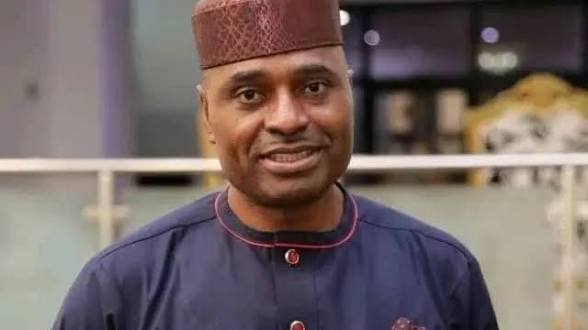
Political arguments often become clearer when former allies begin asking the questions they once answered for others. Kenneth Okonkwo’s decision to revise his previous defence of Peter Obi’s record as Anambra governor does not, by itself, settle the state’s debt dispute, but it has added a new dimension to an argument that is increasingly becoming part of Nigeria’s 2027 political contest.
The important issue is therefore not simply that Okonkwo changed his position. It is whether the competing financial claims about Anambra can withstand detailed examination of the underlying records.
Kenneth Okonkwo, a chieftain of the African Democratic Congress and former spokesman for Peter Obi during the 2023 presidential campaign, said on Sunday that he was previously “misled” when defending Obi against allegations that his administration left debts and other financial obligations in Anambra State.
Okonkwo made the remarks during TVC’s Sunday Politics. He recalled telling Nigerians during the 2023 presidential campaign that Obi had left office without outstanding debt, salaries, pensions or gratuities.
He said he could no longer make the same assertion after subsequent disclosures by the Anambra State Government.
According to Okonkwo, the state government said Obi's administration was associated with eight loans and that workers at the state-owned water corporation were owed salaries and arrears. He said his position would change when new information altered the factual picture.
Okonkwo is now associated with the ADC presidential campaign of former Vice-President Atiku Abubakar for the 2027 election. He described his role in relation to Obi differently from 2023, saying he had previously acted as an “examination in chief” but would approach the 2027 contest as a “cross-examination.”
His remarks come as Obi and the Anambra State Government continue to disagree over the state's financial obligations connected with projects undertaken during his tenure as governor from 2006 to 2014.
The debt question is more complicated than a headline figure
The central disagreement concerns eight external financing facilities linked to projects undertaken during Obi's tenure.
The Anambra State Government says the facilities had a combined contracted value of approximately $123.77 million, with about $92.35 million outstanding as of June 30, 2026. The government has associated the facilities with development projects covering areas including education, healthcare, agriculture, erosion management and community development.
But describing the entire $123.77 million as money “left by Peter Obi” is precisely where the dispute becomes more complicated.
Advertisement
Obi has argued that the figures combine different stages of development financing — including amounts approved, amounts that became effective, funds actually drawn and balances outstanding at different points in time.
He has also argued that many of the facilities were World Bank and International Fund for Agricultural Development programmes negotiated by the Federal Government and accessed by participating states through subsidiary arrangements. His position is that each facility should therefore be examined separately rather than treating the total contracted value as the debt he personally left behind.
There is another important piece of context. During an earlier discussion of the controversy, an Anambra government official acknowledged that the state did not yet know precisely how much of the $123.77 million had actually been drawn down by the Obi administration and said the figures would need to be reconciled.
That distinction matters.
A facility's original value, the amount actually disbursed, the amount outstanding when a governor leaves office and the amount still being repaid years later are not necessarily the same number.
The Anambra State Government's position is that eight external financing arrangements associated with projects during Obi's administration remain part of the state's financial obligations. Its published figures put the original contracted value at $123.77 million and the balance outstanding in June 2026 at $92.35 million.
The Obi camp's position is different. Obi has cited Debt Management Office figures showing Anambra's external debt at roughly $18 million when he assumed office in 2006 and approximately $30 million when he left in March 2014. He has questioned how the state could therefore characterise $123.77 million as debt inherited from his administration without distinguishing the various stages of the financing arrangements.
Obi has also maintained that he left office without unpaid salaries, pensions, gratuities or certified obligations to contractors and suppliers. Separately, he has said his administration left substantial financial investments for the state. Those claims remain part of the broader dispute and should be checked against the relevant government and financial records rather than treated as settled facts.
The competing narratives therefore do not necessarily answer the same question.
The state's argument focuses on financing facilities and continuing repayment obligations. Obi's argument focuses heavily on what was actually borrowed, drawn down and outstanding at the point he handed over power.
That distinction is at the heart of the controversy.
Okonkwo's intervention matters politically because he is not simply an outside commentator. He previously defended Obi during the 2023 presidential election and is now operating within a political coalition that will scrutinise Obi and other political figures ahead of 2027.
His admission that he previously relied on information he now considers inadequate illustrates one of the difficulties of political campaigning: claims made during elections can survive long after the evidence behind them has become more complicated.
But his change of position should not be confused with independent verification of every allegation made by the Anambra government.
Okonkwo himself referred to what the state government had said. That makes his statement politically significant, but the underlying financial questions still require documentary examination.
For voters, the more useful question is therefore not simply whether Okonkwo has changed sides. It is whether the accounting records can establish exactly what was approved, what was disbursed, what was outstanding in March 2014 and what remains outstanding today.
This dispute is likely to have significance beyond Anambra because questions about state borrowing, fiscal responsibility and the credibility of political records are likely to feature prominently in Nigeria's 2027 campaign.
Political opponents can use historical financial records to challenge a candidate's claims about governance. Former allies can also become important sources of scrutiny when political alignments change.
At the same time, the episode demonstrates why voters need to distinguish between a political claim about debt and a verified accounting position.
The difference is particularly important when dollar figures from different years are converted into naira, or when the original value of a development facility is presented alongside its later outstanding balance. Without identifying the date, accounting category and actual drawdown, a large number can create an impression that may not accurately describe the financial position at the time a governor left office.
The controversy also raises a broader governance question: how easily can citizens obtain complete, comprehensible records of state borrowing and inherited liabilities?
If public financial information is sufficiently transparent, disputes over historical debt should ultimately be settled by documents rather than political loyalty.
Advertisement
The next stage of this controversy is likely to depend less on political declarations and more on the underlying records.
A facility-by-facility reconciliation could show the original approval, effective amount, actual drawdown, repayment history and balance at the March 2014 handover. It could also clarify which obligations were directly attributable to the state, which involved federal government arrangements and what portion remained outstanding at each stage.
Such an examination would give Nigerians a clearer basis for assessing the competing accounts.
Okonkwo's political repositioning has certainly given the story fresh attention. But the larger test remains financial rather than rhetorical.
Ultimately, the Anambra debt controversy is bigger than one former spokesman changing his position.
It is a test of whether Nigeria's political debate can move from competing claims to verifiable records.
Okonkwo has changed his argument because he says new information changed his understanding. Obi maintains that the figures being used against his administration do not accurately describe the debt he left behind. The Anambra government maintains that the financing facilities remain legitimate obligations connected with projects undertaken during that period.
Those positions cannot all be resolved by political speeches.
The real issue may therefore be much simpler: what did Anambra owe on March 17, 2014, what had actually been drawn from the relevant facilities by then, and what liabilities did the state inherit?
The records should answer those questions. And as the 2027 election approaches, the credibility of the answer may matter more than the political allegiance of the person making the argument.
You must log in to comment or reply.
Comments