
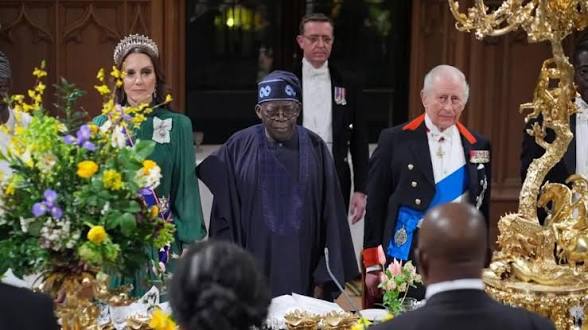
A state banquet at Windsor Castle turned into an unexpected moment of cultural diplomacy on Wednesday night when Britain’s monarch publicly celebrated Nigeria’s global influence — and even closed his speech with a popular Nigerian Pidgin phrase.
The event, hosted by King Charles III in honour of Bola Ahmed Tinubu during the Nigerian president’s state visit to the United Kingdom, underscored both the warmth and the complexity of modern UK–Nigeria relations.
Speaking at the banquet in Windsor Castle, the British monarch highlighted Nigeria’s expanding cultural, economic and diplomatic presence in the United Kingdom.
He pointed to the influence of Nigerian creativity across British society — from Afrobeats music dominating concert venues to Nollywood productions reaching international audiences.
The King also referenced Nigeria’s growing imprint in British institutions, including law, business and sport. Nigerian-heritage athletes competing in England’s top leagues and professionals working across sectors, he said, demonstrate how deeply the two nations have become intertwined.
The speech ended with an unexpected flourish when the monarch declared: “Naija no dey carry last,” drawing laughter and applause from guests at the banquet.
Advertisement
The phrase — widely used in Nigerian Pidgin to express resilience and pride — appeared to resonate with the large Nigerian diaspora present at the event.
President Tinubu’s remarks reflected a similar theme of shared human connections between the two countries.
During his address, he referenced prominent athletes of Nigerian heritage who represent Britain on the global stage, including footballers Bukayo Saka and Eberechi Eze as well as world heavyweight boxing champion Anthony Joshua.
The Nigerian leader used these examples to illustrate the depth of the relationship between the UK and Nigeria, noting that Nigerian professionals also play a significant role within Britain’s National Health Service and other sectors.
“Our partnership is strengthened by the people who connect our two nations every day,” Tinubu said, pointing to the contributions of Nigerian doctors, nurses and entrepreneurs living in Britain.
Beyond symbolism, the speeches highlighted a strengthening economic relationship between both countries.
Recent trade data shows Nigeria emerging as the United Kingdom’s largest export market in Africa, while tourism and business exchanges between the two nations continue to expand.
British officials have also increased investment discussions in sectors such as technology, finance and infrastructure, areas where Nigeria’s rapidly growing population and startup ecosystem are drawing attention from global investors.
Yet the banquet speeches also acknowledged the historical weight behind the relationship. The British monarch referenced the colonial past shared by both nations, describing it as a legacy that cannot simply be erased but must inform future cooperation.
What stood out in both speeches was the emphasis on the Nigerian diaspora.
More than half a million people of Nigerian heritage now live in the United Kingdom, making them one of the most dynamic migrant communities in the country. Their influence spans healthcare, academia, finance, entertainment and politics.
Advertisement
In practical terms, that diaspora is becoming one of the strongest diplomatic bridges between the two nations — shaping trade, culture and public perception far beyond official government policy.
The symbolic gestures at Windsor therefore carried broader meaning: they were not merely ceremonial remarks, but an acknowledgment of how Nigeria’s global influence is increasingly being expressed through its people abroad.
The state visit is expected to focus heavily on strengthening trade cooperation, security collaboration and technology partnerships between both countries.
However, the real measure of progress will likely depend on whether these diplomatic exchanges translate into tangible economic opportunities and policy alignment in the coming years.
With Nigeria positioning itself as a major African economic player and Britain seeking deeper engagement with Commonwealth partners after Brexit, both governments appear eager to redefine their relationship for a new era.
You must log in to comment or reply.
Comments