
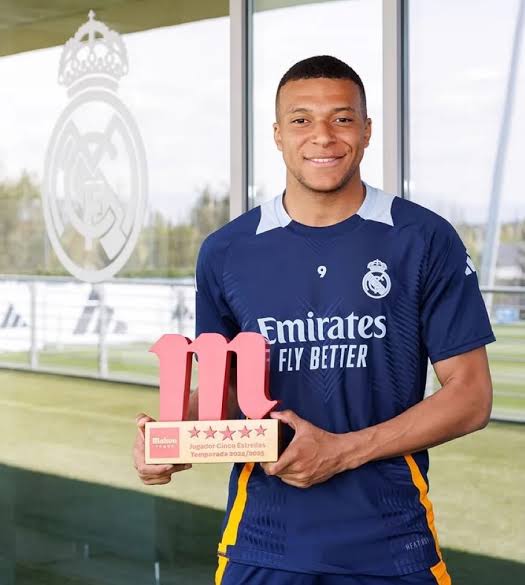
Real Madrid’s 2025/26 season has been increasingly defined by one consistent force in front of goal — Kylian Mbappé.
His latest recognition as the club’s Mahou Five Star Player of the Season reflects not only individual brilliance but also how quickly he has reshaped Madrid’s attacking identity.
On Tuesday, Real Madrid confirmed that Kylian Mbappé has been named the club’s Mahou Five Star Player of the Season for the second consecutive year.
According to the club’s official statement, the French forward scored 42 goals in 44 appearances across all competitions during the 2025/26 season.
His breakdown included:
• 25 goals in LaLiga, finishing as top scorer and winning the Pichichi Trophy
Advertisement
• 15 goals in the UEFA Champions League, making him the competition’s top scorer
Since joining Real Madrid from Paris Saint-Germain in 2024, Mbappé has quickly become the focal point of the club’s attacking system, delivering elite-level consistency in both domestic and European competitions.
Beyond the award itself, Mbappé’s numbers reflect a deeper transformation at Real Madrid — a team increasingly built around vertical speed, transition play, and individual finishing efficiency.
What makes this more significant is the balance of responsibility. With 42 goals in 44 games, Mbappé is averaging nearly a goal per match, a level that places him among the most productive debut-era performers in modern Real Madrid history.
Yet this dominance also raises tactical questions:
as Madrid leans heavily on one elite finisher, the distribution of attacking output becomes narrower, increasing pressure in high-stakes matches where defensive containment strategies target key players.
From a broader European football perspective, his output mirrors a growing trend among elite clubs: reliance on a central superstar to define season outcomes, rather than evenly distributed scoring systems.
For African and global audiences following LaLiga, this also reinforces the league’s current shift post-Messi/Ronaldo era — where individual stars are again shaping narrative value and global visibility.
Historically, only a handful of players in Real Madrid’s modern era have reached similar scoring efficiency in a debut or early season phase, including Cristiano Ronaldo during his peak years.
In comparison:
• Ronaldo averaged over 50 goals in multiple peak seasons
• Karim Benzema’s best season peaked during Madrid’s Champions League-winning campaign in 2021/22
Advertisement
• Mbappé’s current trajectory places him on a similar high-efficiency scoring path within his first two seasons
This highlights a recurring Madrid pattern: elite forwards tend to peak quickly when integrated into their attacking structure.
The real challenge now is whether Mbappé’s individual dominance can translate into sustained European success for Real Madrid.
While the goals are undeniable, the coming season will determine whether the club can evolve beyond dependency on a single scoring engine or continue to build around it.
As expectations rise at the Bernabéu, Mbappé’s role is no longer just about scoring — it is about defining the identity of a new era.
You must log in to comment or reply.
Comments