
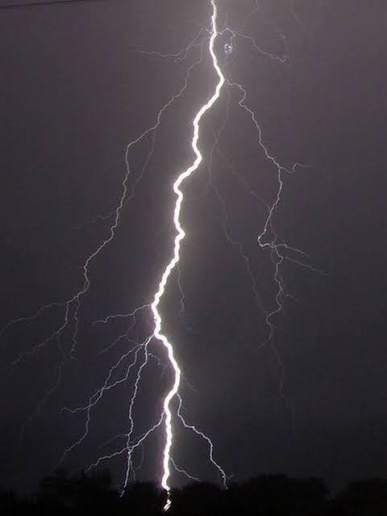
A routine day of farm work turned into tragedy in Adamawa State when a lightning strike during a heavy rainstorm claimed the lives of six children. The incident has left families in mourning and renewed concerns about the dangers rural communities face during Nigeria's rainy season, particularly where access to weather warnings and emergency response remains limited.
Authorities have confirmed that an investigation is underway as residents of Dadiri Village in Ganye Local Government Area struggle to come to terms with one of the deadliest lightning incidents reported in the area in recent years.
The tragedy occurred in Dadiri Village, Ganye Local Government Area of Adamawa State, where a group of children were working on a groundnut farm owned by Musa Maude when a lightning strike hit during a prolonged rainstorm.
According to police reports, the incident happened at about 4:00 p.m. after several hours of rainfall. The Chairman of the Civilian Joint Task Force (CJTF) in Ganye, Mallam Salau Iliya, alerted the Ganye Police Division, prompting officers led by the Divisional Police Officer to rush to the scene.
Advertisement
Police found nine children unconscious. Three later regained consciousness, while six were taken to the Cottage Hospital in Ganye, where doctors confirmed them dead.
The victims were identified as Aliyu Suleiman (10), Jafar Suleiman (8), Abdurrahman Musa (7), Bilkisu Jibrilla (10), Musa Ahmadu (9), and Auwalu Nuhu (11). Their bodies have been deposited at the hospital mortuary as police investigations continue.
Reports from Daily Post Nigeria and security analyst Zagazola Makama focused primarily on the sequence of events, the identities of the victims and the police response.
Other outlets relying on the Adamawa State Police Command placed greater emphasis on the official confirmation of the casualties and the emergency response carried out by officers after the distress call. While there were slight differences in the reported day of the incident in early reports, all accounts agreed on the core facts: six children died, three survived, and the lightning strike occurred during heavy rainfall in Ganye Local Government Area.
Most reports, however, paid little attention to the wider challenge facing farming communities during Nigeria's rainy season, where children often assist their families on farms despite the risks posed by severe weather.
The incident highlights the vulnerability of rural communities where access to real-time weather alerts is limited. In many farming areas across northern Nigeria, families depend on agriculture for survival, making it common for children to accompany adults or work on farms during planting and harvesting periods. When sudden thunderstorms develop, there are often few safe shelters nearby, increasing the risk of lightning-related casualties.
Advertisement
Nigeria experiences hundreds of thunderstorms annually, particularly between April and October, when the rainy season reaches its peak. Meteorological experts have repeatedly advised residents to avoid open fields, isolated trees and farmland during thunderstorms, but such guidance can be difficult to follow for communities whose livelihoods depend on daily farm work.
The latest tragedy also underscores the importance of improving weather awareness in rural areas. While urban centres increasingly receive weather updates through television, radio and mobile applications, many remote communities continue to rely on visual signs of changing weather, leaving little time to respond when storms intensify.
Authorities have not indicated whether additional safety measures or public awareness campaigns will follow the incident. The ongoing investigation by the Adamawa State Criminal Investigation Department is expected to establish the full circumstances surrounding the tragedy, while grieving families continue to mourn the loss of six young lives.
You must log in to comment or reply.
Comments