
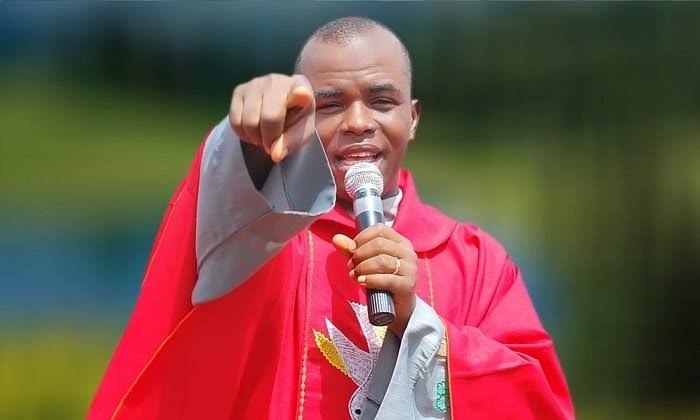
The abduction of schoolchildren in Oyo State has reignited a long-running debate over who should bear responsibility when insecurity strikes. While public attention often turns to federal authorities, Catholic cleric Rev. Fr. Ejike Mbaka has argued that state governments must also be held accountable for protecting citizens within their territories.
His intervention reflects a broader national conversation about security governance, the use of state security funds, and whether Nigeria's current structure gives governors sufficient responsibility—or sufficient scrutiny—when criminal attacks occur.
The Spiritual Director of Adoration Ministry, Enugu, Nigeria (AMEN), Rev. Fr. Ejike Mbaka, has called on Oyo State Governor Seyi Makinde to take urgent action to secure the release of schoolchildren reportedly abducted in the state.
Speaking during a sermon, Mbaka urged the governor to exhaust all available measures to ensure the victims return safely, insisting that state leaders cannot distance themselves from security failures occurring within their jurisdictions.
“The governor should do everything within his power to ensure the release of these children. Stop deceiving Nigerians by asking the President to come and find them,” Mbaka said.
In a video that circulated widely on social media, the cleric also offered prayers for the safe return of the children and called for divine intervention against those responsible for the abduction.
Advertisement
Beyond the immediate rescue effort, Mbaka questioned how state governments utilize security votes—special funds allocated to governors for security-related interventions—and argued that leaders should be able to demonstrate tangible results from such expenditures.
He further warned against turning insecurity into a political blame game, urging cooperation among leaders rather than public confrontations over responsibility.
Mbaka's remarks touch on one of Nigeria's most contentious governance debates: who is truly accountable when insecurity escalates?
Governors receive security votes running into billions of naira annually across the federation. Critics have long argued that these funds often lack transparency because spending details are rarely subjected to extensive public scrutiny.
Supporters of state governments counter that governors face significant limitations because they do not directly command federal security agencies such as the police, military, or intelligence services, despite being referred to as the "chief security officers" of their states.
This contradiction has fueled repeated calls for policing reforms and greater decentralization of security management.
The issue becomes even more urgent when schoolchildren are targeted. Attacks on educational institutions have repeatedly generated national outrage because they affect some of the country's most vulnerable citizens and can disrupt learning for thousands of students.
Nigeria has witnessed several high-profile school abductions over the past decade, beginning with the 2014 Chibok schoolgirls kidnapping that attracted international attention.
Subsequent incidents in states including Kaduna, Niger, Katsina, Zamfara, and Kebbi exposed the growing vulnerability of schools, particularly in rural communities.
The federal government launched various initiatives, including the Safe Schools Programme, aimed at strengthening security around educational institutions. Despite these efforts, concerns remain about implementation gaps, funding challenges, and the ability of authorities to respond rapidly when attacks occur.
Security experts have repeatedly warned that attacks on schools carry consequences beyond immediate ransom demands. Such incidents can reduce school attendance, deepen educational inequality, increase parental fears, and undermine confidence in government institutions.
Advertisement
For states already struggling with poverty and educational deficits, prolonged insecurity around schools can create long-term social and economic consequences.
The immediate priority remains the safe recovery of the abducted children and the identification of those responsible for the attack.
However, Mbaka's comments have once again highlighted broader questions about leadership accountability, security funding, and the effectiveness of Nigeria's current approach to tackling violent crime.
As public pressure mounts, the focus is likely to shift from political exchanges to measurable outcomes. Families, communities, and education advocates will be watching closely to see whether authorities can secure the children's release and prevent similar incidents from occurring in the future.
The real test may not be the rhetoric surrounding the crisis but whether governments at every level can demonstrate that schools remain safe places for learning rather than recurring targets for criminal groups.
You must log in to comment or reply.
Comments