
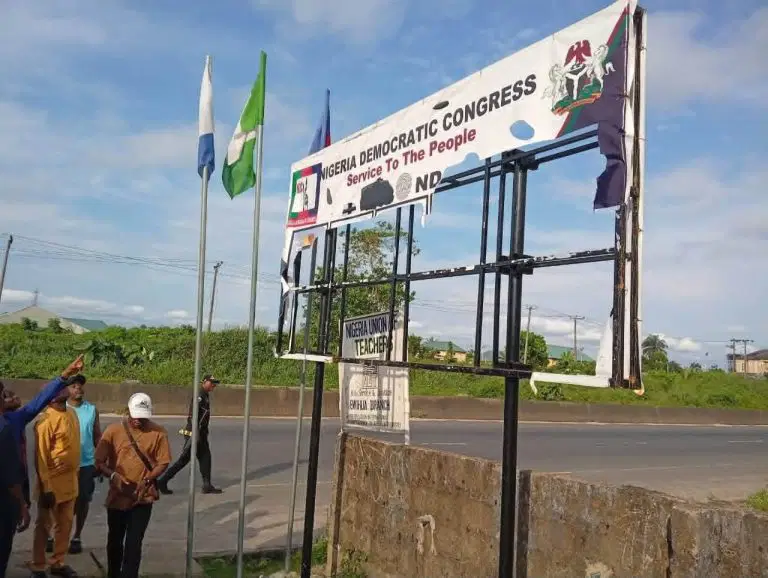
The reported attack on the Nigeria Democratic Congress (NDC) secretariat in Emohua Local Government Area of Rivers State has introduced another security concern into an already active period of political mobilisation ahead of the 2027 elections.
The incident reportedly occurred in the early hours of Wednesday, September 2, with billboards, posters, banners and other campaign materials destroyed. The party has called for an investigation, while available reports indicate that a complaint was made to the police.
But an important question remains unanswered: who carried out the attack and why? Available reporting identifies the perpetrators only as suspected hoodlums or miscreants. No suspect has been publicly identified by the police in the material reviewed for this report.
Reports from multiple Rivers-based and Nigerian news outlets agree on the central facts.
The NDC secretariat in Emohua LGA was reportedly vandalised during the early hours of September 2. Campaign billboards, posters and other materials were destroyed. One report also says valuables were allegedly taken from the office.
The party's Emohua LGA chairman, Benson Lucky, reportedly confirmed the incident in a voice recording and said the matter had been reported at the Emohua Divisional Police Station. A police officer was subsequently quoted as confirming that a report had been lodged and that an investigation team had been sent to the area to examine the incident and take photographs.
The NDC candidate for the Ikwerre/Emohua Federal Constituency, Fugbara Goodluck Ohaka, also condemned the incident and called on security agencies to investigate. The PortCity News reported that he described the destruction of the secretariat's billboards and campaign banners as concerning.
These accounts establish that the alleged vandalism was reported by the party and that a police complaint was made. They do not, however, establish who carried out the attack.
The central unresolved issue: who was responsible?
The most serious allegation in the available reporting comes from the NDC's Emohua leadership.
Lucky reportedly accused a rival political group of responsibility, but did not identify a particular political party. That allegation has not been independently established in the sources reviewed.
That distinction matters.
At this stage, there are three separate propositions:
The NDC office was reportedly vandalised.
The party believes the attack was politically motivated.
Advertisement
The identity and motive of the perpetrators have not been publicly established.
The third question is ultimately for the investigation to resolve.
There is therefore insufficient evidence to attribute the attack to a named political party or political organisation.
The incident comes as political parties are building their structures ahead of the 2027 general elections.
INEC has already begun the formal process of publishing candidates' particulars. On August 29, 2026, the commission began displaying candidate information for the 2027 governorship and State House of Assembly elections. Reports from Rivers said the commission displayed information relating to 19 governorship candidates at its Port Harcourt office.
The NDC is part of that emerging electoral contest.
The party was formally listed by INEC as the Nigeria Democratic Congress, with Sen. Cleopas Moses Zuwoghe listed as national chairman on the commission's current political-party page.
The party's emergence itself has been accompanied by legal developments. In February, INEC said it was registering the NDC in compliance with a Federal High Court order in Lokoja.
However, there was a subsequent legal complication. In June, the Federal High Court in Lokoja reportedly set aside its earlier judgment directing INEC to register the NDC, ruling that the earlier proceedings had been constitutionally defective because necessary parties had not been heard.
Despite that development, INEC's current website continues to list the NDC as a political party, while the party has continued participating in the 2027 electoral process.
That legal history is relevant because it shows that the NDC is operating within a politically and legally contested environment as the 2027 election cycle develops. It does not, however, provide evidence that the Emohua attack was connected to those legal disputes.
A party expanding its grassroots presence
The reported attack also occurred against the background of the NDC's efforts to establish a grassroots organisation in Rivers.
Earlier reports documented the party's mobilisation activities in Emohua, including meetings involving ward leaders and party officials. A July report, for example, described Fugbara Ohaka meeting ward chairmen and secretaries in Emohua as part of grassroots mobilisation efforts ahead of the elections.
The September reports similarly describe ongoing consultations involving communities, traditional institutions, women and youth groups in Rivers.
The significance is straightforward: party offices and campaign materials are part of the physical infrastructure through which political organisations establish visibility and organise supporters.
Destroying them can therefore disrupt campaign activity, although there is currently no evidence showing the extent of any operational or financial loss resulting from the Emohua incident.
The party has condemned the attack and called for the perpetrators to be identified and prosecuted.
Ohaka has urged supporters to remain peaceful rather than retaliate, while calling on security agencies to investigate the incident.
The allegation against an unnamed rival
The Emohua party chairman reportedly believes a rival political group was responsible. However, no specific party was named, and the allegation remains unproven.
The available reports indicate that the incident was reported to the Emohua Divisional Police Station and that investigators were sent to examine the scene.
There is, however, no publicly available police finding in the sources reviewed that identifies the attackers or establishes a political motive.
That makes the police investigation the most important outstanding piece of evidence.
The immediate significance is not simply the destruction of signs and campaign materials.
Political parties depend on local offices, ward structures and campaign infrastructure to maintain contact with voters. An attack on a party facility therefore has the potential to interfere with normal political activity, particularly during an election build-up.
There is also a broader democratic concern.
Nigeria's electoral framework allows competing political parties to organise, campaign and present candidates to voters. When political offices or campaign materials are vandalised, the issue extends beyond the property of one organisation if such incidents become part of a wider pattern of political intimidation.
But the evidence currently available does not establish such a wider pattern from this incident alone.
Advertisement
The responsible conclusion is therefore narrower: an NDC facility in Emohua was reportedly attacked, the party has sought a police investigation, and the identity and motive of the attackers remain unresolved.
Several important questions require answers:
Who carried out the attack?
Was the incident politically motivated, or was there another motive?
What property was damaged or stolen, and what was its value?
Did investigators identify suspects or recover evidence from the scene?
Were CCTV recordings, photographs or eyewitness accounts obtained?
Has anyone been arrested or questioned in connection with the incident?
Was the attack limited to the secretariat and campaign materials, or were other NDC facilities affected?
None of these questions should be answered through assumption.
The immediate next step is the investigation reportedly initiated after the complaint at the Emohua Divisional Police Station. The findings could establish whether the incident was politically motivated and whether specific individuals can be held responsible.
Meanwhile, the NDC and other parties are continuing preparations for the 2027 elections. INEC's publication of candidate particulars has already moved the electoral process into a more formal phase.
For the NDC, the immediate challenge is therefore twofold: maintain its political activities while ensuring that allegations surrounding the attack are resolved through evidence rather than political retaliation.
The central unanswered question remains the same: who attacked the Emohua secretariat, and what evidence will the investigation uncover?
You must log in to comment or reply.
Comments