
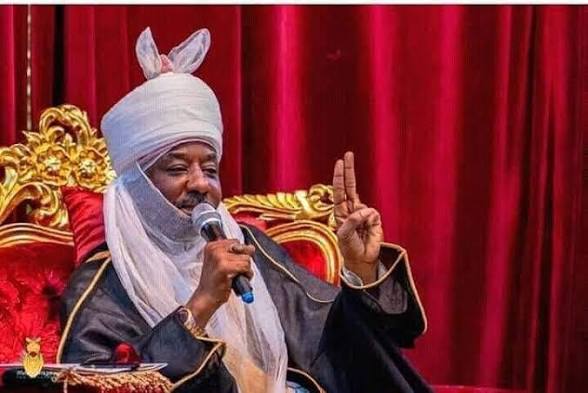
The Emir of Kano, Muhammadu Sanusi II, has become the subject of a fresh wave of online claims after a video showing him at Northwest University, Kano, was circulated with allegations that he had returned to the institution to clear an academic carry-over.
Northwest University has rejected the claim as false, saying the video was from a public lecture attended by the monarch and had subsequently been accompanied by misleading captions on social media.
The controversy followed the circulation of a video showing Sanusi at Northwest University, Kano, after attending a public lecture organised by the International Humanitarian Law Society.
According to a disclaimer attributed to the university’s Public Relations Officer, Abubakar Ibrahim, the institution became aware that some social media users had attached captions claiming that Sanusi had a carry-over and had visited the university to resolve the alleged academic deficiency.
The university said the interpretation was completely false.
In the statement dated August 10, 2026, Northwest University said the event shown in the video was an actual programme held at the institution, but disputed the claims subsequently attached to the footage.
The university described the allegations as “false, baseless, misleading” and urged members of the public to disregard the circulating video, captions and related reports.
It also warned that people responsible for creating or spreading what it described as false and defamatory material could be reported to the appropriate authorities and prosecuted under applicable laws.
That warning is significant because the dispute is no longer simply about a social-media joke. It illustrates how genuine footage of a public figure can acquire a completely different meaning once it is separated from its original context.
Sanusi's relationship with higher education had already attracted considerable public interest before the latest controversy.
Advertisement
Earlier in 2026, reports emerged that the former Central Bank of Nigeria governor had resumed studies at Northwest University as a Law student. Several Nigerian publications reported his return to the classroom and his participation in university activities.
That background gave the new video enough context to appear believable to people encountering it without knowing the details of his academic programme.
But the existence of a genuine university enrolment does not establish the claim that Sanusi was returning to clear a carry-over.
Available reports about his admission described him as entering the Law programme at the 200 level. Earlier coverage also showed him attending lectures, making his presence at a university event unsurprising.
The viral narrative therefore appears to have taken a real fact — Sanusi's connection with Northwest University — and attached an unsupported explanation to it.
Earlier reporting from Nigerian outlets provided a different picture from the viral claim.
QED reported that Sanusi had returned to the classroom as an undergraduate Law student, while Daily Trust focused on his reasons for pursuing the degree and the reactions surrounding his decision.
Other reports later indicated that he participated in the programme virtually because of logistical and security considerations.
Taken together, those reports establish an important piece of context: Sanusi's presence at Northwest University was not itself unusual or evidence that he had suddenly returned to the institution because of an outstanding course.
What remains important for readers is the difference between being enrolled in a university programme and returning to clear an academic deficiency. The viral posts blurred those two completely different claims.
The deeper issue is how context disappears online
The episode points to a wider problem in Nigeria's increasingly social-media-driven news environment.
Videos of public figures can travel across WhatsApp, Facebook, X, TikTok and other platforms without the original description attached to them. Once a provocative caption is added, subsequent users may share the material based on the caption rather than checking where the footage came from or what actually happened.
That creates a particularly difficult verification problem when the underlying footage is genuine.
In this case, the video itself was reportedly connected to a real event at Northwest University. The disputed element was the explanation attached to it.
That distinction is increasingly important for Nigerian readers because misinformation does not always require fabricated photographs or artificially generated videos. Sometimes authentic footage becomes misleading through a false caption.
The Sanusi controversy is therefore less about whether the video exists and more about whether the story being told around the video is supported by evidence.
Northwest University's decision to issue a public disclaimer also demonstrates the pressure institutions face when misinformation begins circulating widely.
Advertisement
Instead of allowing the university's silence to be interpreted as confirmation, management explicitly separated itself from the claims and directed the public towards official university communications.
For a prominent figure such as Sanusi, the consequences of an unsupported academic allegation can extend beyond social-media entertainment. His public profile as a former central bank governor, traditional ruler and public intellectual means claims involving his education can quickly attract political, cultural and media attention.
The university consequently has an interest in protecting both the institution's reputation and the accuracy of information concerning its students and activities.
At the same time, the episode is a reminder to readers that an official denial should be evaluated alongside the underlying evidence. In this case, earlier reporting about Sanusi's university admission and attendance provides useful context for understanding why the viral claim is misleading.
The immediate question is whether the university's warning will stop the claim from continuing to circulate after it has already reached social-media audiences.
Experience with viral misinformation suggests that correcting a false caption can be considerably harder than spreading it. A video can remain online long after the original explanation has been disproved, allowing the same footage to resurface months later with a new caption.
For Sanusi, the controversy is another example of how his public profile can turn an ordinary appearance into a viral story.
For the public, the more important lesson is straightforward: the presence of a real person at a real event does not automatically make every claim attached to the footage true.
The real test now will be whether users who encounter the video again check its context before sharing it — and whether platforms and institutions can provide enough original information to prevent genuine footage from being repurposed into a false narrative.
You must log in to comment or reply.
Comments