
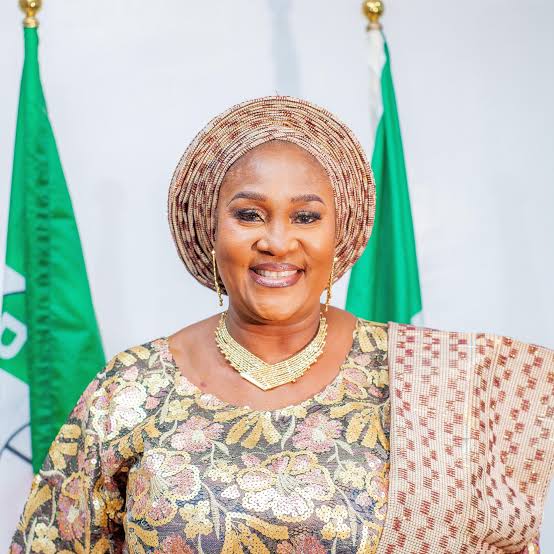
With Osun State less than a week away from its August 15 governorship election, the dispute over security has moved beyond accusations between political parties and into the streets. A protest led by First Lady Titilola Adeleke on Monday, August 10, brought allegations of indiscriminate arrests and political violence directly to the police, underscoring how deeply distrust has entered the final days of the campaign.
The demonstration is significant not simply because of who led it, but because it comes after months of documented killings, competing accusations of police bias and repeated warnings that violence could damage the credibility of the election.
Titilola Adeleke led a group of women from traders' and artisans' associations in a protest against what they described as indiscriminate arrests and violence ahead of Saturday's governorship election, according to Punch.
The march began along the Osogbo–Ilobu Road and ended near the Osun State Police Command along the West Bypass.
The protesters carried placards with messages including “Election is not war,” “Stop indiscriminate arrest of our husbands,” “We want a free and fair election” and “Police must be neutral.”
The group reportedly did not proceed to the main entrance of the police command but was received by CP Samuel Erale Etaifo, the police officer assigned to oversee the election.
Adeleke, who was accompanied by the Commissioner for Women Affairs, Ayobola Awolowo, and the Governor's Special Adviser on Market Affairs, Eniola Omotosho, called for a peaceful election and urged the police to invite some APC chieftains for questioning over what she described as rising violence.
She also alleged that some political leaders could be arrested during the week and raised a specific allegation concerning the Commissioner for Environment.
According to Punch's account, Adeleke alleged that the commissioner had been arrested the previous Friday and stripped naked after being brought to the police command.
That allegation has not been independently verified in the sources reviewed and should therefore be treated as an allegation rather than an established fact.
The First Lady subsequently handed a letter containing the protesters' demands to the police commissioner.
Etaifo said the police had spent the previous two weeks working to reduce tension and warned that competing demonstrations by rival political groups could create further instability.
He said the police had a mandate from the Inspector-General of Police to stabilise Osun, provide a secure environment for political activity and create public confidence ahead of election day.
He also warned that anyone found manipulating the election or violating the law would be arrested.
Advertisement
The most important context surrounding Monday's protest is that concerns about violence in Osun predate the demonstration by several months.
In June, the Nigeria Union of Journalists in Osun warned that political violence was becoming a threat to peace and democracy ahead of the election. The union cited data from the Kimpact Development Initiative indicating that 44 election-related violent incidents had been recorded between October 2025 and June 2026, resulting in 13 deaths.
The Nigeria Police Force subsequently said it was investigating 30 suspected politically motivated killings linked to the build-up to the election. Police said several suspects had been arrested and some had already been taken to court.
The scale of the concern became even clearer in July when an EU-backed coalition of civil-society organisations identified 13 of Osun's 30 local government areas as high-risk areas because of politically motivated killings, violent attacks and heightened political tension. The coalition called for intelligence-led and proportionate security deployments to protect voters, election officials and electoral materials.
This means the women's protest is taking place against an unusually documented security backdrop. It is not simply a disagreement over campaign rhetoric.
Different actors have described the same security environment in sharply different ways.
The Osun State Government has repeatedly demanded stronger and more neutral policing. During an engagement with Inspector-General of Police Tunji Disu in July, Governor Ademola Adeleke called for perpetrators of violence to be arrested regardless of political affiliation and argued that policing in the state must remain impartial.
The IGP's response has been more institutional. Disu said the police would pursue criminals regardless of political affiliation and stressed that Nigeria was preparing for an election, not a war. The Federal Ministry of Information also reported the IGP's warning that anyone involved in political violence would face the law.
The APC, however, has rejected attempts to associate it with political violence. In June, the party called on security agencies to stop the rising violence while distancing itself from attacks in Osun. The Guardian reported that Governor Adeleke had accused the APC of sponsoring some of the violence, an allegation the party rejected.
There is therefore a recurring pattern: the government and its political opponents agree that violence is a problem, but frequently disagree over who is responsible and whether the police are acting impartially.
That disagreement is arguably more dangerous for an election than the individual accusations themselves.
Elections depend on more than police numbers.
Voters must believe that the security agencies will protect them regardless of which candidate they support. Political parties must believe that arrests are based on evidence rather than partisan calculations. Election officials must be able to move sensitive materials without becoming targets. And communities must believe that violence will be investigated regardless of who benefits from it.
Osun's difficulty is that all four forms of confidence are under pressure.
The allegations about selective arrests are particularly sensitive because arrests can have political consequences even when they are legally justified. An opposition politician detained days before an election may be unable to campaign, mobilise supporters or coordinate polling agents. Conversely, failing to arrest genuinely violent actors because they belong to a politically influential group can make ordinary voters feel abandoned.
That is why neutrality cannot simply be declared by the police. It has to be visible in how security decisions are made.
The police have attempted to make that position clear. Disu has publicly warned political actors against violence and said criminals would not be allowed to escape justice. But political actors on both sides continue to accuse security institutions of bias.
The concern over possible politically motivated arrests also predates Monday's protest.
In May, the Osun State Government and Accord Party raised allegations that a special police squad was being prepared to arrest prominent party members and government officials ahead of the election. The Guardian reported that the government warned that selective or partisan operations could increase political tension.
The important qualification is that those claims were allegations, not proof that a political arrest operation had been authorised for partisan purposes.
But their political significance is clear.
Once rival parties begin interpreting routine police investigations through the lens of political persecution, even legitimate law-enforcement activity can become politically explosive.
That is precisely why transparency matters during the final days before an election.
The involvement of women from trader and artisan groups adds another dimension.
Election violence is often discussed through the language of politicians, campaign organisations and security agencies. But its consequences are ultimately felt by ordinary families.
When residents believe that political violence could lead to arrests, attacks or disruption, the consequences can extend into markets, transport, small businesses and household income.
For traders and artisans, a tense election period can mean reduced movement, fewer customers and greater reluctance to operate in areas perceived as dangerous.
Advertisement
The political argument may concern who controls the state government for another four years. For ordinary residents, the immediate concern may be much simpler: whether they can travel to a polling unit, cast a ballot and return home safely.
That is why the protesters' repeated demand for peace is politically more significant than the confrontation itself.
Osun's security agencies now face a narrow window in which to turn public assurances into measurable confidence.
The police have already acknowledged the seriousness of the situation. The IGP has intervened personally, the police say they are investigating dozens of suspected political killings, and civil-society organisations have identified specific areas requiring heightened attention.
The remaining question is implementation.
Security deployments will have to protect voters without intimidating them. Arrests will need to be supported by credible evidence. Political parties will have to restrain supporters, and allegations against opponents will need to be distinguished from established facts.
There is also a broader institutional lesson.
If Osun's election is peaceful, the security agencies will have demonstrated that early intervention and public engagement can reduce the risk of violence. If violence persists, the competing accusations of police bias will become harder to dismiss as ordinary campaign rhetoric.
Monday's protest has brought the dispute over arrests and political violence into sharper public view just days before voters are due to make their choice.
But the real significance of the demonstration will not be measured by the number of placards carried through Osogbo. It will be measured by what happens between now and election day.
The women who protested want peace. The police say they want stability. Political parties say they want a credible election. Civil-society observers are demanding stronger preventive security.
Those objectives should not be difficult to reconcile.
The final test for Osun will be whether the state's institutions can turn those promises into an election in which voters are neither threatened by political violence nor made to fear the very security agencies deployed to protect them.
You must log in to comment or reply.
Comments