
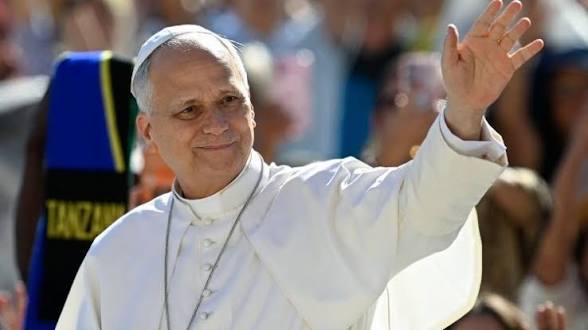
For students using AI to study, workers increasingly interacting with automated systems and families adapting to technology that is becoming part of everyday life, Pope Leo XIV's latest warning raises a question that extends beyond religion: how much of human judgment and responsibility should people hand over to machines?
The Pope raised the issue on Friday, September 25, as he began a four-day visit to France, warning against losing humanity in what he described as a “paradise of machines.” His comments came as artificial intelligence continues to influence education, information, employment and creative work.
Pope Leo XIV arrived in France on Friday for a visit taking him to Paris, Lourdes and Metz from September 25 to 28.
His programme began with a welcome ceremony at Paris Orly Airport and meetings with French President Emmanuel Macron and other authorities at the Élysée Palace. He was then scheduled to visit UNESCO, where discussions are focused on artificial intelligence, information integrity, education and artistic creation in the age of AI.
During his remarks in Paris, Leo warned that technological progress should not come at the expense of humanity and called for greater ethical discernment as machines become more influential in people's daily lives.
The Pope said: “If we are to avoid losing our humanity amid a ‘paradise of machines’ invading and conditioning our daily lives, there is an urgent need for education in ethical discernment and the capacity to acknowledge the moral good.”
His concern is not simply about whether AI works. It is also about how people use it, who makes decisions with it and whether technological convenience begins replacing human judgment.
Young people are directly part of the visit
Young people are among the groups at the centre of Leo's France programme.
Advertisement
On Friday evening, about 80,000 young people aged 17 to 35 were expected at the Stade de France in Saint-Denis for a prayer vigil and encounter with the Pope. Vatican News reported that the meeting was intended to give Leo an opportunity to listen to young people, respond to their questions and address them directly.
The inclusion of young people is significant because they are among those growing up with AI as an increasingly normal part of education, communication and work.
UNESCO's programme for the Pope's visit similarly places young people, researchers, artists, intellectuals and decision-makers in discussions about AI, education, information integrity and artistic creation.
Artificial intelligence is no longer limited to specialist technology companies.
Students can use AI tools for research and learning. Businesses can use them to automate tasks and analyse information. Workers may encounter automated decision-making systems, while artists and other creators face new questions about how human work should coexist with machine-generated material.
That is why UNESCO's programme for Leo's visit specifically addresses AI alongside education, information integrity and artistic creation. The organisation says emerging technologies should be developed and used in ways that serve equity, opportunity and inclusion.
The Pope's intervention therefore comes amid a wider international discussion about how technological development can be balanced with human values.
The France visit is expected to involve large numbers of people beyond those attending the Pope's official meetings.
The Vatican's programme includes a Mass at Place de la Concorde in Paris on Saturday, September 26, followed by travel to Lourdes.
At Lourdes, the sanctuary says registrations for celebrations led by Leo have reached its maximum capacity, with 150,000 people expected to pray with the Pope.
The scale of these gatherings means that the visit also affects local communities, transport arrangements, security operations, religious organisations and businesses serving visitors.
The Pope's warning is relevant to people who may never attend a Catholic service or consider themselves religious because the underlying issue is broader than faith.
AI is increasingly becoming part of ordinary decisions and activities. The question is how people preserve responsibility, critical thinking, creativity and human relationships while using increasingly capable machines.
For students, that can mean distinguishing between using AI as a learning tool and allowing it to replace learning itself.
For workers and businesses, it can mean deciding which tasks can appropriately be automated while retaining meaningful human oversight.
For the wider public, it also involves knowing when information has been generated or altered by AI and being able to assess whether it is reliable.
Advertisement
UNESCO's decision to bring young people, researchers, artists and policymakers into its AI discussions reflects the breadth of the issue.
Pope Leo's France programme continues through Monday, September 28.
After Paris, he is scheduled to travel to Lourdes, where he will celebrate Mass on Sunday and meet bishops and members of the sick community. He will then travel to Metz, where his programme includes events focused on Europe, peace and unity.
His September 25 programme also includes a visit to UNESCO, where AI, information integrity, education and artistic creation are central subjects.
Leo's warning comes at a time when the boundary between human activity and machine assistance is becoming increasingly difficult to define.
His central message in Paris was that technological advancement should remain connected to human judgment and dignity. Whether that principle can be translated into practical decisions by schools, businesses, governments and technology developers remains part of the broader global discussion about AI.
For millions of people encountering AI in ordinary parts of their lives, the debate is no longer only about what machines can do. It is also about what people should continue doing for themselves.
You must log in to comment or reply.
Comments