
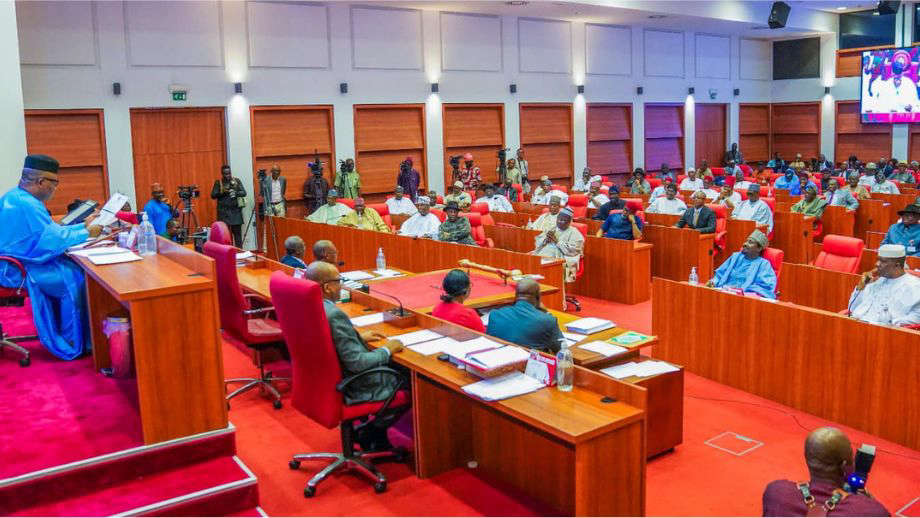
Nigeria’s Senate has suspended consideration of a bill seeking to establish the Chartered Institute of Training and Development of Nigeria, exposing growing concerns within the National Assembly about the increasing number of professional bodies and government-backed institutions being proposed across the country.
The decision reflects a broader debate over whether new regulatory institutions are genuinely needed or merely add another layer to an already crowded administrative landscape.
The Senate on Thursday stepped down the Chartered Institute of Training and Development of Nigeria (Establishment) Bill, 2026, after lawmakers questioned its relevance and potential overlap with existing professional and training institutions.
The proposed legislation aims to create a statutory professional body responsible for regulating certified trainers and development practitioners in Nigeria.
However, during deliberations, several senators argued that the proposal lacked sufficient justification and failed to clearly distinguish itself from existing organizations involved in training, management development, and professional certification.
Leading opposition to the bill, Senator Abdul Ningi warned against approving legislation solely because it originated from the House of Representatives.
According to him, lawmakers must assess the merit of every proposal independently rather than treating passage as a routine legislative exercise.
Senate President Godswill Akpabio supported calls for caution, stressing that the Senate should not automatically endorse bills transmitted from the lower chamber without rigorous scrutiny.
Deputy Senate President Barau Jibrin also questioned the clarity of the proposal, describing its objectives as insufficiently defined and requiring further explanation.
Senate Leader Opeyemi Bamidele subsequently proposed the creation of a sub-committee to examine the legislation more thoroughly and ensure compliance with Senate procedural requirements before any further consideration.
Advertisement
While many lawmakers supported suspending the bill, Senate Minority Leader Abba Moro defended the proposal, insisting that its objectives and provisions were clear enough to justify continued legislative consideration.
Following the debate, the Senate constituted a review committee chaired by Senator Ningi and officially stepped down the bill pending further examination.
The debate extends beyond a single bill.
Over the past several years, Nigeria’s National Assembly has received dozens of establishment bills seeking to create new institutes, commissions, agencies, and professional bodies. Supporters often argue that such institutions improve standards, professionalize industries, and strengthen regulation.
Critics, however, increasingly question whether many of these organizations duplicate functions already performed by existing agencies, universities, professional associations, or government departments.
The concerns raised during Thursday’s session reflect a wider shift among lawmakers who appear increasingly reluctant to approve new institutions without demonstrating a clear policy gap.
At a time when government spending remains under pressure and public debt obligations continue to consume a significant share of federal revenues, questions about administrative efficiency have become more prominent within policy discussions.
The controversy surrounding the training institute bill therefore highlights a larger governance challenge: whether expanding regulatory structures automatically translates into better outcomes or simply increases bureaucratic complexity.
Most Nigerian media reports focused on the Senate debate itself, emphasizing disagreements among lawmakers and the eventual decision to suspend consideration of the bill.
Parliamentary-focused coverage highlighted the sharp comments made by senators questioning the bill’s relevance and warning against legislative rubber-stamping.
However, much of the reporting paid less attention to the broader pattern emerging within the National Assembly regarding the proliferation of establishment bills.
Some legislative observers have noted that similar concerns have surfaced in previous debates involving proposals for new professional institutes and government-backed agencies.
While coverage largely centered on the immediate controversy, the deeper issue is whether Nigeria’s institutional framework is becoming increasingly fragmented through the creation of overlapping bodies with similar mandates.
That concern appears to be gaining traction among lawmakers from both the majority and opposition blocs.
Professional regulation remains an important issue in Nigeria’s workforce development agenda.
Training, capacity-building, and skills development have become increasingly important as both public and private sectors seek to improve productivity and competitiveness.
Supporters of the proposed institute argue that professional trainers require a formal regulatory structure capable of setting standards, certifying practitioners, and promoting continuous development.
Yet opponents believe existing professional bodies, educational institutions, and management development organizations may already perform many of those functions.
Advertisement
The Senate’s decision signals that future establishment bills may face tougher scrutiny, particularly if lawmakers perceive potential overlaps with existing institutions.
This could affect several pending proposals currently before the National Assembly seeking to establish additional institutes and specialized regulatory organizations.
Historically, Nigeria has experienced periodic debates over agency proliferation, with successive administrations facing criticism over the cost and efficiency of maintaining numerous public institutions.
The current legislative posture suggests lawmakers are becoming more sensitive to those concerns amid increasing calls for government reform and fiscal discipline.
The newly constituted Senate sub-committee is expected to review the bill’s objectives, legal framework, and relationship with existing institutions before presenting recommendations to the chamber.
Its findings could determine whether the legislation returns for further consideration, undergoes significant amndments, or faces prolonged delay.
The outcome may also serve as an important test case for how the National Assembly handles future proposals aimed at creating new professional bodies.
For now, the Senate’s message appears clear: the creation of additional institutions will require stronger justification, clearer mandates, and convincing evidence that existing structures cannot already perform the same functions.
What lawmakers decide next could shape not only the future of the training profession in Nigeria but also the broader debate over government expansion, regulatory efficiency, and institutional reform.
You must log in to comment or reply.
Comments