
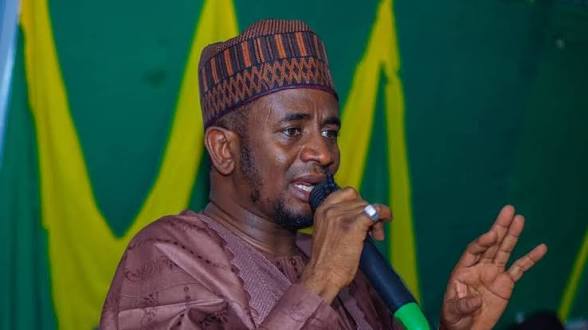
Senator Shehu Buba, who represents Bauchi South, is again facing allegations linking him to suspected bandits, but the evidence publicly available so far does not establish those allegations as fact.
The controversy intensified in August and September 2026 after videos circulated online appearing to show people described as bandit leaders at the senator's residence. A resident identified as Hassan subsequently made further allegations against Buba in interviews with content creator D English Alhaji, including a claim that people associated with bandit leader Dogo Gide were taken to Abuja for specialised training with the alleged assistance of one of the senator's aides. Buba has denied the accusations and challenged his accusers to provide evidence to security agencies or the courts.
The dispute is significant because it is not entirely new. Buba has faced accusations concerning alleged links to banditry since 2024. At the same time, at least one independent verification of the latest viral video found that footage presented as evidence of bandits visiting the senator had been assembled from unrelated clips. That finding weakens one of the principal pieces of material being circulated online, but it does not by itself resolve every allegation made against the senator.
The strongest independently verifiable finding concerning the latest controversy concerns the viral video.
A fact-check by PRNigeria examined the footage circulated by D English Alhaji and found that it appeared to combine two unrelated video segments. The first showed men in traditional northern clothing inside a residence, while another section showed different individuals displaying international passports and speaking mainly in English.
PRNigeria's investigation found that the men in the first clip were Isa Usman and Abubakar Bula, whom it identified as businessmen and pilgrims who visited Buba in 2023. It found no evidence connecting those individuals to banditry or terrorism. The investigation also reported that the second video involved different people and was unrelated to the first footage.
Its conclusion was that the combined material created a misleading impression that the people shown were bandits visiting the senator's residence.
That is an important distinction. The verification does not establish that every allegation against Buba is false. It establishes something narrower: the particular viral video examined by PRNigeria does not reliably prove the claim it was being used to support.
Buba has also disputed the interpretation of the videos. He said the footage had been manipulated or combined to create a false narrative and urged journalists and members of the public to examine its origins.
The underlying dispute is whether there is credible evidence connecting Senator Buba to the activities of bandits or other criminal groups.
That question cannot be answered simply by determining whether a person appearing in a photograph or video is a bandit.
The latest accusations include claims that individuals associated with Dogo Gide were allegedly brought to Abuja for specialised training through an aide to Buba. Those claims were made by Hassan during interviews circulated online. They have been reported by multiple Nigerian news organisations, but they remain allegations.
No publicly available evidence examined for this report independently establishes that Buba ordered, financed or facilitated such training.
That distinction is particularly important in a story involving accusations of criminal activity. A person's association with visitors, photographs or community members does not by itself establish participation in a criminal organisation.
Advertisement
The current dispute follows an earlier controversy involving Buba and alleged sponsorship of a suspected bandit for the 2024 Hajj.
In October 2024, reports emerged that security authorities were investigating allegations involving a suspected bandit, Abubakar Idris, and claims that the individual had been registered for Hajj through an aide allegedly connected to Buba. Contemporary reporting said the allegations involved the DSS and the Bauchi State Muslim Pilgrims Welfare Board.
Buba denied the allegations.
In his latest response, he said the 2024 controversy followed events surrounding the killing of two charcoal sellers in Bauchi State. He said he had visited the victims' families and called for justice, after which he alleged that officials linked him to banditry. He also disputed the claim that he sponsored a bandit kingpin for Hajj, saying he did not have the aide named in the allegation and had invited security agencies to investigate.
Buba says he subsequently filed a defamation case, identified as CV/413/2024, at the High Court of the Federal Capital Territory. This is his account of the legal response; the existence and current status of the case should be distinguished from the truth or otherwise of the allegations themselves.
The newest allegations originated largely from social-media material rather than a publicly released security investigation or court finding.
A resident identified as Hassan accused Buba of being among politicians allegedly supporting bandits in the area. He also alleged that people connected to Dogo Gide were taken to Abuja for specialised training with the assistance of an aide.
Buba has rejected the claims and said the campaign against him is politically motivated. He has also accused his opponents of attempting to damage his reputation ahead of the 2027 elections.
There is therefore a clear conflict between the accusations made by Hassan and Buba's denial. But the available reporting does not provide sufficient independently verified evidence to resolve that conflict in favour of the criminal allegations.
Buba is the Peoples Redemption Party's candidate for governor of Bauchi State in the 2027 election. His political position gives the allegations an obvious political dimension, although the existence of that political context does not, by itself, prove either that the allegations are politically motivated or that they are genuine.
Buba has argued that the accusations are part of a campaign intended to undermine his reputation before the election. He has said he prefers to challenge the allegations through security agencies and the courts rather than engage in prolonged media exchanges.
This makes the distinction between political accusation and independently established evidence particularly important.
A claim can be politically motivated and still contain information worth investigating. Conversely, the fact that an allegation is serious or widely circulated does not make it true.
Buba's position:
The senator denies supporting or facilitating banditry. He says some of the material circulating online has been manipulated or taken out of context and maintains that the accusations are part of a campaign against him. He has called on anyone with credible evidence to take it to security agencies or the courts.
The accusers' position:
Hassan has alleged that Buba is connected to politicians or individuals supporting bandit activities and has made specific claims concerning people allegedly associated with Dogo Gide. Those allegations have been publicly circulated but have not been independently established by the evidence reviewed for this report.
What independent verification shows:
The PRNigeria examination of the principal viral video found that two unrelated videos had been combined and concluded that the resulting presentation was false and misleading. It did not, however, purport to determine every allegation concerning Buba.
The most immediate significance is the danger of treating social-media footage as conclusive evidence of criminal association.
The PRNigeria fact-check demonstrates why context matters. Individuals appearing in a senator's residence may be visitors, supporters, pilgrims, community members or something else; their identity and purpose cannot reliably be established merely from a short video.
At the same time, allegations involving political office holders and criminal groups deserve appropriate scrutiny. If credible evidence exists that a public official assisted or financed criminal organisations, that evidence should be assessed by the relevant security and judicial institutions rather than settled through social-media accusations.
Buba's challenge to his accusers therefore places the controversy before the institutions capable of establishing facts: investigators and courts.
Several important questions remain unresolved in the public record reviewed for this report.
- Has any Nigerian security agency publicly confirmed evidence linking Buba to bandit groups?
- What evidence, beyond the disputed videos, supports Hassan's specific allegations?
Advertisement
- Did individuals associated with Dogo Gide actually receive training in Abuja as alleged?
- If so, who organised, financed or facilitated that training?
- What is the current status of the various legal proceedings Buba says he initiated?
- What evidence was contained in the earlier 2024 allegations concerning the Hajj sponsorship?
- Have investigators publicly issued a final finding on those earlier allegations?
These questions should not be answered through assumption or repetition of unverified claims.
Buba has said he will continue pursuing the matter through legal and institutional channels and has challenged anyone with incriminating evidence to submit it to the appropriate authorities.
A separate report based on Buba's account says a criminal case involving five suspects was filed in Abuja following an alleged extortion attempt and that a hearing is scheduled for September 29, 2026. That development concerns the legal dispute surrounding the allegations and should not be interpreted as a judicial finding on whether Buba has any connection to banditry.
The more important development to watch is whether security agencies, courts or other competent institutions produce independently verifiable evidence addressing the substantive allegations.
For now, the clearest finding from the available evidence is that one major piece of viral material used to associate Senator Shehu Buba with suspected bandits was found to be misleading because unrelated footage had been combined.
That does not establish that every allegation against Buba is false, just as the existence of allegations does not establish that he is involved in banditry.
The unresolved question is therefore straightforward: will credible, independently verifiable evidence emerge that establishes or disproves the specific allegations now being made against the senator?
Until that happens, the accusations should remain reported as allegations rather than facts.
You must log in to comment or reply.
Comments