
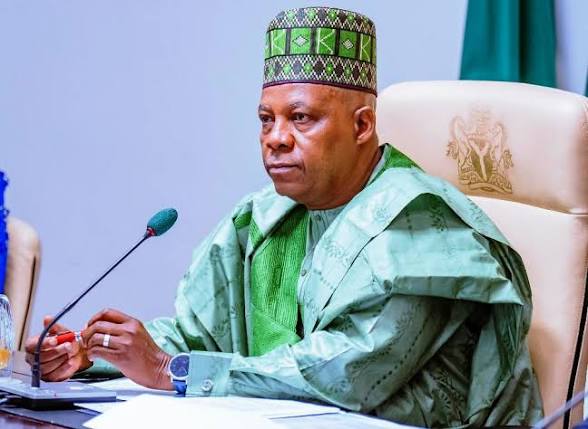
Vice President Kashim Shettima has travelled to Addis Ababa, Ethiopia, to lead a Nigerian delegation for a government-to-government exchange focused on improving nutrition delivery.
The October 6, 2026 visit will give Nigerian officials an opportunity to study Ethiopia’s approach to coordinating nutrition programmes across different levels of government and sectors.
The engagement is also linked to Nigeria’s broader efforts to strengthen nutrition planning and financing through the Nutrition 774 Initiative.
Vice President Kashim Shettima departed Abuja on Tuesday, October 6, 2026, for Addis Ababa, where he is leading Nigeria’s delegation to a nutrition leadership exchange with Ethiopian officials.
According to a statement issued by Shettima’s media aide, Stanley Nkwocha, the visit followed an invitation from Ethiopia’s Deputy Prime Minister, Temesgen Tiruneh.
The programme is designed to allow officials from both countries to share experiences on how governments can coordinate nutrition policies and improve delivery at federal, state and local levels.
The Nigerian delegation is also expected to visit several facilities and projects in Ethiopia as part of the exchange. The itinerary includes a wheat farm and banana plantation in Oromia, the Bounty of the Basket Training Centre and households in Mojo, as well as Jabdu Motors in Bishoftu.
Among the Nigerian officials accompanying Shettima are Zamfara State Governor Dauda Lawal, Jigawa State Governor Umar Namadi and Minister of Budget and Economic Planning Abubakar Bagudu.
The visit is expected to continue through the week, after which Shettima will return to Abuja.
Advertisement
Nutrition is not solely a health-sector issue. Poor nutrition can affect child development, education outcomes, household welfare and the productivity of communities.
For Nigeria, the significance of the Ethiopia exchange is therefore in how lessons from another African country can be adapted to the country's own system.
The Federal Government has been developing the Nutrition 774 Initiative, which is aimed at strengthening nutrition action across Nigeria's 774 local government areas. The initiative places emphasis on coordination between different levels of government and on domestic financing for nutrition programmes.
Studying Ethiopia's experience could help Nigerian policymakers identify approaches that may be useful for coordinating nutrition programmes and translating national commitments into action at state and local government levels.
However, the visit itself does not mean that Nigeria has adopted Ethiopia's model. The immediate purpose is to exchange experiences and examine approaches that could inform Nigeria's own policies.
Key Questions
Why is Shettima visiting Ethiopia?
The visit is focused on a government-to-government exchange on nutrition. Nigerian and Ethiopian officials are expected to share experiences on coordinating nutrition policies and improving delivery.
Who invited Shettima?
Shettima was invited by Ethiopia's Deputy Prime Minister, Temesgen Tiruneh, who is involved in Ethiopia's multisectoral approach to nutrition.
What is Nigeria expected to learn?
The delegation is expected to examine how Ethiopia coordinates government-led nutrition interventions and how different sectors and levels of government contribute to nutrition outcomes.
Is this Nigeria's first nutrition exchange with Ethiopia?
The current programme has been described as the inaugural Nigeria-Ethiopia Nutrition Leadership Exchange Visit.
How does this relate to Nigeria's Nutrition 774 Initiative?
Nigeria's Nutrition 774 Initiative seeks to strengthen nutrition action across the country's 774 local government areas. The Ethiopia engagement provides an opportunity for Nigerian officials involved in nutrition policy to study another country's approach to government coordination and implementation.
Nigeria has continued to place greater emphasis on nutrition as a national development issue rather than treating it solely as a health matter.
Advertisement
The Nutrition 774 Initiative is part of that broader approach. Earlier government discussions around the initiative have focused on stronger state and local structures as well as domestic financing for nutrition.
Ethiopia, meanwhile, has developed a multisectoral nutrition framework that has attracted attention within Africa. One of the programmes Nigerian officials are examining is associated with Ethiopia's Seqota Declaration, a government commitment launched in 2015 with a long-term goal of eliminating stunting among children under two by 2030.
The Nigerian delegation's programme includes visits to agricultural, training and community-based establishments, reflecting the broader idea that nutrition outcomes can be influenced by agriculture, household conditions, food availability and other sectors alongside healthcare.
Shettima and the Nigerian delegation are expected to continue their engagements in Addis Ababa and other locations included in the programme.
The delegation will participate in discussions with Ethiopian officials and visit selected facilities and projects before returning to Nigeria.
The key issue to watch after the exchange will be whether lessons from the Ethiopian experience translate into specific changes or strengthened implementation of Nigeria's own nutrition programmes.
Shettima's Ethiopia visit places Nigeria's nutrition policy in the context of a wider African exchange on how governments can improve nutrition delivery.
The immediate outcome is an exchange of experiences. Its longer-term importance will depend on how Nigeria applies any lessons from the visit through its existing nutrition programmes, particularly at state and local government levels.
You must log in to comment or reply.
Comments