
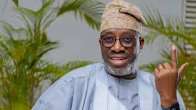
When questions about a president’s health become part of an election conversation, the distinction between verified information, political argument and speculation becomes particularly important. Segun Sowunmi’s latest defence of President Bola Tinubu therefore says as much about Nigeria’s increasingly political information environment as it does about the President’s health.
PDP chieftain and convener of The Alternative Movement, Segun Sowunmi, said on Thursday, October 1, that President Bola Tinubu was in good health and of sound mind and urged Nigerians to disregard rumours about the President’s health.
Sowunmi made the comments during a town-hall meeting in Ijebu North East Local Government Area of Ogun State.
His remarks followed renewed political discussion surrounding Tinubu’s absence from the 81st United Nations General Assembly in New York. Vice-President Kashim Shettima represented Nigeria at the meeting and delivered the national statement on behalf of the President. The Federal Government had said Tinubu was on annual leave and that Shettima was representing him with the President’s full mandate.
The issue became more prominent after Tinubu returned to Lagos on September 29 following an extended working vacation in Europe. Speaking to journalists, Tinubu rejected concerns about his health, saying: “There’s nothing wrong” and that he was “healthy, sound, and ready to go.”
Sowunmi subsequently argued that Nigerians should not interpret the President’s absence from the UN gathering as evidence of ill health. He also criticised what he described as a tendency to focus on negative developments and accused opposition politicians of highlighting problems while overlooking positive developments.
On the 2027 election, Sowunmi expressed confidence that Tinubu would win Ogun State and urged residents to participate in large numbers.
He also said Ogun had almost three million registered voters and argued that the state should produce voting numbers comparable with other populous states.
The significance of Sowunmi’s comments lies partly in the timing.
Advertisement
Tinubu's European stay lasted about four weeks, after the Presidency initially announced a three-week working vacation. His absence coincided with the UN General Assembly, where Nigeria was represented by Shettima. The combination created an opening for political debate about the President’s health, his absence from a major international gathering and the constitutional implications of a prolonged presidential absence.
The government's explanation has been straightforward: Tinubu was on leave, remained in contact with officials in Nigeria and delegated the UNGA assignment to the Vice-President.
There is also a concrete record of Nigeria's participation. Shettima led the Nigerian delegation, attended the high-level session and delivered Tinubu's national statement on September 24.
That does not, however, settle every political interpretation surrounding the President's absence. It establishes what happened; political actors remain free to debate whether the decision was appropriate, whether the timing was desirable and whether the Presidency communicated sufficiently with the public.
Tinubu has publicly said that he is healthy and ready to work. Sowunmi has repeated that position. The Presidency has also previously described the President as “hale and hearty.” Those statements are relevant evidence of the administration's position, but they should not be confused with an independent medical assessment.
That distinction matters because political confidence and medical verification are not the same thing.
The Presidency's position is that Tinubu's absence from the UNGA did not prevent Nigeria from being effectively represented. The Federal Government specifically said Shettima carried the President's full mandate, while Nigeria's official statement at the General Assembly was delivered in Tinubu's name.
Tinubu himself has rejected the health rumours, describing them as political rumours after returning to Nigeria.
Sowunmi's argument goes further. He has framed the controversy as part of a broader political culture in which opponents allegedly concentrate on negative developments. He has also argued that Nigeria's interests can be advanced through the Vice-President's participation at international meetings rather than requiring the President's physical attendance at every event.
The opposition and critics, however, have focused on different questions. Their concerns have included the length of Tinubu's absence, his decision not to attend the UNGA personally and questions surrounding the constitutional procedure for presidential absence. Reports have also documented legal and political challenges concerning the vacation.
These positions do not necessarily answer the same question. The government is primarily addressing whether Nigeria was represented and whether Tinubu remained able to direct government. Critics have also raised questions about transparency, constitutional procedure and political accountability.
That distinction is important because an argument about presidential attendance at UNGA is not automatically evidence of a health problem, just as a presidential statement that he is healthy is not itself an independent medical examination.
The timing makes the controversy politically significant.
The 2027 presidential election is already becoming a central frame through which developments involving Tinubu are interpreted. Sowunmi's comments explicitly move the conversation from the President's present health and UNGA absence to his ability to seek another term.
His declaration that Tinubu will win Ogun is therefore political advocacy, not an established electoral outcome. The actual result will depend on voters and the election process.
The Ogun voter-registration figure should also be treated carefully. Sowunmi said the state has almost three million registered voters, but that figure should remain attributed to him unless and until the latest applicable INEC register independently confirms it.
More broadly, voter numbers alone do not establish turnout or electoral results. Registration creates the potential electorate; participation on election day determines how many registered voters actually cast ballots.
For Nigerian voters, this distinction will become increasingly relevant as political parties and aspirants intensify their mobilisation ahead of 2027.
Advertisement
The episode illustrates a recurring challenge in Nigerian political communication: a factual event can quickly acquire several competing narratives.
Tinubu's absence from the UNGA is a fact. Shettima's representation of Nigeria is a fact. Tinubu's statement that he is healthy is also a documented public statement. What remains politically contested is what those facts mean.
That is where responsible reporting becomes especially important.
Health claims about public officials can affect public confidence, while unsubstantiated claims can also become instruments of political campaigning. At the same time, dismissing every question as political rumour can make legitimate questions about transparency harder to distinguish from misinformation.
The same principle applies to the 2027 election. Political supporters are entitled to make predictions and campaign for candidates, but those claims should remain clearly separated from independently verifiable electoral facts.
Ultimately, the important question is not simply whether political figures believe Tinubu is fit for another election. It is whether Nigerians have enough reliable information to distinguish the President's own account, the government's explanation, opposition criticism and independently verifiable facts.
Sowunmi has made his position clear: he believes the health concerns are misplaced and that Tinubu should be supported in 2027. The Presidency has similarly rejected health concerns, while critics continue to question aspects of the President's prolonged absence.
As the 2027 contest approaches, those competing narratives will become harder to separate from campaign politics. The responsibility for voters and news organisations alike will be to keep the distinction between evidence, political claims and speculation clear.
You must log in to comment or reply.
Comments