
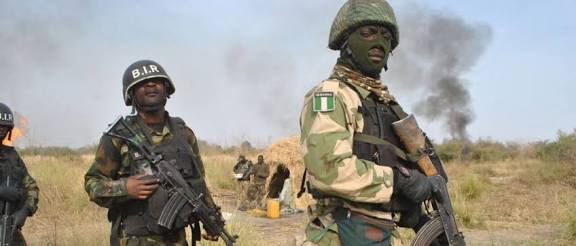
A convoy carrying a senior Nigerian Army commander came under sudden heavy gunfire near Mayama Hill in Kebbi State on Monday, triggering a fierce exchange that left five suspected terrorists dead and exposed the evolving risks facing top military leadership in the North-West.
The attempted ambush targeted Major General Bemgha Koughna, General Officer Commanding (GOC) 8 Division and Commander, Sector 2 of Operation FANSAN YAMMA. Soldiers escorting him repelled the attack, securing the convoy and recovering weapons, ammunition and cash from the fleeing assailants.
According to military sources, the attack occurred as the GOC was travelling to inspect frontline troops. The convoy reportedly came under coordinated fire from suspected members of the Lakurawa armed group operating within the forest belt linking Kebbi to parts of Zamfara and Sokoto.
Five attackers were killed in the firefight, while others escaped into surrounding forests, some believed to have sustained gunshot wounds. Troops later conducted a sweep of the area, recovering a PKT machine gun, AK-47 rifles, magazines, 12.7mm rounds, motorcycles and ₦840,000 in cash.
The targeting of a divisional commander marks a significant escalation. Ambushes on patrol units are common in the North-West conflict theatre, but direct attempts against high-ranking officers are rarer — and strategically symbolic.
Advertisement
Beyond the firefight itself, the attempted ambush underscores mounting pressure on armed groups in the North-West.
Operation FANSAN YAMMA has intensified operations in recent months, targeting bandit enclaves and disrupting supply lines. Security analysts note that when insurgent or bandit networks feel operational squeeze, they often shift tactics — from territorial raids to high-impact symbolic attacks.
A strike on a GOC would have delivered propaganda value and psychological shock, potentially undermining troop morale and projecting resilience despite sustained offensives.
Yet the deeper issue is structural: forested border corridors in the North-West remain difficult to dominate fully. While clearance operations produce short-term tactical wins, holding terrain and maintaining intelligence superiority remain ongoing challenges.
The recovered cash and communication devices may now offer insight into logistics chains and financing streams. However, armed groups in the region have historically demonstrated the ability to regenerate cells even after leadership losses.
The North-West has experienced a shift in violence patterns over the past five years. What began largely as banditry evolved into more structured armed networks with cross-border linkages, access to heavier weaponry and improved mobility through motorcycles and forest routes.
Military operations have degraded several camps, but the terrain — and porous state borders — continue to complicate containment efforts.
This latest incident reflects a dual reality:
• The Army retains operational superiority in direct engagements.
• Armed groups remain capable of intelligence-led ambush attempts, even against hardened convoys.
Advertisement
That tension defines the current phase of the conflict.
The immediate firefight may be over, but the strategic response now matters more than the casualty count.
If follow-up intelligence operations dismantle the network behind the ambush, it could significantly weaken militant coordination in the corridor. If not, the attempted targeting of senior commanders could become a tactical template.
The real test now is whether sustained territorial control — not just reactive engagements — can be achieved in vulnerable forest belts across Kebbi and neighbouring states.
You must log in to comment or reply.
Comments