
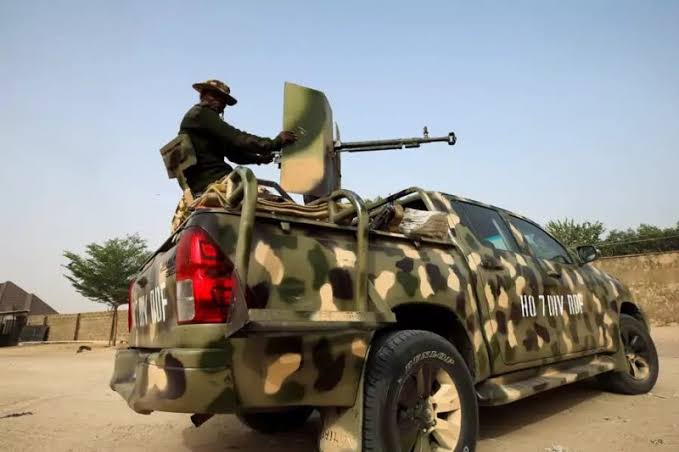
Troops of the Joint Task Force North-West, Operation FANSAN YAMMA, rescued 16 civilians during two separate operations in Zamfara State on August 28, 2026, after armed groups attempted to abduct residents and commuters.
The operations took place in Kaura Namoda and Tsafe local government areas, according to a statement attributed to the Joint Task Force's Media Information Officer, Lt. Col. Aliyu Danja. Four civilians were rescued in Kaura Namoda, while another 12 passengers were rescued during an attempted abduction involving two commercial vehicles in Tsafe.
The significance of the report goes beyond the number rescued. It comes only days after a deadly attack on the Gusau–Funtua Federal Highway in Tsafe, where police said eight travellers were killed and eight others abducted. That sequence raises an important question about the security of major transport routes in Zamfara even as military operations are producing successful rescues.
The military account describes two separate incidents on August 28.
In Kaura Namoda LGA, troops responded to a distress call in the early hours of the day after suspected terrorists invaded a community and attempted to abduct residents. The troops engaged the attackers, who fled, and four male civilians were rescued unharmed. The area was subsequently reinforced, according to the Joint Task Force account.
Later that day, troops operating in Tsafe LGA responded to another attempted abduction involving commuters on a major transit route. A firefight followed, after which the attackers reportedly abandoned their captives and retreated. Twelve passengers travelling in two commercial vehicles were rescued without injury, and traffic was restored along the route.
The combined figure is therefore 16 rescued civilians.
The report does not provide the names of the rescued passengers, the exact communities involved in either incident, the number of attackers or any confirmed figure for terrorist casualties. Those details should not be inferred from the military's account.
The key issue: rescue operations versus persistent access to civilians
The latest operation shows that security forces can respond successfully when they receive information about an attack and reach the affected location quickly.
But it also illustrates a continuing problem: armed groups are still attempting to exploit both rural communities and transportation corridors in Zamfara.
The distinction is important. Rescuing victims during an attack is a tactical success, but it does not by itself establish that the underlying threat has been eliminated.
Advertisement
That concern is particularly relevant in Tsafe.
On August 25, just three days before the latest reported rescue, the Zamfara State Police Command said armed bandits attacked motorists near Unguwar Chida on the Gusau–Funtua Federal Highway. Police said eight travellers were killed, nine were injured and eight passengers were abducted. Security forces subsequently engaged the attackers, with police reporting that 17 suspected bandits were killed.
The two incidents should not be treated as the same attack. The August 28 military report describes a separate attempted abduction. But their close timing and location underline the continuing security pressure around routes used by civilians.
Zamfara's wider security picture
The recent incidents also form part of a broader sequence of military operations in the state.
Earlier in August, troops of Operation FANSAN YAMMA rescued nine civilians, including an infant, after foiling an attempted mass abduction in Unguwar Rogo, Kaura Namoda LGA. The military said the August 16 attack involved gunmen who had concealed themselves in a millet farm and opened fire on passing vehicles. Two women were reportedly wounded and taken for medical treatment.
The military has also reported operations aimed at disrupting the infrastructure that allows armed groups to operate.
On August 23, troops intercepted three disassembled canoes allegedly being moved into Zamfara for use by terrorists to cross riverine areas. The military said the canoes were intended to improve the group's mobility and that the people transporting them fled when troops approached.
On August 27, troops also recovered and safely disposed of an improvised explosive device along the Gurusu–Gwashi Road in Bukkuyum LGA, after receiving intelligence about the device.
Taken together, these incidents show that the security challenge is not limited to traditional attacks on isolated communities. Armed groups have also sought to exploit roads, transport routes, logistics and difficult terrain.
The latest Tsafe rescue is particularly relevant because of the importance of road transport to people living and working across the region.
The Gusau–Funtua corridor connects communities and provides a route for commercial movement. The August 25 attack demonstrated the potential consequences when armed groups can stop vehicles on the highway.
Police said attackers in that incident intercepted two commercial vehicles. One was a Sharon vehicle travelling from Sokoto towards Gwagwalada, while the other was a Sokoto State Transport Authority bus carrying 18 passengers towards Kaduna and Abuja.
The attack resulted in deaths, injuries and abductions.
The subsequent rescue of 12 commuters during a separate attempted abduction on August 28 therefore provides evidence of a successful security response, but also shows why maintaining safe transport corridors remains a central challenge.
The recent pattern indicates that Operation FANSAN YAMMA is pursuing several approaches simultaneously.
These include responding to distress calls, conducting fighting patrols, disrupting terrorist logistics and attempting to prevent attacks before they reach civilians.
The reported interception of the canoes and the disposal of the IED are examples of operations designed to restrict the movement and capabilities of armed groups rather than simply respond after casualties occur.
The rescue operations, meanwhile, demonstrate the importance of rapid response and intelligence from communities.
However, the available reports do not provide enough evidence to determine how much the overall security situation in Zamfara has improved. Individual operational successes cannot, by themselves, establish that armed groups have been permanently displaced or that affected roads and communities are now consistently safe.
Several important details about the August 28 operations have not been publicly established.
The identities and locations of the 16 rescued civilians have not been disclosed in the available report.
Advertisement
The military has not publicly stated how many attackers were involved.
There is no confirmed public figure for terrorist casualties from the two operations.
It is unclear whether any suspects were arrested following either attempted abduction.
The exact location of the Tsafe incident has not been publicly identified in the available account.
It is also not clear whether the attackers involved in the August 28 incident were connected to the armed group responsible for the August 25 highway attack.
Those gaps matter because they limit what can responsibly be concluded about the organisation, strength and movement of the groups operating in the area.
For residents and commuters, the immediate issue is whether the security reinforcement reported after the latest incidents will translate into sustained protection.
The Joint Task Force said it would continue coordinated and intelligence-driven operations aimed at disrupting terrorist networks, restricting their freedom of movement and protecting affected communities.
The latest rescue operation is therefore best understood as a successful intervention within a continuing security problem, rather than evidence that the problem has been resolved.
The unresolved question is whether repeated military interventions can eventually prevent armed groups from regaining access to the same communities and transport corridors where civilians remain vulnerable.
You must log in to comment or reply.
Comments