
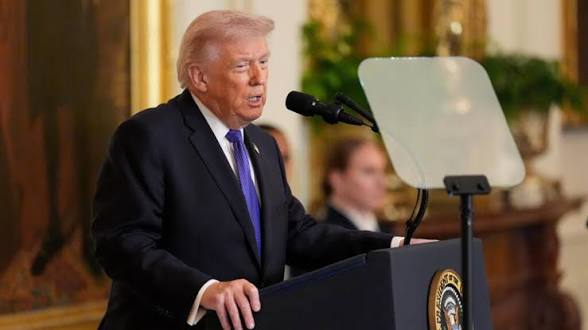
The Iran war is again at a critical point, with Donald Trump warning that Tehran faces a choice between reaching a deal with Washington or facing potentially devastating consequences.
U.S. President Donald Trump delivered the warning on Tuesday, September 22, during the United Nations General Assembly in New York, as the prolonged conflict with Iran remained at the centre of international attention.
Trump said he was considering whether to pursue an agreement with Iran or take much stronger military action against the Iranian regime. In remarks reported from his UN address, he asked whether he should “annihilate” Iran if diplomacy failed, while also suggesting that a deal could eventually be reached.
Trump points to possible deal after US midterms
Trump told reporters on Tuesday that he believed the United States could reach an agreement with Iran after the U.S. midterm elections scheduled for November 3. Reuters reported that Trump expressed confidence that a deal could be reached after the election.
The comments come after Trump told Axios last week that he was approaching a major decision over whether to launch renewed large-scale attacks against Iran. He said at the time: “Do I want to go in and annihilate them or do I not? It’s a big decision.”
Advertisement
That statement was made before his UN appearance and helps explain the significance of Tuesday's warning.
The confrontation is not limited to the United States and Iran.
The conflict has affected the wider Middle East, including shipping through the Strait of Hormuz, one of the world's most strategically important maritime routes. Iran has indicated that it could consider reopening the waterway if the United States reduces military pressure and lifts port blockades.
Any prolonged disruption in the region can have wider consequences for energy markets, shipping and businesses that depend on international trade. The Strait of Hormuz is particularly important because of its role in global oil transportation.
For ordinary people, developments around the conflict can therefore extend beyond the battlefield through fuel prices, transportation costs and the price of imported goods.
Iran also signals willingness to negotiate — under conditions
While Trump has maintained pressure on Tehran, diplomatic activity has also increased.
Reuters reported that Iran and the United States were signaling the possibility of renewed negotiations as both Trump and Iranian President Masoud Pezeshkian attended the UN General Assembly in New York. Iran's delegation has authority to negotiate, although no direct Trump-Pezeshkian meeting had been announced.
Iran has linked potential negotiations to conditions including reduced U.S. military pressure and changes affecting the Strait of Hormuz.
U.S. Secretary of State Marco Rubio has also indicated that Washington remains open to dialogue, even as the military confrontation continues.
Advertisement
The situation remains unresolved
Trump's latest remarks therefore leave two possibilities on the table: continued pressure and possible renewed military action, or another attempt at diplomacy.
His statement that he expects a deal after the November midterm elections adds a political timeline to the crisis, but it does not amount to a confirmed agreement with Iran. Reuters reported that no deal had been reached as of Tuesday.
For now, Washington and Tehran remain publicly far apart, even as diplomatic contacts appear to be increasing.
The next moves by the United States and Iran could affect not only the two countries, but also energy markets, shipping routes and economies far beyond the Middle East.
You must log in to comment or reply.
Comments