
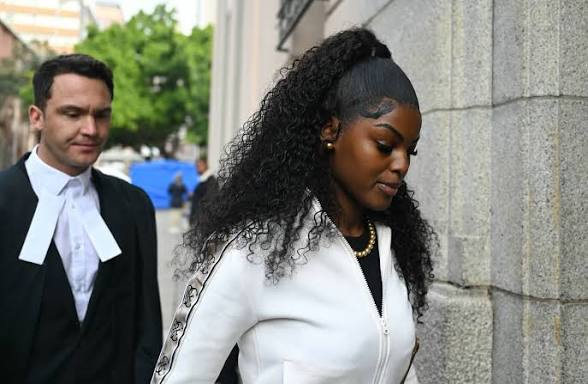
What began as a beauty pageant controversy has evolved into a complex legal battle spanning citizenship, immigration law, and national identity. As South Africa's courts continue to deliberate her fate, former Miss Universe Nigeria Chidimma Adetshina says the emotional toll is becoming increasingly difficult to bear.
Former Miss Universe Nigeria, Chidimma Adetshina, has revealed that she is "depressed" after a South African court postponed judgment in her deportation case until August 19, 2026.
The Cape Town Regional Court reserved judgment after hearing arguments from Adetshina's legal team and South Africa's Department of Home Affairs over whether she should remain free or be detained pending deportation.
Adetshina, 25, was arrested in Cape Town in June following allegations that she is residing in South Africa illegally.
According to South African authorities, Adetshina allegedly lacks valid immigration documents and continues to possess a South African passport despite also holding Nigerian citizenship. Prosecutors further argued that she obtained Nigerian passports for herself and her child before securing a South African visa and returning through Mozambique.
Her legal team strongly disputed those allegations, maintaining that she was born in South Africa, has limited ties to Nigeria, and poses no flight risk. They also argued that the Department of Home Affairs failed to conduct a fair investigation before invalidating her documents and noted that her citizenship remains the subject of a separate High Court challenge.
Instead of detention, her lawyers proposed that she report to immigration officials every two weeks while the legal process continues.
After Monday's hearing, Adetshina shared an emotional message on Instagram:
Advertisement
"Exhausted – Yes, Burnt out – Yes, Depressed – Yes, Will I give up, No! We no dey carry last. See you next month."
South Africa's SABC News focused primarily on the courtroom proceedings and the legal arguments surrounding whether Adetshina should be detained before deportation.
EWN (Eyewitness News) placed greater emphasis on the legal uncertainty created by a recent Western Cape High Court judgment, which held that magistrates cannot issue warrants for immigration detention because that authority belongs to immigration officers.
Meanwhile, Nigerian media, including Punch, highlighted Adetshina's emotional reaction after the hearing and reminded readers of her journey from withdrawing from Miss South Africa to becoming Miss Universe Nigeria and finishing as first runner-up at the Miss Universe competition.
One aspect that has received comparatively less attention is the wider legal complexity of the dispute. The current proceedings are not determining whether Adetshina is guilty of any offence but whether she should remain free while broader challenges to her immigration and citizenship status continue before South African courts.
The case has grown far beyond one individual's immigration status.
It has become one of South Africa's most closely watched citizenship disputes, raising difficult questions about nationality, identity, administrative due process, and immigration enforcement.
The controversy first erupted during the 2024 Miss South Africa competition after questions emerged regarding Adetshina's nationality. The resulting public debate led her to withdraw from the pageant, citing safety concerns for herself and her family.
Soon afterwards, she accepted an invitation to compete in Miss Universe Nigeria, where she won the national title before representing Nigeria internationally and securing the country's highest-ever placement as first runner-up at Miss Universe.
Her success transformed her into a celebrated public figure in Nigeria while simultaneously remaining at the centre of legal scrutiny in South Africa.
The current proceedings also highlight broader challenges facing countries dealing with increasingly complex questions surrounding dual nationality, migration, citizenship documentation, and administrative fairness.
Legal experts note that immigration disputes involving citizenship claims often require careful judicial review because decisions can affect not only residency rights but also personal identity, employment opportunities, travel, and family life.
Adetshina was born in Soweto, South Africa, to a Nigerian father of Igbo descent and a Mozambican mother.
South Africa's Department of Home Affairs has previously questioned aspects of documentation relating to her citizenship, while Adetshina continues to challenge those decisions through the courts.
Advertisement
The latest hearing follows earlier proceedings in which she submitted an affidavit outlining attempts to regularise her immigration status after authorities initiated deportation proceedings.
The legal process has also been influenced by a recent Western Cape High Court ruling that limited the authority of magistrates to issue warrants for immigration detention, adding another procedural layer to an already complex case.
Importantly, the allegations made by South African authorities remain contested. The court has not yet delivered a final judgment on the merits of either side's claims.
The Cape Town Regional Court is expected to deliver its ruling on August 19.
That decision will determine whether Adetshina should remain free while immigration proceedings continue or face detention pending deportation.
Whatever the outcome, the broader legal questions surrounding her citizenship are unlikely to end immediately, meaning the case could continue through South Africa's higher courts.
You must log in to comment or reply.
Comments