
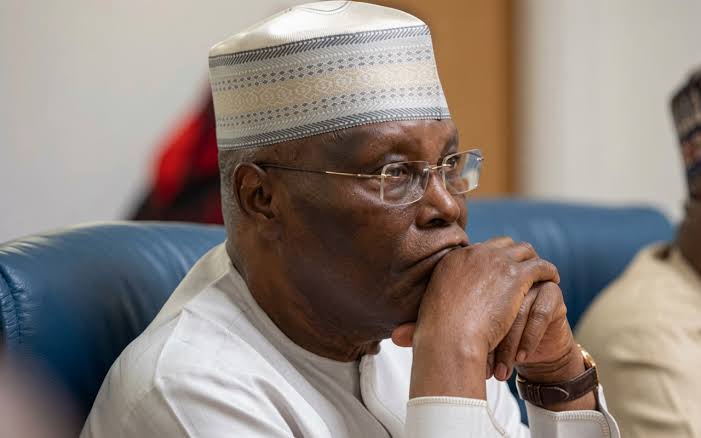
The latest exchange between former Vice President Atiku Abubakar and the Presidency has intensified Nigeria's political debate over President Bola Tinubu's past legal controversies, with both sides trading accusations instead of settling the issues at the center of public attention. As the country moves closer to the 2027 general election, the renewed confrontation highlights how historical legal matters and governance records continue to shape political narratives.
Rather than ending questions surrounding President Tinubu's 1993 U.S. civil forfeiture case, the Presidency's latest defense has triggered fresh arguments from the opposition, which insists that the government's response has only drawn greater attention to unresolved public concerns.
Former Vice President Atiku Abubakar, now the presidential candidate of the African Democratic Congress (ADC) for the 2027 election, criticized the Presidency after presidential spokesman Bayo Onanuga compared Atiku's record with China's justice system.
The dispute follows reports that a lobbying group linked to Atiku submitted petitions to U.S. President Donald Trump and the U.S. State Department concerning President Bola Tinubu's 1993 civil forfeiture case in the United States and other governance issues.
Responding through his Senior Special Assistant on Public Communication, Phrank Shaibu, Atiku argued that the Presidency had made a strategic mistake by invoking China as an example.
According to the statement, China is known for imposing some of the world's toughest penalties for serious narcotics offences, making the comparison counterproductive for the Presidency.
"It takes a peculiar kind of unintelligence for a spokesman to set out to drag an opponent before a hypothetical Chinese court, only to end up dragging his own principal into the dock," the statement said.
Advertisement
Atiku also maintained that he has never been indicted or convicted of corruption, drug-related offences, or any criminal offence in Nigeria or abroad.
He further questioned how Chinese authorities would have handled a civil forfeiture involving $460,000 connected to allegations of narcotics trafficking and money laundering—an apparent reference to President Tinubu's well-publicized 1993 U.S. civil forfeiture case.
The Presidency has consistently maintained that there are no outstanding criminal proceedings against President Tinubu in the United States and has cited diplomatic correspondence from U.S. authorities to support its position.
Most Nigerian media outlets reported the exchange as another chapter in the growing political rivalry between the Presidency and the opposition.
Punch Newspapers focused primarily on Atiku's criticism of the Presidency's use of China as a legal comparison while reproducing large portions of his official statement.
Legit.ng emphasized the political implications of Atiku's response and highlighted his argument that the comparison had unintentionally revived discussions about Tinubu's U.S. forfeiture case.
Other political news platforms gave more attention to Bayo Onanuga's earlier remarks accusing Atiku of presiding over a flawed privatization programme during the Obasanjo administration, framing the disagreement as a broader contest over the records of both political leaders.
However, many reports paid less attention to the broader implications of the dispute—particularly how historical legal controversies continue to dominate Nigeria's political discourse while pressing governance issues compete for public attention.
The renewed confrontation reflects a familiar pattern in Nigerian politics, where legal history and allegations from previous decades frequently resurface during election cycles.
President Tinubu's 1993 U.S. civil forfeiture proceeding has repeatedly become a subject of political debate. Although U.S. authorities have stated that there are currently no criminal proceedings against him, opposition figures continue to argue that the civil forfeiture remains relevant to questions of public accountability.
At the same time, the Presidency has attempted to redirect attention toward Atiku's own political record, particularly his role during Nigeria's privatization programme between 1999 and 2007.
This exchange illustrates how both major political camps are seeking to shape public perception ahead of the 2027 elections—not only through policy debates but also through competing narratives about integrity, accountability, and leadership.
For many Nigerians facing rising living costs, inflation, unemployment, and persistent insecurity, however, political arguments over decades-old controversies may increasingly be judged against current economic realities rather than historical allegations alone.
Advertisement
The 1993 U.S. civil forfeiture involving funds linked to President Tinubu has remained part of Nigeria's political conversation for years, resurfacing during election campaigns and major political contests.
Unlike a criminal conviction, a civil forfeiture proceeding does not necessarily establish criminal guilt. Nevertheless, the case has continued to generate political debate because of its association with allegations involving narcotics-related financial transactions.
Similarly, Atiku has faced political criticism over Nigeria's privatization programme during his tenure as Vice President, although he continues to deny allegations of corruption and insists he has never been convicted of any criminal offence.
With the 2027 election approaching, analysts expect historical controversies involving leading candidates to remain central themes alongside discussions on economic reforms, security, governance, and anti-corruption efforts.
The latest war of words underscores how political campaigns are increasingly being shaped by competing interpretations of past events as much as by present-day policy proposals.
Whether the public remains focused on historical legal disputes or shifts attention toward economic performance, inflation, security, and governance may influence the tone of Nigeria's political debate in the months ahead. The challenge for both the government and the opposition will be convincing voters that their responses address not only political rivalries but also the country's pressing national concerns.
You must log in to comment or reply.
Comments