
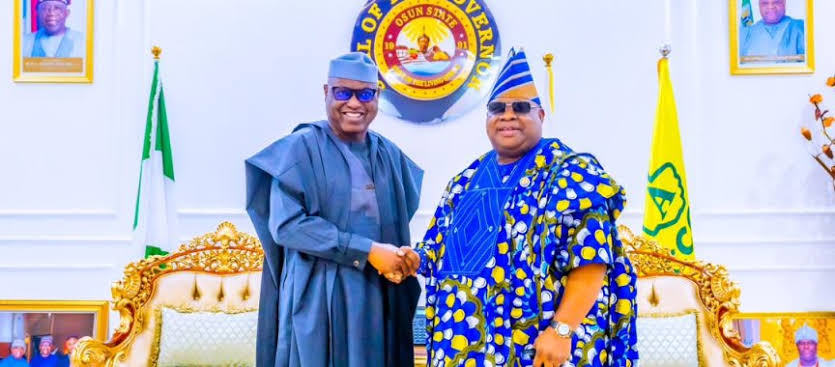
Ekiti State Governor Biodun Oyebanji has congratulated Osun State Governor Ademola Adeleke on his reported re-election after the August 15, 2026 governorship election. Oyebanji described the result as the choice of Osun voters and urged Adeleke to use his renewed mandate to bring other contestants and political groups into the task of governing the state.
The development comes after a closely contested election between Adeleke of the Accord Party and APC candidate Bola Oyebamiji, with the result carrying significance for political alignments in Osun and the wider South-West.
According to a statement reported by The PUNCH on August 16, Oyebanji congratulated Adeleke following the declaration of the Osun governorship election result.
Oyebanji said the outcome represented the preference expressed by the majority of voters and called on the re-elected governor to be magnanimous in victory.
He also congratulated Bola Oyebamiji, the APC candidate, describing him as a worthy challenger, while commending Osun APC members for what he described as a strong electoral contest.
The Ekiti governor further praised the Independent National Electoral Commission and security agencies for their roles in the election.
Oyebanji also credited President Bola Tinubu with providing what he described as a level playing field for the contestants. He argued that the conduct of the election and the resulting reduction in tension demonstrated the importance of allowing voters to make their choice.
However, his statement also contained a political assessment of the result. Oyebanji argued that Adeleke's victory should not be interpreted as a rejection of Tinubu and predicted that Osun voters would support the President in the 2027 presidential election.
That prediction is a political view attributed to Oyebanji and should not be treated as an established fact.
The significance of the development goes beyond a congratulatory message.
Advertisement
Adeleke's reported return to office would give the Osun governor another term to pursue the policies and projects of his administration. It also means the APC will have to reassess its strategy in a state where it had hoped to regain control through Oyebamiji.
The contest was closely watched because Adeleke entered the election seeking another mandate after leaving the Peoples Democratic Party for the Accord Party.
INEC's earlier published candidate information confirmed Adeleke as the Accord candidate and Oyebamiji as the APC candidate.
The election also followed months of intense political activity, with the two leading camps expressing confidence in victory before voting day.
For Osun residents, the most important issue now is likely to shift from campaigning to governance: whether the next administration can address infrastructure, public services, employment and other issues affecting residents.
Who are Adeleke and Oyebamiji?
Ademola Adeleke is the incumbent Osun governor and contested the 2026 election under the Accord Party.
Bola Oyebamiji was the APC candidate. Before the election, he had served as Managing Director of the National Inland Waterways Authority and previously held political office in Osun. INEC's final candidate list confirmed both men among the contenders.
Was the election expected to be competitive?
Yes. Before voting, the election was widely regarded as a major contest between Adeleke and Oyebamiji, although ADC candidate Najeem Salaam was also identified as a significant contender.
The Guardian reported before the election that Adeleke and Oyebamiji were the two leading candidates while concerns about electoral credibility, voter inducement and political tension remained part of the wider discussion.
What did Oyebanji say about Tinubu?
Oyebanji praised Tinubu for what he described as providing a level playing field during the election.
He further argued that Adeleke's victory should not be interpreted as an indication that Osun voters had rejected the President. That is Oyebanji's political assessment, rather than an independently established conclusion about voters' intentions.
What about the APC candidate?
Oyebanji congratulated Oyebamiji and urged Osun APC members to return to the drawing board and prepare for future elections.
That means the election result is also likely to trigger an internal review within the opposition party over its campaign strategy and performance.
The 2026 election was particularly significant because Adeleke's political journey to the poll was different from the one that brought him to office in 2022.
Adeleke won the 2022 Osun governorship election on the PDP platform, defeating incumbent Gboyega Oyetola of the APC. By 2026, however, Adeleke was contesting under the Accord Party following the political crisis that affected the PDP in the state and nationally.
Advertisement
The APC, meanwhile, selected Oyebamiji as its candidate as the party attempted to reclaim the state.
The election therefore tested not only the popularity of the incumbent governor but also the APC's ability to rebuild its electoral strength in Osun.
The result also has a wider political dimension because Osun is part of the South-West, a region that remains strategically important ahead of the 2027 general elections.
The immediate focus will be on the formal electoral processes following the declaration of the result, including any actions available to candidates or political parties under Nigeria's electoral and legal framework.
For Adeleke, the next major challenge is moving from electoral victory back to governance and delivering on the expectations associated with another mandate.
For the APC, the priority will be understanding why its candidate did not secure the governorship and determining how the party approaches future elections in the state.
Oyebanji's call for Adeleke to carry other contestants along also places attention on the need for political reconciliation after a competitive campaign.
Oyebanji's congratulatory message marks an early political reaction to the reported Osun election outcome. While he presented Adeleke's victory as the choice of voters, his comments about Tinubu and the 2027 presidential election remain political assessments rather than evidence of how Osun voters will vote in the future.
For now, the central issue is whether the reported election result will translate into a period of political stability and effective governance in Osun State.
You must log in to comment or reply.
Comments