
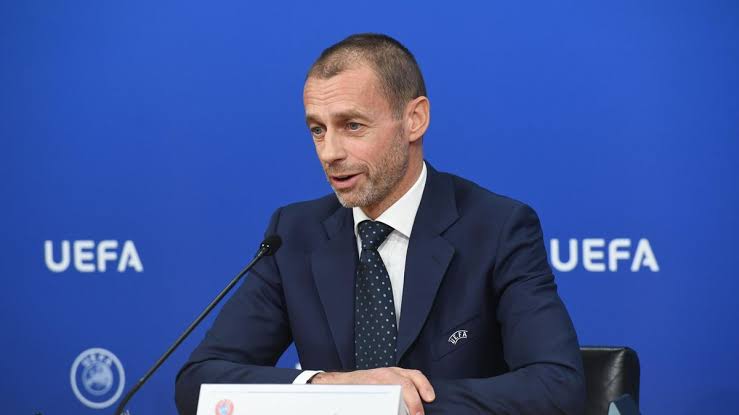
UEFA President Aleksander Ceferin has ruled himself out of running for FIFA president in 2027, but says Gianni Infantino could face an opponent if he seeks another term. His comments come amid growing opposition to Infantino following FIFA’s abandoned proposal to bring private investment into major tournament commercial rights. �
Reuters +1
The FIFA leadership contest is now becoming more uncertain, with the election scheduled for March 18, 2027, in Rabat, Morocco.
Ceferin said he is not interested in replacing Infantino as FIFA president.
Speaking to The Rest Is Politics: Leading podcast, the UEFA president said he preferred to remain at UEFA and suggested that staying outside the race would strengthen his credibility when challenging decisions made by FIFA's leadership.
Ceferin nevertheless delivered a significant warning about Infantino's political position.
He said Infantino has two options: recognise that he no longer has sufficient support and leave, or contest the March 2027 election and face a challenger.
Ceferin did not identify who that challenger would be.
The comments follow a major dispute over FIFA's FIFA Forward Enterprise proposal, which involved plans to attract private investment into commercial interests connected to FIFA competitions. The proposal was abandoned after opposition from UEFA and other football organisations.
The dispute has continued even after the proposal was shelved.
Advertisement
On August 23, six Nordic football associations — Sweden, Norway, Finland, Denmark, Iceland and the Faroe Islands — said they had lost confidence in Infantino's leadership. They also called for an independent external investigation into the FIFA Forward Enterprise proposal and demanded stronger guarantees against private ownership of FIFA governance or competitions.
The development matters because Infantino had previously appeared likely to face little or no serious opposition in the 2027 FIFA presidential election.
He has been FIFA president since 2016, and FIFA confirmed that its next presidential election will take place at the 77th FIFA Congress in Rabat on March 18, 2027.
The emergence of organised opposition could therefore change the political dynamics around the election.
However, opposition from UEFA or individual football associations does not automatically mean Infantino will lose. FIFA's presidency is decided through the votes of FIFA member associations, meaning a challenger would need to build sufficient support across the global football community.
Infantino also retains significant backing, particularly among associations that support FIFA's development programmes and increased financial distribution to less wealthy football nations. Reuters reported that Infantino has been presenting himself as an advocate for poorer football associations as he seeks another term.
Ceferin has explicitly ruled himself out of the 2027 FIFA presidential race.
He said his continued commitment to UEFA and his desire to maintain credibility as an independent critic were among the reasons for his decision.
Does Infantino have an opponent already?
Not officially, based on the latest reporting.
Ceferin said he expects a challenger if Infantino contests the election, but he did not name one. Victor Montagliani, president of CONCACAF, has been mentioned in reporting as a possible challenger, but that should not be treated as a confirmed candidacy.
Why is Infantino facing pressure?
The immediate dispute centres on FIFA's abandoned private-investment proposal.
UEFA and other football bodies objected to the proposal and raised broader concerns about FIFA's governance and the possibility of private ownership becoming involved in the organisation's competitions.
Has the investment proposal been abandoned?
Yes. The proposal that triggered the current dispute was shelved, but opposition to FIFA's handling of the matter has continued.
The six Nordic associations have called for an independent review of the proposal and FIFA's governance framework.
When is the FIFA presidential election?
The election is scheduled for March 18, 2027, in Rabat, Morocco. FIFA has also set November 18, 2026 as the deadline for challengers to nominate, according to AP reporting.
The disagreement represents a wider clash over how world football should be governed and financed.
Advertisement
UEFA has been particularly critical of Infantino's approach following the private-investment controversy. The opposition has extended beyond Europe, with the Asian Football Confederation and CONCACAF also supporting calls for an independent investigation into the FIFA Forward Enterprise proposal.
The Nordic associations' statement adds another layer to the dispute because it came from national football bodies rather than only UEFA's central leadership.
For Infantino, the challenge is therefore not simply whether Ceferin will run against him. The more important question is whether the current opposition can produce a credible candidate capable of attracting enough votes from FIFA's 200-plus member associations.
At the same time, Infantino is campaigning for another term and has continued to engage with football officials around the world. Reuters reported that he was in the Dominican Republic during the weekend as part of efforts to maintain support among football associations.
The immediate focus will be on whether an opposition candidate formally enters the FIFA presidential race before the November 18, 2026 nomination deadline.
The election itself will take place in Rabat on March 18, 2027.
Until a challenger is officially nominated, Ceferin's prediction that Infantino will face an opponent remains a political assessment rather than confirmation of a particular candidacy.
Ceferin's decision removes one of the most prominent potential challengers from the FIFA presidential race, but his criticism ensures that the controversy surrounding Infantino is unlikely to disappear.
The key unresolved issue is now whether the growing opposition will translate into a formal and sufficiently supported challenge before FIFA's November nomination deadline.
You must log in to comment or reply.
Comments