
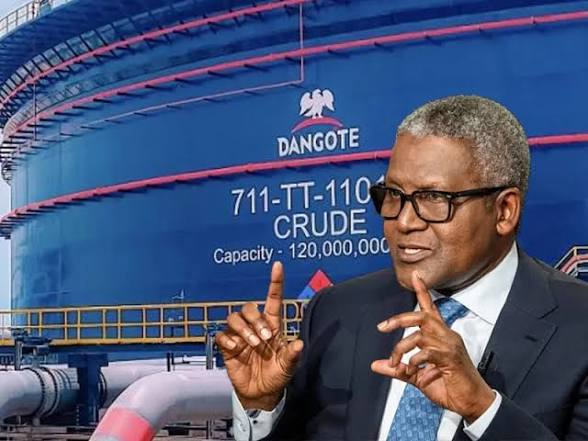
 Global conflicts often reshape markets in unexpected ways, creating winners alongside economic uncertainty. As tensions between the United States and Iran disrupted energy supply chains, Nigeria's Dangote Refinery appears to have emerged as one of the biggest commercial beneficiaries, underscoring how geopolitical events can quickly alter the fortunes of businesses far beyond the Middle East.
A report by The Wall Street Journal, cited by Punch Newspapers, says billionaire industrialist Aliko Dangote has benefited significantly from the recent disruption in global energy markets triggered by the US-Iran conflict.
According to the report, the $20 billion Dangote Refinery reached full production capacity in February 2026, positioning it to meet growing international demand for diesel, gasoline and jet fuel at a time when concerns over shipping through the Strait of Hormuz unsettled global markets.
The newspaper reported that Dangote's personal wealth has increased by approximately $4.86 billion since the beginning of the year, raising his estimated net worth to $34.8 billion, according to the Bloomberg Billionaires Index.
Dangote Industries Group Vice-President Devakumar Edwin disclosed that refinery output has risen by more than 70 percent this year. The company also plans to list the refinery on the Nigerian Exchange (NGX) before the end of 2026 with a target valuation of at least $50 billion, while pursuing a secondary listing that could take place in New York.
The company further plans to expand production capacity from 650,000 barrels per day to 1.4 million barrels daily by 2028, an investment estimated at $13 billion.
Advertisement
How Other Platforms Framed It
While Punch Newspapers highlighted the refinery's financial gains from the US-Iran conflict, The Wall Street Journal placed greater emphasis on the refinery's strategic timing, noting that it reached full capacity just as international buyers sought alternatives to supplies affected by Middle East tensions.
Meanwhile, business-focused coverage from international financial publications has concentrated on Dangote Refinery's broader transformation of Nigeria's downstream petroleum industry, highlighting its growing role as an exporter of refined petroleum products across Africa and Europe rather than simply a domestic fuel supplier.
An important detail receiving less attention in some reports is that the refinery's commercial success remains constrained by one persistent challenge: securing enough locally produced crude oil. Despite Nigeria being Africa's largest crude producer, domestic supply obligations and existing export commitments continue to limit the volume available to the refinery.
The Bigger Story Behind the Numbers
The refinery's recent gains illustrate how geopolitical shocks can create opportunities for producers outside traditional energy centres.
As uncertainty affected oil shipments through the Gulf region, buyers increasingly turned to suppliers capable of delivering refined products without relying on routes exposed to potential disruptions. Dangote Refinery's scale and operational readiness allowed Nigeria to capture part of that demand.
The development also carries domestic significance.
Higher exports generate additional foreign exchange earnings, helping strengthen Nigeria's external reserves while providing some support for the naira. Increased refining capacity may also improve the long-term stability of domestic fuel supplies, although local pump prices will still depend on crude oil costs, exchange rates and government policy.
For Nigeria's economy, the refinery represents more than a single industrial project. It has become central to efforts aimed at reducing dependence on imported petroleum products, improving energy security and positioning the country as a regional refining hub.
The Dangote Refinery is the largest single-train refinery in Africa, with an installed capacity of 650,000 barrels per day.
For decades, Nigeria exported crude oil while importing much of its refined fuel, exposing the economy to exchange-rate volatility and international supply disruptions.
Advertisement
The latest global tensions have once again demonstrated how vulnerable international energy markets remain. Previous geopolitical crises—including disruptions linked to the Russia-Ukraine war and earlier tensions in the Middle East—also triggered sharp movements in crude oil and refined fuel prices.
Against that backdrop, Nigeria's growing refining capacity could become an increasingly valuable strategic asset, provided adequate crude supply can be maintained.
The company is also expanding beyond Nigeria. According to the report, Dangote Industries plans to build a new refinery and port in Lamu, Kenya, while strengthening its distribution network through vessels, a logistics hub in Namibia and pipeline infrastructure serving several landlocked African countries.
The refinery's rapid expansion reflects growing confidence in its commercial prospects, but significant challenges remain. Securing reliable domestic crude supplies, completing planned capacity expansion and successfully listing the refinery on the stock market will all influence whether the project achieves its long-term ambitions.
As global energy markets continue responding to geopolitical uncertainty, the Dangote Refinery may increasingly become both a symbol of Nigeria's industrial capacity and a test of whether the country can fully leverage its vast energy resources for sustained economic growth.
You must log in to comment or reply.
Comments