
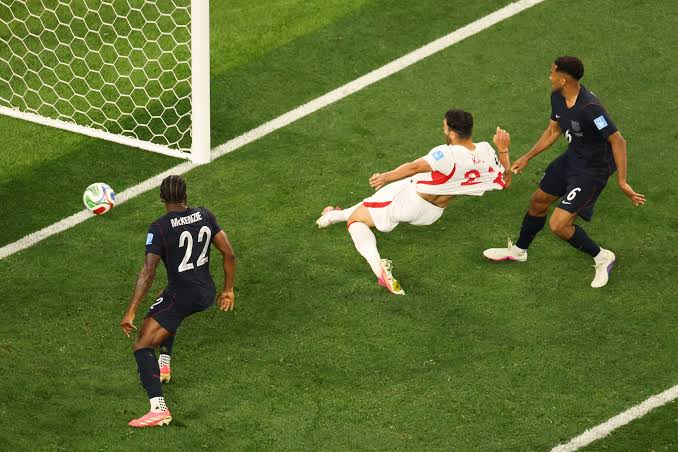
Momentum in a World Cup can create a sense of inevitability, but football has a habit of reminding teams that success is rarely linear. The United States had already secured top spot in Group D and qualification for the knockout stages, yet a dramatic 3-2 defeat to Turkey in Los Angeles exposed both the depth and the vulnerabilities of Mauricio Pochettino's side.
The result may not change the standings, but it has reopened an important debate: how much does a late defeat matter when bigger challenges lie ahead?
The United States entered Thursday's match against Turkey already confirmed as Group D winners and with one eye firmly on next week's Round of 32 clash against Bosnia-Herzegovina.
With the knockout stage approaching, coach Mauricio Pochettino made nine changes to his starting line-up in a bid to preserve key players and test squad depth.
The Americans made a dream start when defender Auston Trusty scored from a corner in less than three minutes. It was the Celtic defender's first international goal and the second-fastest goal ever scored by the United States at a FIFA World Cup.
Turkey, already eliminated after defeats to Paraguay and Australia, refused to leave the tournament quietly.
Real Madrid star Arda Guler levelled the score in the 10th minute after a clever attacking move involving Baris Alper Yilmaz. The same Yilmaz then put Turkey ahead in the 31st minute after being set up by Eren Elmali.
The United States responded immediately after the break. Sebastian Berhalter fired home in the 49th minute to make it 2-2 before Christian Pulisic, returning from injury, energized the crowd with an impressive cameo.
Advertisement
But deep into stoppage time, Kaan Ayhan struck from close range to hand Turkey a dramatic 3-2 victory and deny the Americans a perfect group-stage record.
For the United States, the defeat is less about points and more about perspective.
Pochettino's decision to rotate heavily suggests that the coaching staff view the tournament in stages rather than individual matches. In modern football, managing player fitness can be just as important as winning every game.
The defeat also highlighted an uncomfortable reality: the American squad still lacks the defensive consistency of the tournament's elite nations. Conceding three goals to an already eliminated side will raise questions about concentration and game management ahead of the knockout rounds.
Yet there is another interpretation.
The Americans have already achieved their first objective by topping the group, and the return of Christian Pulisic offers encouragement at precisely the right time. A single defeat, particularly in a dead-rubber encounter, may ultimately prove insignificant if the team responds positively against Bosnia-Herzegovina.
For Turkey, meanwhile, the victory serves as a reminder that even disappointing campaigns can end with a statement performance. After failing to score in their first two matches, the Turks rediscovered their attacking quality and left the tournament with renewed pride.
The official American view is clear.
Pochettino insisted the result would not damage his team's momentum.
«"What does it mean to win three group matches if you're going to be losing the next one and you're not going to be winning the World Cup?"»
His argument is straightforward: protecting players and preparing for the knockout stage is more important than preserving an unbeaten record.
However, critics may argue that momentum matters in tournament football. Winning breeds confidence, and conceding a stoppage-time winner can leave emotional scars, especially against a team that had already been eliminated.
Turkey's perspective is entirely different. For them, this was not merely a consolation victory. It was proof that the team possessed more quality than their earlier performances suggested and that their tournament exit does not tell the full story.
For American football, expectations surrounding this World Cup are enormous.
Advertisement
As one of the tournament's co-hosts, the United States faces pressure to deliver a deep run and demonstrate that the country's growing investment in football is producing results on the biggest stage.
The defeat also serves as a warning to other contenders. Squad rotation may be necessary, but it can disrupt rhythm and expose weaknesses.
For fans across Nigeria and the rest of Africa, the game offers a familiar lesson seen repeatedly in major tournaments: group-stage success means little if a team cannot sustain its level when the knockout rounds begin.
The real test for the United States starts now.
Ultimately, the question remains whether this defeat was merely an inconsequential stumble or an early sign of vulnerabilities that stronger opponents could exploit.
Pochettino appears convinced it is the former. The players, gathered in a circle after the final whistle, seemed equally determined to move forward.
What happens against Bosnia-Herzegovina will define whether this dramatic loss to Turkey becomes a forgotten footnote—or the first warning sign of a campaign beginning to lose its momentum.
You must log in to comment or reply.
Comments