
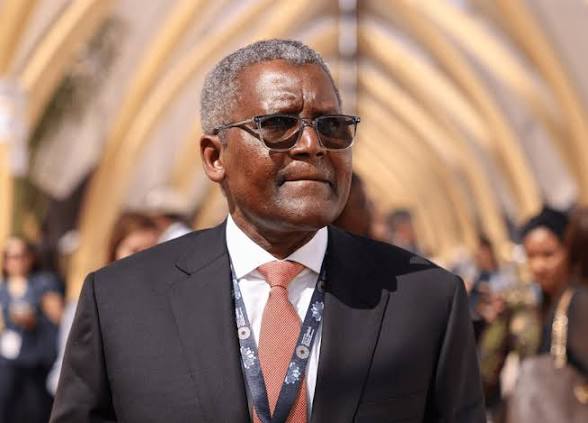
For Nigerian businesses and consumers that depend on reliable fuel supplies, the planned expansion of the Dangote Petroleum Refinery represents a potentially significant development in the country’s energy system. The company says the facility is being positioned to process more crude and serve a wider range of markets in Africa and internationally.
The development could also affect businesses that depend on petroleum products, aviation fuel and other refined products, although the longer-term effects will depend on how the expansion is completed and how the market responds.
Dangote Group Chairman Aliko Dangote said on Monday, September 7, that the Dangote Petroleum Refinery and Petrochemicals could become the world’s largest refinery by 2028.
He made the statement in Abuja during the preliminary signing ceremony for the proposed initial public offering of the refinery.
The facility, located in Lagos, is already Africa’s largest refinery and the world’s largest single-train refinery. The company has announced plans to expand its refining capacity by another 700,000 barrels per day, potentially taking the facility towards 1.4 million barrels per day.
Dangote described the proposed IPO as an important milestone for the company, Nigeria and Africa.
The planned share offering would also open ownership of the refinery to investors. Dangote said there would be no segregation over who could own the shares and that the company wanted people across the continent to participate.
Dangote said the refinery was developed over more than a decade with support from its bankers, who he said backed the project even before seeing the refinery site or its licence.
Advertisement
“Today also shows that nothing is impossible for us to achieve once we are focused and determined,” Dangote said.
He also linked the refinery to the group's wider industrialisation plans, arguing that reliable energy supplies are essential for African economic development.
“We have learned the hard way, and we cannot industrialise if we do not have the energy security,” he said.
Dangote Refinery CEO David Bird said the facility is operating as a merchant refinery serving Nigeria and markets across West Africa while also expanding into international markets.
Bird said the refinery has become the largest supplier of jet fuel to Europe and has performed strongly over the past six months.
He said the planned expansion has already been sponsored, engineered and procured, with construction remaining the major outstanding stage.
“This is now just a construction exercise that we believe we can deliver by 2028 to make the Dangote refinery the largest integrated refinery and petrochemical complex on the planet,” Bird said.
The refinery's development matters beyond the facility itself because refined petroleum products are used across several parts of the economy.
Transport operators depend on fuel to move passengers and goods. Manufacturers require energy to operate machinery and transport products. Airlines require aviation fuel, while businesses across Nigeria and West Africa depend on steady petroleum-product supplies.
The refinery is also expanding its role in international markets. Bird said it can process different grades of crude and supply several international markets.
The company's expansion plans therefore go beyond increasing the amount of fuel available in Nigeria. Dangote Group says its broader investment strategy is aimed at strengthening energy security in Nigeria while supporting industrialisation elsewhere in Africa.
The group has announced expansion plans in countries including Ethiopia, Kenya, Tanzania and Namibia, according to Dangote.
For ordinary Nigerians, the most important issue is not simply the size of the refinery but what increased refining capacity could mean for the wider energy supply chain.
A larger facility could give businesses involved in transportation, manufacturing, aviation and other industries access to a major regional source of refined petroleum products.
The refinery's international operations also show that Nigerian-produced petroleum products are increasingly competing in overseas markets.
Advertisement
However, the size of the planned expansion alone does not determine what consumers will pay for fuel or other products. Prices will continue to depend on crude oil costs, exchange rates, logistics, taxes, market conditions and other factors.
The immediate development is the proposed IPO process.
The refinery has begun preparations for the public share offering, while construction remains the major outstanding phase of the planned expansion.
If the expansion is completed as planned by 2028, Dangote says the refinery would become the world's largest integrated refinery and petrochemical complex.
For now, that remains a company target, rather than an achievement that has already occurred.
The Dangote refinery has already changed Nigeria's refining landscape. Its planned expansion would take that development further, with the company seeking to increase capacity while serving both Nigerian and international markets.
The key test now is whether the planned construction can be completed by 2028 and how the expanded facility ultimately affects Nigeria's energy supply and businesses.
You must log in to comment or reply.
Comments