
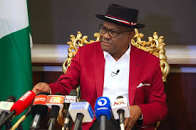
Federal Capital Territory Minister Nyesom Wike has accused Imo State Governor Hope Uzodinma and Kwara State Governor AbdulRahman AbdulRazaq of working against him politically, exposing another layer of tension among politicians who are otherwise aligned with President Bola Tinubu ahead of the 2027 election.
Wike made the allegations during a media chat in Port Harcourt on Wednesday, September 2, 2026. He said his disagreements with the two governors were rooted partly in what he described as a failure to reciprocate political support he had previously provided.
The remarks are significant because Wike remains a PDP member while serving in Tinubu's APC-led federal government and has repeatedly declared support for the President's 2027 re-election. His latest comments therefore point to a distinction between supporting Tinubu nationally and maintaining political relationships with individual APC governors.
The immediate evidence is Wike's own account of his relationships with the two governors.
His strongest criticism was directed at AbdulRahman AbdulRazaq of Kwara. Wike alleged that the governor had been "championing" a campaign against him and said he had confronted AbdulRazaq personally.
Wike further claimed that AbdulRazaq had accused him of sponsoring political candidates opposed to the governor's preferred choices in Kwara.
Those claims remain allegations made by Wike. The reports available do not establish independently that AbdulRazaq organised a campaign against the minister or sponsored opposition to him.
Wike's comments about Uzodinma were shorter. He said the Imo governor knew the support he had previously received from him and complained that Uzodinma had declined to support him at a point when he needed it.
There is also historical evidence that the relationship between Wike and Uzodinma has not always been hostile. In May 2023, shortly before leaving office as Rivers governor, Wike honoured Uzodinma with the Grand Service Star of Rivers State, describing the Imo governor among public officials he considered distinguished in service.
That history helps explain why Wike's present complaint is framed around reciprocity of political support, rather than simply ideological disagreement.
The wider issue is the unusual political position Wike occupies.
Wike contested the 2023 presidential primary as a PDP politician and subsequently became a minister under Tinubu, who leads the APC administration. The Federal Capital Development Authority identifies Wike as the serving FCT minister and records that he was sworn into the position on August 21, 2023.
Yet Wike has continued to identify with the PDP. In March 2026, he said the PDP would participate in the 2027 election, even while maintaining his support for Tinubu's re-election.
Advertisement
This creates an unusual political arrangement: Wike can support Tinubu for president while remaining outside the APC as a formal party member.
His comments about Uzodinma and AbdulRazaq suggest that his political calculations also extend beyond formal party structures. Personal alliances, state-level interests and competing candidates can produce conflicts even among politicians who ultimately support the same presidential candidate.
Wike's complaint about Kwara appears to involve the question of who controls political alliances in the state.
According to his account, AbdulRazaq objected to Wike's alleged involvement with candidates competing against people backed by the governor. Wike, however, argued that he had provided political space for aggrieved APC politicians who moved into the PDP rather than joining the anti-Tinubu coalition.
That is an important distinction.
Wike is effectively presenting his political activity as part of the broader struggle over where politicians who oppose particular APC figures—but may still support Tinubu—should position themselves.
However, the available reports do not provide AbdulRazaq's response to Wike's latest allegations. That means the governor's explanation of the dispute remains an important missing part of the account.
The disagreement with Uzodinma also has a longer background.
In 2022, when Wike was still Rivers governor and an influential PDP figure, Imo government officials publicly criticised his intervention in the state's politics. The dispute demonstrated that relations between the two politicians had previously crossed party and state political boundaries.
At the same time, Wike's decision to honour Uzodinma only months before leaving office demonstrates that political relationships can change considerably over time.
That history makes it difficult to reduce the current disagreement to a simple APC-versus-PDP conflict.
Despite his accusations, Wike said the disagreements would not change his larger political objective.
He maintained that he remains focused on helping Tinubu secure another term in 2027. This is consistent with his recent public comments.
In August, Wike said he was not interested in becoming director-general of the APC presidential campaign organisation and instead said his focus was on delivering Rivers State and the FCT for Tinubu.
That position is important when assessing his latest comments.
His criticism of two APC governors does not, based on the available evidence, amount to a withdrawal of support for Tinubu.
Rather, Wike is distinguishing between disagreements with individual APC politicians and his stated support for the President.
There are currently two principal positions documented in the dispute.
Wike's position: He says he previously supported Uzodinma and AbdulRazaq politically and believes that support has not been reciprocated. He particularly accuses AbdulRazaq of campaigning against him.
The governors' position: Their direct responses to these latest allegations were not contained in the reports reviewed for this article. Consequently, claims that they are deliberately conducting a political campaign against Wike should not be presented as established facts.
This distinction matters because political accusations can quickly become treated as facts when repeated during an election cycle.
What the development means
The immediate significance is that political competition ahead of 2027 is becoming increasingly visible even among figures who support the same presidential candidate.
For Tinubu's re-election effort, this could matter because presidential campaigns depend not only on national alliances but also on relationships with state-level political structures.
Wike has already identified Rivers and the FCT as areas where he intends to help Tinubu.
His dispute with governors in other states therefore illustrates a broader feature of Nigerian electoral politics: support for a presidential candidate does not necessarily eliminate competition between influential politicians over candidates, local structures and political influence.
Advertisement
Several questions remain unanswered.
What specific actions does Wike regard as AbdulRazaq's "campaign" against him?
What evidence does Wike have for the allegation?
How does AbdulRazaq respond to the accusation?
What specific support does Wike say he provided to Uzodinma and AbdulRazaq?
Why did Uzodinma allegedly decline to support Wike when the minister says he needed his backing?
Will the disagreements affect cooperation among Tinubu's supporters before the 2027 election?
None of these questions can be conclusively answered from Wike's latest comments alone.
The immediate development to watch is whether AbdulRazaq or Uzodinma publicly responds to Wike's allegations.
The broader political test will come as the 2027 election approaches and politicians supporting Tinubu attempt to reconcile national cooperation with competing interests in individual states.
For now, the confirmed position is that Wike continues to back Tinubu's re-election while openly acknowledging political disagreements with two APC governors.
The unresolved question is whether those disagreements remain personal political disputes or develop into a more consequential struggle over candidates and political structures ahead of 2027.
You must log in to comment or reply.
Comments