
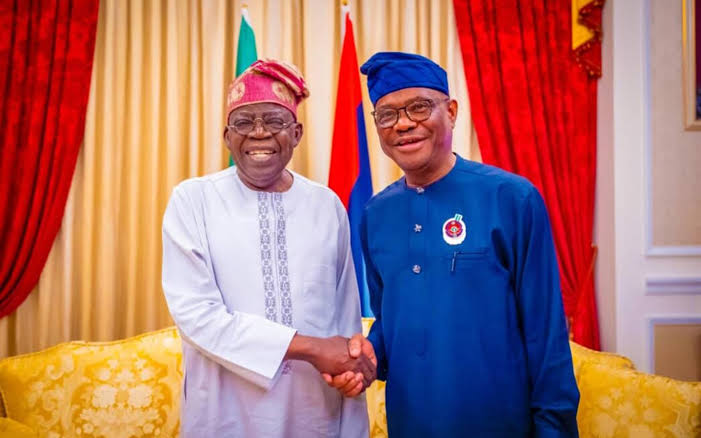
Nyesom Wike’s decision to personally lead campaign teams for President Bola Tinubu in the FCT and Rivers State adds another layer to an already complicated political landscape ahead of Nigeria’s 2027 election. The announcement is significant not simply because of Wike’s support for Tinubu, but because of the question it raises over how that support will interact with the established structures of the ruling APC.
Wike, the Minister of the Federal Capital Territory, announced on Friday, September 25, that he would soon inaugurate campaign teams for Tinubu in the FCT and Rivers and personally lead them.
He made the statement in Abuja after inspecting the ongoing Kuje-Gwagwalada road dualisation project. Wike said supporters of the president from different political platforms had already prepared their mobilisation machinery.
“Very soon, I will inaugurate the campaign team for Tinubu in the FCT and Rivers, which I will lead,” he said.
Wike also linked the administration’s infrastructure projects in Abuja to the 2027 political contest, arguing that residents would respond positively to visible development.
Advertisement
The interesting part of Wike’s position is that his political support for Tinubu does not neatly fit into conventional party lines. Wike remains associated with the opposition PDP while serving in Tinubu’s APC-led Federal Government, and he has promoted a broader political coalition that he says can support Tinubu at the presidential level while backing other candidates at state and legislative levels.
That approach has already generated friction with some APC leaders. The Guardian reported this week that the emerging Rainbow Coalition has become part of a wider dispute over who controls the political machinery that will mobilise support for Tinubu in 2027.
Wike’s new announcement therefore goes beyond a personal endorsement. It places him directly at the centre of campaign mobilisation in two politically important territories while leaving open the question of how his proposed structure will coexist with formal APC structures.
From Wike’s perspective, the argument is straightforward: political actors from different platforms can cooperate on the presidential contest while maintaining separate interests in other elections. His recent comments have consistently presented his support for Tinubu as compatible with broader political alliances.
Some APC stakeholders see the situation differently. Critics within the party have warned that Wike’s Rainbow Coalition should not become a parallel structure competing with APC governors, candidates and party organs. The APC Grassroots Organisation, for example, has argued that support for Tinubu should strengthen rather than weaken the party's established machinery.
The disagreement is therefore less about whether Wike supports Tinubu and more about who controls the machinery through which that support is converted into electoral mobilisation.
Wike is also placing considerable emphasis on governance and infrastructure.
During his inspection of FCT projects, he argued that completed roads and other developments would demonstrate the administration's performance to voters. The Kuje-Gwagwalada project itself has been identified by the Presidency as a significant FCT infrastructure project.
But infrastructure delivery and electoral behaviour are not automatically the same thing. Completed projects can become part of a government's political message, while voters ultimately make decisions based on a much wider range of factors, including economic conditions, local political alliances, candidate preferences and perceptions of governance.
That distinction matters because Wike's assertion that projects will translate directly into votes is a political argument rather than an established electoral outcome.
Advertisement
In the FCT and Rivers, Wike's announcement places greater attention on the competing networks forming ahead of the presidential election.
The FCT is particularly important because Wike controls a major administrative portfolio there and has made infrastructure delivery a central part of his public messaging. Rivers, meanwhile, remains deeply connected to his political base and to the continuing realignment of political forces in the state.
The wider question is whether multiple pro-Tinubu political structures can operate alongside the APC's formal machinery without creating competition over candidates, influence and grassroots mobilisation. Recent disagreements between Wike and APC governors show that this issue is already politically sensitive.
Ultimately, Wike's announcement is less a conclusion than another indication of how unusual the 2027 political alignment is becoming. A politician identified with the opposition can simultaneously campaign for an incumbent president while maintaining a separate political coalition. Whether that arrangement produces broader coordination or deeper competition will depend on how the various political structures negotiate their interests as the election approaches.
You must log in to comment or reply.
Comments