
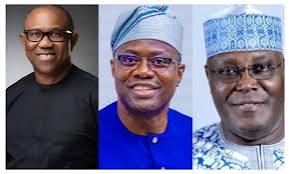
Nigeria’s opposition landscape shifted sharply on Thursday as several heavyweight politicians intensified moves that could define the country’s 2027 presidential election. From Abuja to Ibadan, declarations, alliances, and public attacks on the ruling party revealed an increasingly coordinated attempt to challenge President Bola Tinubu and the ruling All Progressives Congress.
Beyond campaign rhetoric, the growing opposition activity reflects deeper concerns over inflation, insecurity, political fragmentation, and rising frustration among many Nigerians struggling with economic hardship. What is emerging is no longer isolated ambition from individual politicians, but an early battle over who becomes the most credible alternative to the current administration.
Former Vice President Atiku Abubakar formally submitted his presidential nomination form under the African Democratic Congress in Abuja, describing his campaign as a “national movement” aimed at rescuing Nigeria from economic and political decline.
“The march to restore prosperity and better days to our beloved nation took a firm and decisive step forward,” Atiku said after submitting his form. “This is more than a political journey; it is a national movement rooted in hope, renewal, and the collective resolve to save Nigeria from despair.”
At nearly the same time, former Rivers State governor and ex-Minister of Transportation Rotimi Amaechi also submitted his ADC nomination form and launched one of the sharpest attacks yet on the Tinubu administration’s political philosophy.
“It is Emilokan that brought us here,” Amaechi said, referencing the slogan associated with Tinubu’s 2023 campaign. “Nigerians are suffering.”
Amaechi argued that the country could no longer afford leadership built around ethnicity, religion, or regional entitlement. He urged voters to focus instead on competence and governance records.
Advertisement
“The current president has put us in this suffering,” he stated. “Nigerians should vote for merit.”
Meanwhile in Ibadan, Oyo State Governor Seyi Makinde formally declared his presidential ambition under a newly announced alliance involving the Peoples Democratic Party and the Allied Peoples’ Movement.
Makinde used the event to accuse the ruling party of weakening democratic competition and pushing Nigeria toward a one-party political structure.
“We have continued to witness interference in the affairs of opposition parties,” he said. “Without a multi-party system, there can be no true democracy.”
He described the new coalition as the beginning of what he called the “Reset Nigeria Movement,” positioning it as a broader opposition platform beyond traditional party lines.
Former Anambra State governor Peter Obi also reignited debate around presidential tenure after promising publicly that he would serve only one term if elected under the Nigeria Democratic Congress platform.
“I will not stay a day longer than four years,” Obi said during an interview with News Central TV. “Even with a gun to my head.”
Obi referenced former world leaders including Nelson Mandela and Abraham Lincoln while arguing that prolonged political power often damages democratic accountability.
However, a closer look at the emerging opposition landscape shows that unity may still be the opposition’s biggest challenge. While several parties now publicly oppose Tinubu’s re-election ambitions, no single coalition has fully consolidated around one candidate.
Yet the deeper issue is not only who contests the election, but whether opposition parties can avoid splitting anti-incumbent votes across multiple regions and ethnic blocs. Nigeria’s presidential elections have historically rewarded broad coalitions capable of combining northern and southern voting strength.
That challenge became visible in the 2023 election when opposition votes were divided among multiple candidates despite widespread public dissatisfaction with economic conditions. Political analysts warn that a repeat scenario in 2027 could benefit the APC unless opposition leaders eventually negotiate a common front.
Economic realities are also shaping the tone of the early campaigns. Since subsidy removal and currency reforms under the Tinubu administration, inflation has remained high while food, transportation, and electricity costs have continued to pressure households and small businesses across cities including Lagos, Abuja, Port Harcourt, Kano, and Ibadan.
Advertisement
Opposition figures are increasingly framing the election around economic survival rather than traditional regional or ethnic politics. That messaging appears designed to connect with urban voters, young Nigerians, and small business owners frustrated by declining purchasing power.
Historically, Nigerian opposition alliances have struggled to survive internal rivalry. Similar coalition attempts before previous elections often collapsed over zoning disagreements, personal ambition, and disputes over party structure. What makes the current situation more complex is that several opposition politicians entering the race were themselves former insiders within governments they now criticise.
Amaechi served as a senior minister under the APC administration. Atiku was previously a PDP presidential candidate multiple times. Obi emerged as one of the strongest opposition figures in 2023, while Makinde remains one of the PDP’s most influential governors.
That overlap creates both strength and vulnerability. While the opposition can claim executive experience, critics may also question whether the same political class can truly deliver a different outcome.
The real issue now is whether opposition parties can transform public frustration into a coordinated national movement rather than another fragmented contest dominated by personality clashes. With nearly two years before the next presidential election, the battle for alliances, regional influence, and voter trust has already begun — and it is likely to intensify as Nigeria’s economic pressures continue shaping political sentiment.
You must log in to comment or reply.
Comments