
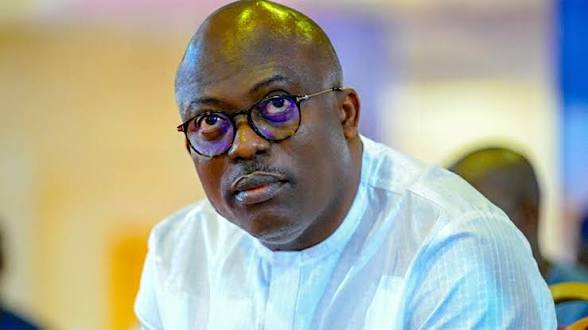
Political tensions ahead of the 2027 elections continue to reshape conversations across Rivers State, with Governor Siminalayi Fubara forced to publicly address rumours about his alleged exit from the All Progressives Congress, APC.
The governor’s clarification comes at a sensitive moment for Nigerian politics, where defections, coalition talks, and regional alignments are already influencing calculations ahead of the next general election.
Rivers State Governor, Siminalayi Fubara, on Wednesday dismissed reports circulating on social media claiming he had defected from the APC to the Nigerian Democratic Congress, NDC.
Speaking with journalists after inspecting the reconstructed Rivers State Psychiatric Hospital in Rumuigbo, Obio/Akpor Local Government Area, the governor insisted that he remains fully committed to the ruling party.
According to Fubara:
“I’m a member of the APC, and nothing has changed. Whatever happens, what is important is supporting the overall interest of the party.”
Advertisement
The governor urged residents and political supporters to disregard rumours suggesting he had switched political allegiance.
He also used the hospital inspection to highlight ongoing healthcare projects under his administration, explaining that the former psychiatric facility was upgraded into a general hospital to improve healthcare access for residents in surrounding communities.
Fubara noted that many residents previously relied heavily on the University of Port Harcourt Teaching Hospital due to the absence of closer treatment centres.
In Nigeria’s political landscape, defection rumours are rarely dismissed as ordinary gossip, especially when they involve governors controlling economically strategic states.
What makes this more complex is the growing uncertainty surrounding coalition-building ahead of the 2027 presidential race. Political actors across multiple parties are already repositioning, even as the Independent National Electoral Commission, INEC, continues to warn against premature campaigns.
Fubara’s public reaffirmation of loyalty to the APC appears aimed not only at calming supporters but also at sending a message to party stakeholders monitoring political stability in Rivers State.
Beyond the official statement, the development also reflects how social media speculation increasingly shapes political narratives before formal declarations are made.
In recent election cycles, rumours of defections have often triggered negotiations, internal party tensions, and shifts in political loyalty long before campaign season officially begins.
While the political clarification dominated headlines, the hospital inspection itself carried governance implications that received less attention in many reports.
Fubara said the upgraded health facility was designed to address healthcare access challenges in Obio/Akpor and nearby communities.
The governor stated that residents previously travelled long distances to receive treatment, placing pressure on larger referral hospitals in Port Harcourt.
Advertisement
At a time when healthcare infrastructure remains uneven across many Nigerian states, projects tied directly to local service delivery could become politically valuable ahead of future elections.
Governors across Nigeria are increasingly using infrastructure and healthcare projects to reinforce public support amid rising economic pressures and voter dissatisfaction over inflation and living costs.
Rivers State has remained central to national political calculations for decades due to its economic importance, voting strength, and influence within the South-South region.
Nigeria has also witnessed frequent high-profile defections in previous election cycles, particularly between ruling and opposition parties. Ahead of the 2019 and 2023 elections, several governors and lawmakers switched parties as alliances shifted nationally.
Current political tensions suggest the 2027 cycle may produce another wave of strategic repositioning.
You must log in to comment or reply.
Comments