
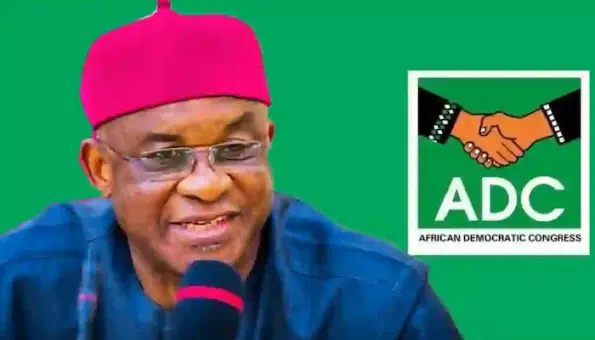
Confusion over leadership within the African Democratic Congress is deepening at a sensitive political moment, with implications for opposition alignment ahead of the 2027 elections. A viral claim suggesting a leadership shake-up has now been firmly rejected by the party, but the underlying crisis remains unresolved.
On April 5, 2026, the ADC dismissed reports alleging that David Mark stepped aside as national chairman to allow Ralph Nwosu return to leadership ahead of the party’s convention. The denial, issued by spokesman Bolaji Abdullahi, described the claim as “fake news” and urged the public to disregard it.
However, a closer look shows the controversy did not emerge in isolation. The confusion followed a decision by the Independent National Electoral Commission (INEC) to remove the names of the party’s National Working Committee from its official portal. INEC cited a Court of Appeal ruling delivered on March 12, 2026, which directed all parties involved in the dispute to maintain the status quo pending a final judgment at the Federal High Court in Abuja.
Advertisement
While Vanguard’s report focused on the denial itself, other platforms covering the ADC crisis have placed more emphasis on the legal battle and factional rivalry shaping the party’s internal dynamics. That framing leaves out a key implication: the misinformation around leadership change reflects deeper uncertainty about who truly controls the party structure at a time when strategic positioning for 2027 is already underway.
Beyond the official statement, the dispute highlights a recurring challenge within Nigeria’s opposition parties — internal fragmentation at critical political moments. With factions linked to different power blocs, including those aligned with both Mark and other claimants, the absence of a clear leadership structure risks weakening the party’s credibility among voters and potential coalition partners.
What makes this more complex is the timing. The ADC has scheduled its national convention for April 14 in Abuja, a move that suggests one faction is pushing ahead despite legal ambiguities. Yet the Court of Appeal’s directive to maintain the status quo introduces legal uncertainty around any decisions taken at such a convention. That contradiction could trigger further disputes, especially if outcomes are contested in court.
Nigeria has faced similar party leadership crises in the past. In the years leading up to the 2019 elections, internal disputes within major parties led to parallel conventions, prolonged litigation, and, in some cases, weakened electoral performance. Current trends suggest history may be repeating itself, particularly as smaller parties attempt to reposition as viable alternatives in a highly competitive political landscape.
Advertisement
The bigger issue is not just whether a leadership change occurred — it is the credibility gap created when legal rulings, regulatory actions, and internal party politics collide in the public space. For party members at the grassroots level, especially in politically active states like Lagos, Kano, and Rivers, such uncertainty can translate into confusion over loyalty, mobilisation, and campaign direction.
You must log in to comment or reply.
Comments