
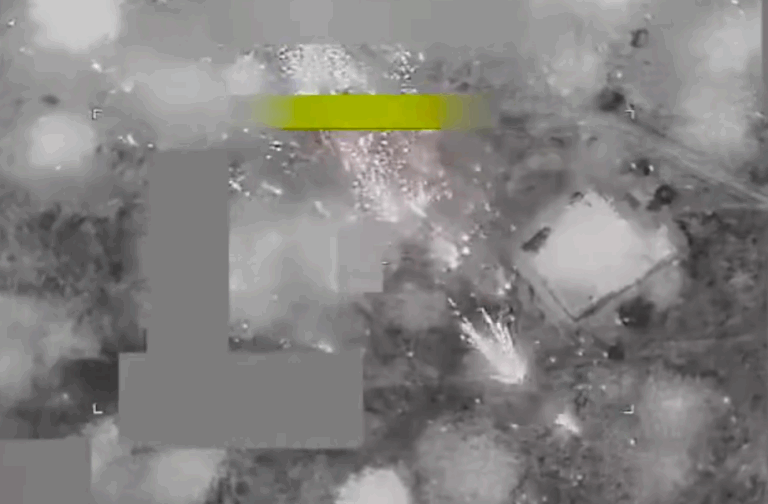
Fresh footage released by the United States Africa Command has pushed the Nigeria-US counterterrorism operation back into global focus, offering the first visual confirmation of a mission that both Washington and Abuja describe as a major strike against ISIS operations in Africa.
The video, released hours after President Donald Trump and Nigerian authorities confirmed the operation, has intensified international attention on the growing security partnership between Nigeria and the United States — and on the wider threat posed by extremist networks operating across the Lake Chad region.
According to AFRICOM, the coordinated strike targeted Abu-Bilal al-Minuki, a senior ISIS operative accused of overseeing global operational activities for the group. The command said the operation was carried out on May 16, 2026, in northeastern Nigeria in collaboration with the Armed Forces of Nigeria.
In the footage shared online, aerial surveillance and precision strike visuals appear to show military assets tracking and engaging suspected ISIS positions in remote terrain believed to be within the broader Lake Chad Basin region. AFRICOM did not disclose the exact operational location, but officials described the mission as the result of months of intelligence coordination between both countries.
The release of the footage marks a shift from the earlier announcement made by President Trump on Truth Social, where he described the mission as a “meticulously planned and very complex operation” involving American forces and Nigerian troops.
“Tonight, at my direction, brave American forces and the Armed Forces of Nigeria flawlessly executed a meticulously planned and very complex mission,” Trump said, adding that Abu-Bilal al-Minuki “will no longer terrorize the people of Africa.”
Advertisement
AFRICOM commander, U.S. Air Force Gen. Dagvin Anderson, also described the operation as evidence of expanding military cooperation between Nigeria and the United States.
“This operation underscores the exceptional value of the U.S.-Nigeria partnership and was made possible through the cooperation and coordination of our forces in recent months,” Anderson said.
Beyond confirming the strike, the video serves as a geopolitical message. It signals renewed American counterterrorism engagement in West Africa at a time when instability across the Sahel has created new openings for extremist groups linked to ISIS and Al-Qaeda.
That framing also reflects growing concern among Western security agencies that ISIS-affiliated factions in the Lake Chad region are becoming more sophisticated in drone usage, financing operations, propaganda distribution, and cross-border coordination.
AFRICOM alleged that al-Minuki played a significant role in ISIS global operations, including media coordination, explosives development, weapons logistics, and hostage-related activities.
Yet the deeper issue is that the elimination of high-profile commanders has not always translated into long-term stability on the ground.
Nigeria has recorded several major military victories against insurgent leaders over the past decade, particularly during operations targeting Boko Haram and ISWAP strongholds in Borno State and surrounding regions. Despite those successes, attacks on civilian communities, military formations, and transportation routes have continued in varying forms.
Security analysts increasingly warn that extremist groups across West Africa now operate through decentralized cells capable of adapting even after losing senior commanders.
That makes the AFRICOM footage politically important as much as militarily significant. The visual release reinforces confidence in the operation, but it also raises expectations about whether Nigeria and its allies can sustain pressure on insurgent networks beyond headline-making strikes.
The development may also influence broader security discussions around foreign military involvement in Africa. In recent years, the United States has expanded intelligence-sharing and targeted operations in parts of the continent amid rising instability following military coups and shifting alliances in the Sahel.
Advertisement
For Nigeria, the operation could strengthen international security cooperation while simultaneously reopening debates around sovereignty, transparency, and the long-term effectiveness of foreign-backed counterterrorism strategies.
Economic implications remain closely tied to the security situation. Persistent insurgency in northern Nigeria has disrupted agricultural production, damaged transport corridors, displaced rural populations, and contributed to food inflation pressures across parts of the country. Any sustained reduction in extremist activity could improve commercial confidence and humanitarian conditions in affected areas.
Still, military analysts caution against viewing the latest operation as a definitive turning point.
The real test now is whether Nigerian authorities can convert tactical victories and international intelligence support into lasting security improvements for civilians living in conflict-prone regions. What happens next may determine whether the operation becomes a genuine strategic breakthrough — or another temporary disruption in a conflict that has evolved for more than a decade.
You must log in to comment or reply.
Comments