
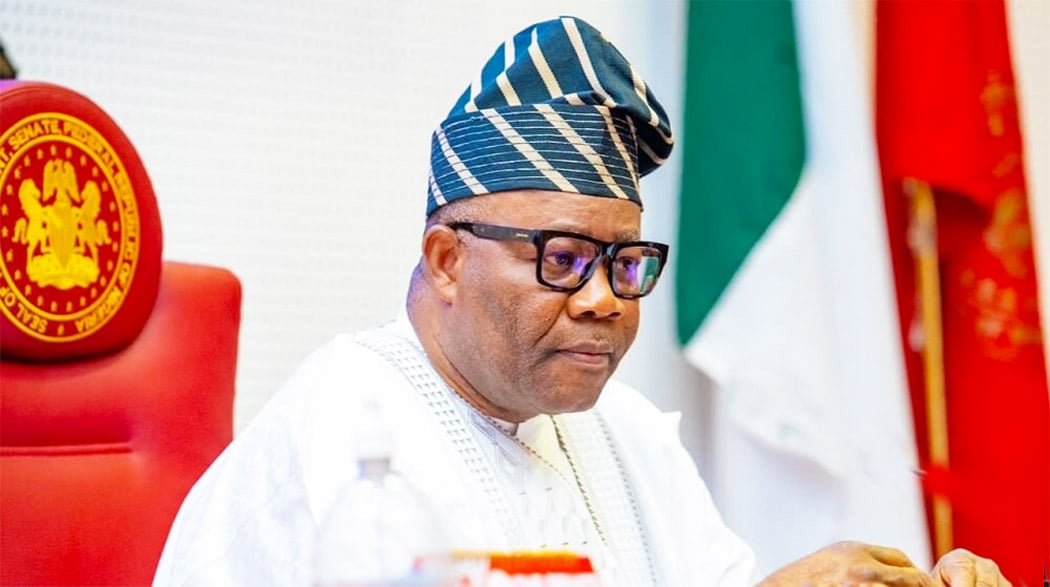
As criticism mounts over proposed changes to Nigeria’s Electoral Act, Senate President Godswill Akpabio has broken his silence. He insists the National Assembly has not scrapped electronic transmission of election results, arguing that public outrage is based on misunderstanding an unfinished legislative process.
The President of the Senate, Godswill Akpabio, has pushed back strongly against widespread criticism surrounding the ongoing amendment of Nigeria’s Electoral Act, saying lawmakers are being unfairly attacked over a process that is still incomplete.
Speaking in Abuja at the public presentation of The Burden of Legislators in Nigeria, a book authored by Senator Effiong Bob, Akpabio clarified that the Senate did not remove provisions for electronic transmission of election results. According to him, the controversy stems from lawmakers questioning the requirement that results must be transmitted in real time, not the use of electronic transmission itself.
His comments come amid backlash from opposition parties, civil society organisations, and professional bodies, including the Nigerian Bar Association (NBA). On Saturday, the NBA urged the Senate to reinstate mandatory real-time electronic transmission, warning that leaving the method solely to the discretion of the Independent National Electoral Commission (INEC) could weaken electoral credibility and create loopholes for manipulation.
Advertisement
Akpabio, however, described the reactions as premature, stressing that legislative work is not final until it is formally adopted in the Senate’s Votes and Proceedings. He criticised commentators who, in his view, misunderstand lawmaking and attempt to dictate outcomes from outside the National Assembly.
“The Electoral Act amendment is not yet complete, yet people are already drawing conclusions,” he said, adding that consultations held during retreats do not automatically translate into final legislative decisions.
Emphasising flexibility, the Senate President stated that lawmakers have not restricted the means of transmitting results. He argued that what matters is legality, not the specific device used. The Senate’s main concern, he explained, is that making real-time transmission compulsory could expose elections to legal disputes, especially in areas affected by poor network coverage or power failures.
This concern is not unfounded. According to data from the Nigerian Communications Commission (NCC), millions of Nigerians still live in areas with unstable or limited internet connectivity, particularly in rural and insecurity-prone regions. Akpabio warned that insisting on real-time transmission could lead to large-scale invalidation of results if technical challenges occur.
He maintained that INEC, as the constitutionally empowered body, should determine the most practical and secure method for transmitting results within the framework of the law. Electoral reforms, he added, must reflect Nigeria’s current technological and institutional realities rather than ideal assumptions.
Akpabio also cautioned that persistent attacks on democratic institutions, without a clear understanding of legislative procedures, could weaken public trust in democracy itself.
Earlier at the event, former Senate President and current National Chairman of the African Democratic Congress (ADC), David Mark, urged the National Assembly to pass the amendment and allow INEC to decide on operational feasibility. Other speakers, including Akwa Ibom State Governor Umo Eno and legal scholar Professor Maxwell Gidado (SAN), praised Senator Bob’s book for shedding light on the often-overlooked challenges faced by lawmakers.
Summary
Advertisement
• Godswill Akpabio says the Senate has not removed electronic transmission of election results from the Electoral Act amendment.
• He argues that lawmakers only questioned mandatory real-time transmission due to legal and technical risks.
• The Senate President insists criticism is premature, as the amendment process is still ongoing.
You must log in to comment or reply.
Comments